
What Is Arbitrary Precision Arithmetic and Why Does It Matter?
Learn what arbitrary precision arithmetic is, how it works, why precision matters, and where high-precision calculations are used.
Calcifyai Team
Expert calculators & financial tools
When numbers become extremely large, extremely small, or require many decimal places, ordinary computer arithmetic can sometimes lose important digits. This is where arbitrary precision arithmetic becomes useful.
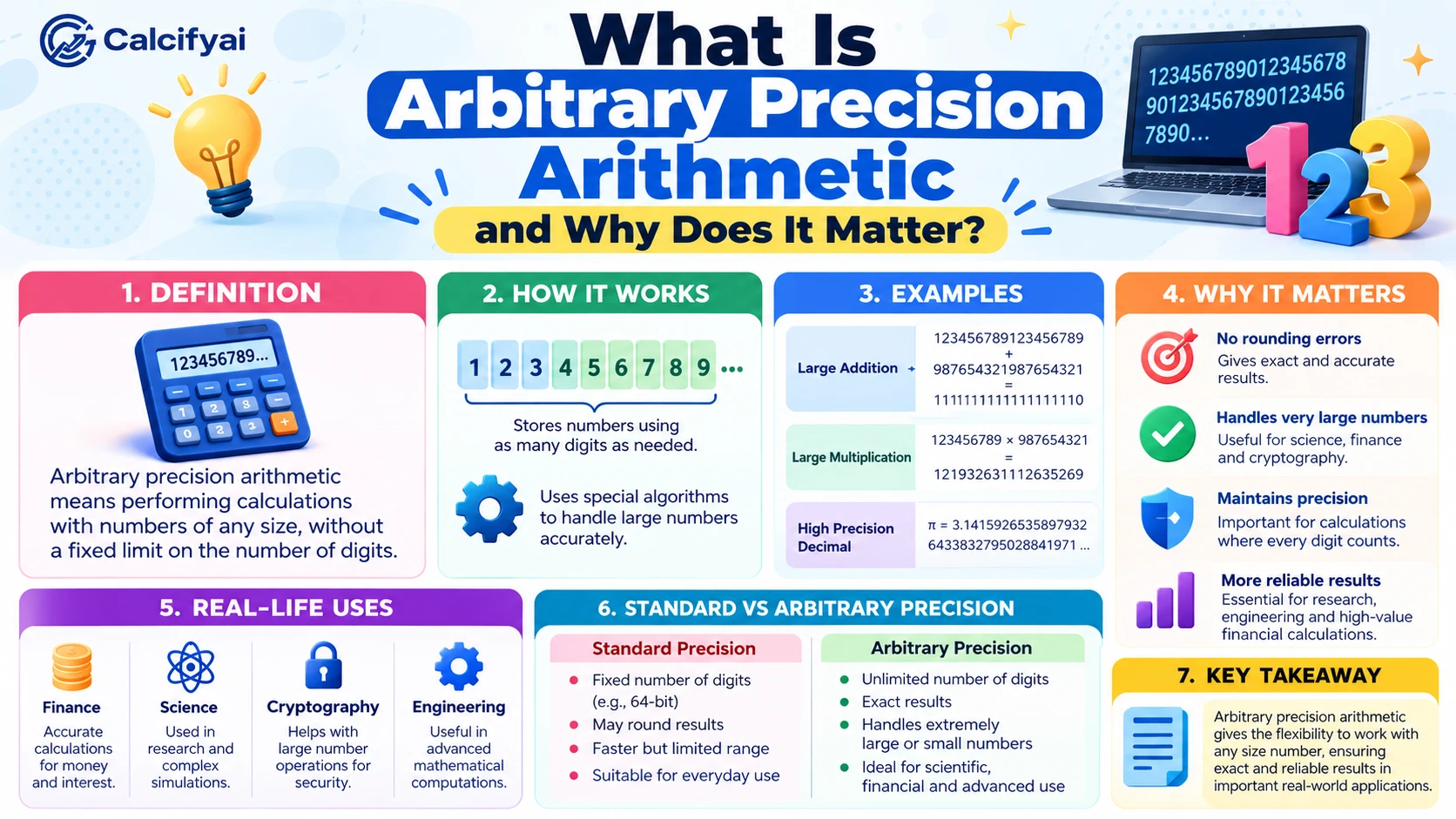
Arbitrary precision arithmetic is a way of performing calculations with a user-defined number of digits rather than being limited to the fixed precision of common hardware data types. It is widely useful in mathematics, scientific computing, finance, cryptography, programming, and data analysis.
In simple terms, arbitrary precision arithmetic lets you choose how much numerical precision you need for a calculation.
What Is Arbitrary Precision Arithmetic?
Arbitrary precision arithmetic, also called multiple-precision arithmetic or big-number arithmetic, uses software-based number representations that can store and calculate values with far more digits than standard fixed-size numeric types.
For example, a typical floating-point number may have a fixed amount of precision determined by its representation. If you need hundreds of digits, that standard representation may not be enough.
With arbitrary precision arithmetic, you can work with values such as:
123456789012345678901234567890
or calculate a value such as:
1 ÷ 7
to many decimal places:
0.142857142857142857142857...
The important idea is that precision is not restricted to a small, fixed number of digits.
How Does Arbitrary Precision Arithmetic Work?
Instead of storing a number in the same fixed format used by common hardware floating-point types, arbitrary precision libraries store numbers using multiple units of data.
Think of it like writing a very long number across several pages instead of trying to fit the entire number on one small piece of paper.
A software library can store:
The sign of a number
Its significant digits
Its exponent or decimal position
Information about the selected precision
Rounding information when necessary
The software then performs arithmetic using these stored parts.
Python’s decimal module is one practical example of high-precision arithmetic. It supports adjustable precision and correctly rounded decimal calculations, making it useful when standard floating-point arithmetic is not precise enough. Learn more about Python’s decimal arithmetic.
A Simple Example
Suppose you want to calculate:
1 ÷ 7
At low precision, you might use:
0.142857
At higher precision, you could calculate:
0.142857142857142857142857142857...
The result is still not a terminating decimal, so it cannot contain every digit forever. Instead, arbitrary precision allows you to calculate and retain as many digits as your chosen precision requires.
This distinction is important: arbitrary precision does not mean infinite precision.
Why Does Arbitrary Precision Matter?
Precision matters when a small numerical error can affect a final result.
With ordinary floating-point arithmetic, some decimal values cannot be represented exactly in binary.
A Big Number Calculator can be useful when working with extremely large integers and decimals.
But in a long sequence of calculations, small errors can accumulate.
1. It Reduces Loss of Important Digits
Suppose a calculation produces:
98765432109876543210.123456789
A system with limited precision may not preserve every digit.
Arbitrary precision can retain substantially more digits, depending on the precision selected.
2. It Helps With Very Large Numbers
Some mathematical operations produce enormous values very quickly.
For example:
100!
is much larger than ordinary everyday numbers.
Factorials, powers, combinatorial calculations, and some cryptographic operations can produce numbers containing hundreds or thousands of digits.
A big-number system is designed to handle such values more effectively than fixed-size numeric types.
3. It Helps With High-Precision Decimals
Scientific calculations sometimes require many digits after the decimal point.
For example:
π = 3.141592653589793238462643383279...
If an application needs more digits than standard floating-point arithmetic provides, higher precision can be selected.
Arbitrary Precision vs Fixed Precision
The difference becomes easier to understand when the two approaches are compared.
Feature | Fixed Precision | Arbitrary Precision |
|---|---|---|
Number of digits | Limited | User-defined within implementation limits |
Very large numbers | May overflow or lose detail | Can handle much larger values |
Decimal precision | Limited | Can be increased |
Memory use | Usually predictable | Increases with number size |
Speed | Often faster | Can require more processing |
Best for | Everyday computing | High-precision calculations |
Arbitrary precision is not automatically better for every calculation. If ordinary floating-point precision is sufficient, using a higher-precision system can add unnecessary processing and memory costs.
Arbitrary Precision Arithmetic vs Big Integers
These terms are related, but they are not exactly the same.
A big integer system focuses on whole numbers that exceed the normal size of standard integer types.
For example:
123456789012345678901234567890123456789
An arbitrary precision system can go further and support high-precision decimal or floating-point calculations.
For example:
123456789.123456789123456789
So, big integers are one important application of high-precision arithmetic, while arbitrary precision can cover a wider range of numerical calculations.
Where Is Arbitrary Precision Arithmetic Used?
Arbitrary precision arithmetic is useful whenever numerical accuracy or very large values matter.
Scientific Computing
Scientists may need high precision when calculating mathematical constants, simulations, or numerical models.
Some calculations are also sensitive to small numerical errors, meaning that extra precision can improve the reliability of intermediate calculations.
Finance
Financial calculations often involve decimal values where exact decimal representation and controlled rounding are important.
Examples include:
Interest calculations
Financial modeling
Currency calculations
Tax calculations
Accounting systems
Cryptography
Cryptographic algorithms frequently work with very large integers.
Large-number arithmetic is therefore an important part of many cryptographic computations.
Mathematics
Researchers and students may use arbitrary precision when working with:
Large factorials
Prime numbers
Mathematical constants
Number theory
High-precision numerical analysis
Programming and Software Development
Developers may need arbitrary precision when standard numeric types cannot safely represent the values required by an application.
This can be especially important when calculations involve very large integers or repeated high-precision decimal operations.
A Practical Example of Precision
Consider this calculation:
1 ÷ 3
The decimal result continues forever:
0.333333333333333333...
If you select 5 decimal places, you might store:
0.33333
With 20 decimal places:
0.33333333333333333333
The underlying mathematical value has not changed. You have simply chosen a different level of numerical precision for representing the result.
This is why precision settings are important in high-accuracy calculations.
Arbitrary Precision Does Not Eliminate Rounding
One common misunderstanding is that arbitrary precision always produces an exact answer.
That is not true.
If a number has an infinite decimal expansion, such as:
1 ÷ 7
the software must eventually stop at the selected precision.
For example:
Precision = 10 digits
1 ÷ 7 ≈ 0.1428571429
The result is highly precise, but it is still an approximation unless the number has an exact finite representation in the chosen number system.
Arbitrary Precision and Scientific Notation
Very large or very small numbers are often displayed using scientific notation.
For example:
5,000,000,000
can be written as:
5 × 10⁹
Scientific notation makes large values easier to read, while arbitrary precision focuses on how accurately those values are represented and calculated.
If you want to understand the difference between full numerical values and compact scientific notation, see this guide on scientific notation vs standard numbers .
How to Choose the Right Precision
The right precision depends on the problem.
Step 1: Understand the Required Accuracy
Ask how many digits the final answer actually needs.
A school calculation may need only a few decimal places, while a scientific calculation may require dozens or hundreds.
Step 2: Consider Intermediate Calculations
Do not look only at the final result. Intermediate calculations can lose precision and affect the final answer.
Step 3: Avoid Unnecessary Precision
More digits require more memory and processing.
If six decimal places are sufficient, calculating thousands of digits may provide little practical benefit.
Step 4: Round Only When Appropriate
If you need a specific number of decimal places, it is often better to perform the calculation with sufficient internal precision and round the final result at the appropriate stage.
Common Mistakes to Avoid
Confusing Precision With Accuracy
Precision describes how many digits are represented. Accuracy describes how close the result is to the true value.
More digits do not automatically guarantee a correct model or correct input.
Assuming More Digits Mean Exact Results
Some mathematical values cannot be represented completely with a finite number of digits.
Rounding Too Early
Rounding intermediate values can introduce unnecessary errors.
Ignoring Performance
High-precision calculations require additional resources. Extremely large numbers can take more time and memory to process.
Mixing Number Types Carelessly
Combining ordinary floating-point values with high-precision decimal values can sometimes introduce the very representation issues you were trying to avoid.
Frequently Asked Questions
What is arbitrary precision arithmetic in simple terms?
It is a method of performing calculations where the number of digits used for a value can be increased beyond the fixed precision of common numeric types.
Is arbitrary precision the same as infinite precision?
No. Arbitrary precision means you can choose a high level of precision within the limits of the software and available resources. It does not mean infinitely many digits.
Why is arbitrary precision important?
It is useful when calculations involve very large numbers, many decimal places, or situations where small numerical errors can affect the final result.
Is arbitrary precision slower?
It can be. More digits require more storage and computation, so high-precision arithmetic may be slower than standard fixed-precision arithmetic.
Is arbitrary precision useful for finance?
Yes. High-precision decimal arithmetic can be useful for financial calculations where exact decimal representation and controlled rounding are important.
Can arbitrary precision handle huge integers?
Yes. Big-integer arithmetic is one of the common uses of arbitrary precision techniques.
Conclusion
Arbitrary precision arithmetic gives computers more flexibility when working with numbers that require more digits than standard numeric types can safely provide.
It is especially useful for large integers, high-precision decimals, scientific calculations, financial applications, mathematics, and cryptography.
The key idea is simple: use enough precision for the problem, but do not assume that more digits automatically mean perfect accuracy. Choosing the right number representation, precision, and rounding method is just as important as performing the arithmetic itself.
Disclaimer
The information provided in this article is for educational and informational purposes only. It should not be considered as professional financial, medical, or legal advice. Always consult with qualified professionals for specific guidance related to your situation.
Popular Calculators
Explore our most-used free calculators for finance, health, and everyday needs.