
How to Find a Missing Value in a Ratio or Proportion
Learn how to find a missing value in a ratio or proportion using cross multiplication, equivalent ratios, examples, and simple steps.
Calcifyai Team
Expert calculators & financial tools
Finding a missing value in a ratio or proportion is a common math skill used in school, exams, recipes, measurements, maps, finance, and everyday comparisons.
The basic idea is simple: when two ratios are equal, you can use the known numbers to calculate the missing value.
For example:
3 : 5 = x : 20
The missing value is 12 because 3 is to 5 as 12 is to 20.
This guide explains how to find a missing value in a ratio step by step, including cross multiplication, equivalent ratios, decimals, fractions, real-life examples, and common mistakes.
What Is a Ratio?
A ratio compares two or more quantities.
Ratios can be written in different ways:
3:5
3 to 5
3/5
For example, if a box contains 6 red balls and 4 blue balls, the ratio of red balls to blue balls is:
6:4
You can simplify this to:
3:2
If you want to review the basics first, see this guide to calculating ratios step by step.
What Is a Proportion?
A proportion is an equation that says two ratios are equal.
For example:
2:3 = 8:12
Both ratios represent the same relationship.
A proportion can also contain an unknown value:
2:3 = x:12
Here, x is the missing value that needs to be found.
How to Find a Missing Value in a Ratio
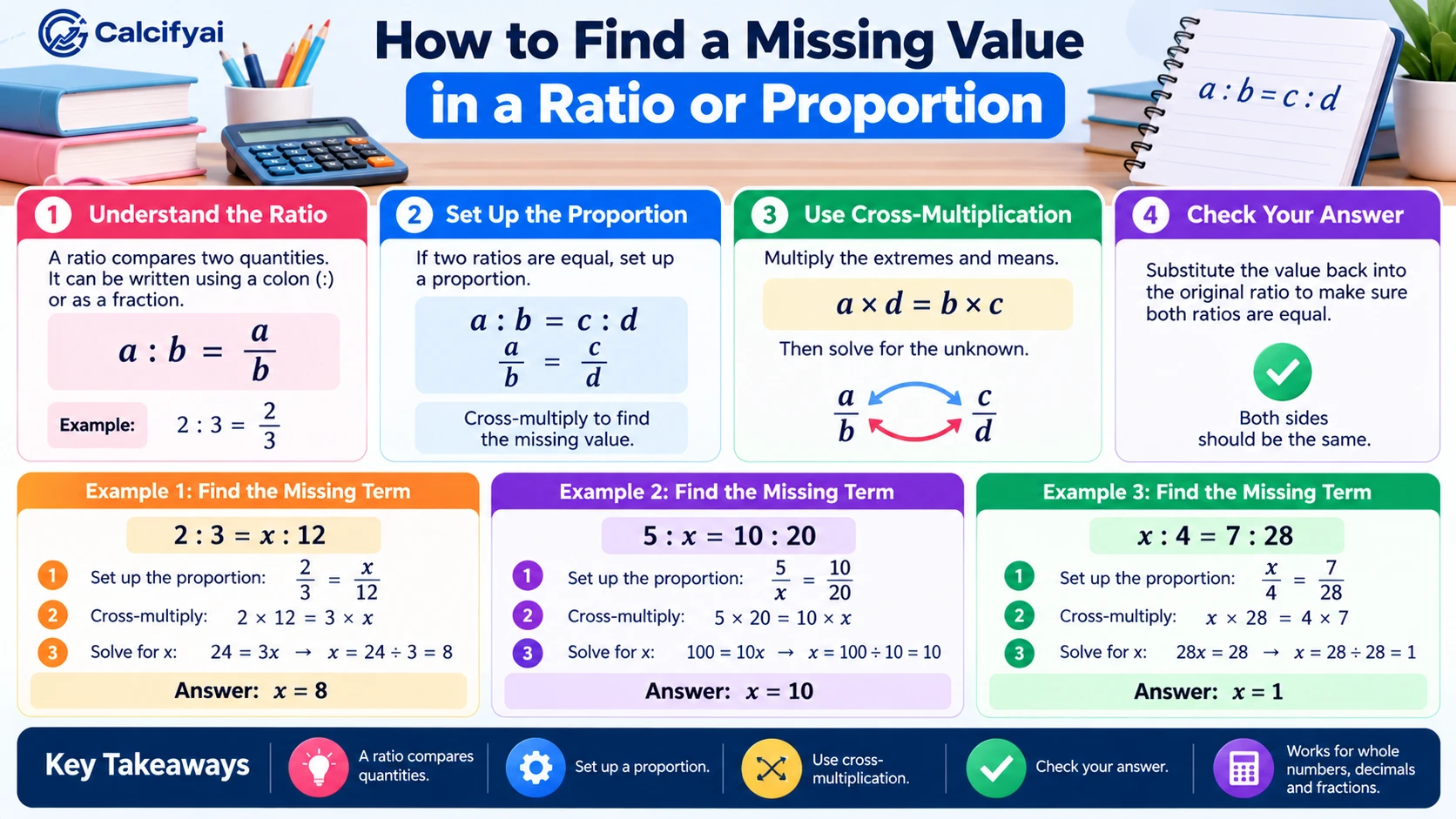
The most common method is cross multiplication.
For a proportion written as:
a:b = c:d
you can cross multiply:
a × d = b × c
This creates an equation that can be solved for the missing value. OpenStax explains the same cross-multiplication rule for proportions and notes that the two ratios must first be correctly set up as a proportion.
Step 1: Identify the Missing Value
Look at the ratio and determine which number is unknown.
Example:
4:7 = x:21
The missing value is x.
Step 2: Cross Multiply
Multiply the numbers diagonally:
4 × 21 = 7 × x
This gives:
84 = 7x
Step 3: Divide to Find x
Divide both sides by 7:
84 ÷ 7 = x
Therefore:
x = 12
Step 4: Check the Answer
Put 12 back into the original proportion:
4:7 = 12:21
Both ratios simplify to the same relationship, so the answer is correct.
Example 1: Basic Missing Ratio Value
Suppose you have:
3:5 = x:20
We need to find x.
Cross Multiply
3 × 20 = 5 × x
60 = 5x
Solve
60 ÷ 5 = x
x = 12
So the missing value is:
12
Example 2: Missing Value on the Other Side
Consider:
x:6 = 15:18
Cross multiply:
18 × x = 6 × 15
Calculate:
18x = 90
Divide by 18:
x = 5
So:
5:6 = 15:18
The ratios are equivalent.
Example 3: A Missing Denominator
Sometimes the unknown value appears as the second number in a ratio.
For example:
8:12 = 14:x
Cross multiply:
8 × x = 12 × 14
8x = 168
Now divide by 8:
x = 21
Therefore:
8:12 = 14:21
Using Equivalent Ratios Instead of Cross Multiplication
Cross multiplication is not the only way to find a missing value.
You can also use equivalent ratios.
Suppose:
2:5 = x:20
Ask yourself:
How did 5 become 20?
5 × 4 = 20
Therefore, multiply the other part by 4:
2 × 4 = 8
So:
x = 8
This method can be faster when the numbers have an obvious multiplication relationship.
How to Find a Missing Value With Decimals
Ratios can contain decimal numbers.
For example:
2.5:5 = x:20
First, determine how 5 changes to 20:
5 × 4 = 20
Apply the same multiplier to 2.5:
2.5 × 4 = 10
Therefore:
x = 10
You can also solve this using cross multiplication:
2.5 × 20 = 5 × x
50 = 5x
x = 10
Both methods produce the same answer.
How to Find a Missing Value With Fractions
Fractions can also appear in proportions.
For example:
1/2 : 3/4 = x : 3
One approach is to convert the relationship into multiplication and solve carefully.
Another example is easier to see:
1/3 = x/12
Cross multiply:
1 × 12 = 3 × x
12 = 3x
Divide by 3:
x = 4
So:
1/3 = 4/12
Both sides represent the same value.
Real-Life Examples of Missing Values in Ratios
Recipe Scaling
Suppose a recipe uses 2 cups of flour for every 3 cups of milk.
You want to make a larger batch using 12 cups of milk.
Set up the proportion:
2:3 = x:12
Since 3 is multiplied by 4 to get 12, multiply 2 by 4:
2 × 4 = 8
You need:
8 cups of flour
Map Scales
Suppose 1 inch on a map represents 20 miles.
If two locations are 5 inches apart, you can find the actual distance using:
1:20 = 5:x
Cross multiply:
1 × x = 20 × 5
x = 100
The actual distance is:
100 miles
Shopping and Pricing
Suppose 3 notebooks cost $9.
How much would 8 notebooks cost at the same rate?
Set up the proportion:
3:9 = 8:x
Cross multiply:
3 × x = 9 × 8
3x = 72
x = 24
So 8 notebooks would cost $24, assuming the same price per notebook.
A Quick Formula for Finding a Missing Value
If you have:
a:b = c:x
then:
x = (b × c) ÷ a
If you have:
a:b = x:d
then:
x = (a × d) ÷ b
These formulas are simply shortcuts created from cross multiplication.
Common Mistakes When Finding Missing Values
Reversing the Ratio
Order matters.
2:3 is not the same as 3:2.
Always keep corresponding quantities in the same position.
Cross Multiplying Incorrectly
For:
4:7 = x:21
the correct cross multiplication is:
4 × 21 = 7 × x
Do not multiply the numbers that are next to each other.
Forgetting Units
When solving real-world problems, make sure corresponding quantities use compatible units.
For example, do not directly compare:
2 meters : 50 centimeters
Convert the units first.
Using the Wrong Relationship
A proportion only works when the two ratios represent the same relationship.
Before calculating, ask whether the quantities actually change proportionally.
Not Checking the Answer
After finding the missing value, substitute it back into the original proportion.
This quick check can catch many arithmetic or setup errors.
How to Check a Missing Ratio Value
Suppose you calculated:
x = 15
for:
5:8 = x:24
Check the result:
5 × 24 = 8 × 15
120 = 120
Because both cross products are equal, the proportion is correct.
Frequently Asked Questions
What is the easiest way to find a missing value in a ratio?
Set up the two ratios as a proportion, cross multiply, and then divide to isolate the unknown value.
What is the formula for a missing value in a proportion?
For a proportion such as a:b = c:x, multiply b by c and divide the result by a.
Can I solve a ratio without cross multiplication?
Yes. If the relationship is easy to see, you can use equivalent ratios and multiply or divide both parts by the same number.
Can ratios include decimals?
Yes. You can solve proportions containing decimals using the same methods used for whole numbers.
Can ratios include fractions?
Yes. Fractions can be used in ratios and proportions. You may need to simplify or convert them before solving.
How do I know if my answer is correct?
Substitute the missing value into the original proportion and check whether the two ratios are equivalent. You can also check whether the cross products are equal.
Conclusion
Learning how to find a missing value in a ratio becomes much easier once you understand the relationship between ratios and proportions.
The basic process is:
Identify the missing value.
Write the two ratios as a proportion.
Cross multiply.
Solve for the unknown.
Check the answer.
For simple problems, equivalent ratios can sometimes be even faster. The most important thing is to keep the corresponding quantities in the correct order and make sure the ratios describe the same relationship.
Once you understand these steps, you can apply them to recipes, maps, prices, measurements, school math problems, and many other everyday situations.
Disclaimer
The information provided in this article is for educational and informational purposes only. It should not be considered as professional financial, medical, or legal advice. Always consult with qualified professionals for specific guidance related to your situation.
Popular Calculators
Explore our most-used free calculators for finance, health, and everyday needs.