
How to Find Area When Measurements Use Different Units
Learn how to find area when measurements use different units with simple conversion steps, formulas, real-life examples, and helpful tips.
Calcifyai Team
Expert calculators & financial tools
When all measurements are in the same units, calculating area is easy. What happens when a length is measured in metres and a width is measured in centimetres? They cannot be multiplied without changing their units first.
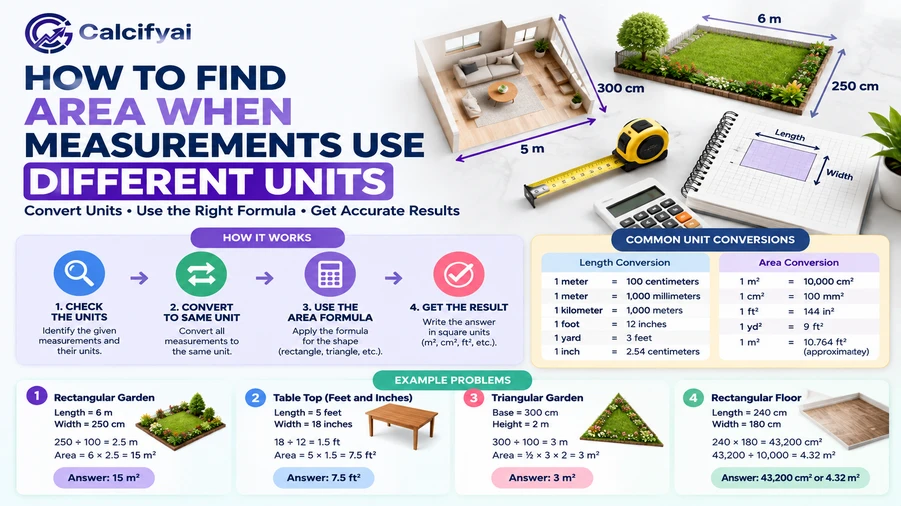
If measurements are in different units, convert all measurements to the same unit, use an appropriate area formula and answer in square units. This works for rectangles, squares, triangles and much more.
You'll be able to convert units prior to calculating area, complete examples step-by-step, avoid common errors, and solve real-world measurement problems in this guide.
Why Is It Necessary to Convert Units Before Calculating Area?
Area is a measurement of the flat surface of a 2 dimensional shape. It is determined by multiplying or combining of measurements like length, width, and height.
Using units of measure that are not the same can give confusing or incorrect results if measurements are multiplied without unit conversion.
Suppose that there is a rectangular room that has:
Length: 5 meters
Width: 300 centimeters
Meters and centimetres are different units of length so the width must be measured in metres before multiplying.
300 cm = 3 m
Now calculate:
Area = 5 × 3 = 15 m²
The square area of the room is 15m².
When You Are Given Measurements in Different Units, How Do You Determine the Area?
Use these 3 simple steps to measure area correctly.
Step 1: First, Determine What and What Units Are Used for Measurements
First, Identify what are the measurements and what are the units used.
Write all the measurements you have first. Determine if they measure in meters, centimeters, millimeters, inches, feet or other units.
For example:
Length = 250 cm
Width = 4 m
The two measurements relate to the sides of a rectangle and have different units.
Step 2: All Measurements to the Same Scale
Pick one of the units and make the others equal.
Some common conversion of length:
Unit conversion | Equivalent |
|---|---|
1 meter | 100 centimeters |
1 meter | 1,000 millimeters |
1 kilometer | 1,000 meters |
1 foot | 12 inches |
1 yard | 3 feet |
1 inch | 2.54 centimeters |
In the above example, change 250cm to m:
250 ÷ 100 = 2.5 m
The two measurements are now in metres.
Step 3: Avoid Using the Wrong Area Formula
Don't use the wrong area formula (step 3).
When all the measurements are in the same unit, apply the formula for the shape.
For a rectangle:
Area = Length × Width
Replace the converted measurements with the numbers:
Area = 2.5 × 4 = 10 m²
The last is 10m².
Examples: Finding Area with Different Units
Let's now see some examples of how unit conversion works in various situations.
Example 1: The Area of a Rectangle Is 1584 Square Meters
If the area of a rectangle is 1584 m², then…
If the length of a garden is 6 m and the width of a garden is 250 cm, then...
Step 1: Change centimeters to meters.
250 ÷ 100 = 2.5 m
Step 2: Multiply the length x width.
6 × 2.5 = 15 m²
Answer: 15 m² of garden.
Example 2: To Find the Area with Feet and Inches
Suppose a rectangle table-top of and:
Length = 5 feet
Width = 18 inches
The width is first converted to feet.
18 ÷ 12 = 1.5 ft
Now find the area:
5 × 1.5 = 7.5 ft²
Answer. The area of the table top is 7.5 square feet.
Example 3: The Area of a Triangle Is Computed Using Different Units
If a garden is triangular with a base of 300cm and a vertical height of 2m, then find the area of the garden.
If it is a triangle, then use:
Area = ½ × Base × Height
Convert bases to meters:
300 ÷ 100 = 3 m
Now use the formula:
Area = ½ × 3 × 2
Area = 3 m²
Answer: The area of the triangular garden is 3 m².
Example 4: Find the Area and Convert the Final Answer
Sometimes it is necessary to find an area measured in one unit and report it in another.
Let's assume a rectangular floor has a length of 240 cm and a width of 180 cm.
Calculate its area in square cm (sq cm):
240 × 180 = 43,200 cm²
To change square centimeters to square meters, divide by 10,000.
43,200 ÷ 10,000 = 4.32 m²
Answer: The floor area is 43,200 cm² or 4.32 m².
Writing Square Units Properly
An important note is that area conversions cannot be performed in the same manner as length conversions.
For example:
1 meter = 100 centimeters.
One meter square is equal to 10,000 square centimetres.
Why? In area, two dimensions are used. Both length and width need to be converted.
Quick Conversion Reference
Area conversion | Equivalent |
|---|---|
1 m² | 10,000 cm² |
1 cm² | 100 mm² |
1 ft² | 144 in² |
1 yd² | 9 ft² |
1 m² | Approximately 10.764 ft² |
See the NIST guide to area units for more information on how area units work.
. Describes square measures and the relationship between square units.
This can be followed up by a discussion of Understanding Square Units.
to understand the importance of measuring areas in square units, and the applications of square units in daily life.
For more information about square meters, square centimeters, and other area measurements, see the NIST guide to area units.
Some Useful Tips on What Not to Do
The units can lead to a wrong answer even for simple area calculations. Watch out for these common mistakes.
1. Multiplying Different Units Directly
Don't multiply 5 meters by 200 centimeters, without changing one of them to meters first.
Convert 200 cm to 2 m and multiply:
5 × 2 = 10 m²
2. To Use a Length Conversion for Area
One frequent mistake is dividing square centimetres by 100 to get the square metres.
The correct conversion is a division by 10,000, because both dimensions have to be converted.
3. Forgetting Square Units
You don't multiply meters by meters to get square meters.You multiply meters times meters in order to obtain square meters, not meters.
Write answers to area questions in squared units.
4. Selecting the Appropriate Formula
There are formulas for calculating the area of different shapes.
Rectangle: Length × Width
Square: Side × Side
Triangle: ½ × Base × Height
Circle: π × Radius²
Be sure to recognize the shape before calculating.
5. Rounding Too Early
Unless specified in the question, do not round any converted measurements before the problem is solved.
If more decimal places are retained when calculating, then small errors in the final answer can be avoided.
Frequently Asked Questions
How Do You Calculate Area When Length and Width Have Different Units?
Convert one measurement so both dimensions use the same unit. Then multiply the length by the width for a rectangle. Express the answer in square units.
Can You Calculate Area Without Converting Units First?
You can, but you must account for the conversion factor in your formula. For beginners, converting all measurements to the same unit first is usually easier and less error-prone.
What Happens If You Multiply Meters by Centimeters?
The result is a mixed unit, such as meter-centimeters (m·cm), rather than a standard square unit. You must convert the result or one of the measurements to obtain an area in a consistent unit.
How Do You Convert Square Centimeters to Square Meters?
Divide the area in square centimeters by 10,000.
For example:
25,000 ÷ 10,000 = 2.5 m²
Therefore, 25,000 cm² equals 2.5 m².
Should I Convert Measurements Before or After Finding the Area?
Converting measurements before calculating area is generally simpler. However, you can calculate the area first and convert the final result if both original measurements use the same unit.
Does the Same Unit Conversion Method Work for All Shapes?
Yes. Convert the relevant dimensions to consistent units before applying the formula. This works for rectangles, triangles, circles, squares, and other shapes. Just remember to use the correct formula for each shape.
Conclusion
Finding area when measurements use different units becomes much easier when you follow a consistent process. Identify the measurements, convert them into the same unit, and apply the appropriate area formula.
Whether you are measuring a room, planning a garden, solving a geometry problem, or estimating materials, understanding unit conversion helps you get accurate results.
For quicker calculations, try the
Area Calculator to calculate the area of common shapes and work with different measurement units.
Disclaimer
The information provided in this article is for educational and informational purposes only. It should not be considered as professional financial, medical, or legal advice. Always consult with qualified professionals for specific guidance related to your situation.
Popular Calculators
Explore our most-used free calculators for finance, health, and everyday needs.