
How to Calculate Part-Time Work Hours Per Week
Learn how to calculate part-time hours per week with simple formulas, examples, breaks, different shifts, and average weekly hours.
Calcifyai Team
Expert calculators & financial tools
If you work part-time, knowing your part time hours per week helps you understand your schedule, estimate your paycheck, compare job offers, and track your actual working time.
There is no single number of hours that makes a job “part-time” in every situation. Employers, benefit programs, and laws can use different definitions. For example, the U.S. Department of Labor states that the Fair Labor Standards Act (FLSA) does not define full-time or part-time employment; the employer generally determines the classification. U.S. Department of Labor
So, instead of relying on a label, the easiest approach is to calculate the hours you actually work each week.
What Are Part-Time Hours Per Week?
Part-time hours per week are the total number of hours an employee is scheduled to work during a typical seven-day workweek.
For example:
4 hours per day × 5 days = 20 hours per week
5 hours per day × 4 days = 20 hours per week
6 hours per day × 3 days = 18 hours per week
8 hours per day × 3 days = 24 hours per week
A part-time schedule can therefore look very different from one job to another.
How to Calculate Part-Time Work Hours Per Week
The basic formula is:
Weekly Work Hours = Hours Worked Per Day × Number of Workdays Per Week
If your schedule changes from day to day, add the hours for each day instead.
Example 1: Same Hours Every Day
Suppose you work:
Monday: 5 hours
Tuesday: 5 hours
Wednesday: 5 hours
Thursday: 5 hours
Calculate:
5 + 5 + 5 + 5 = 20 hours
Your part-time schedule is 20 hours per week.
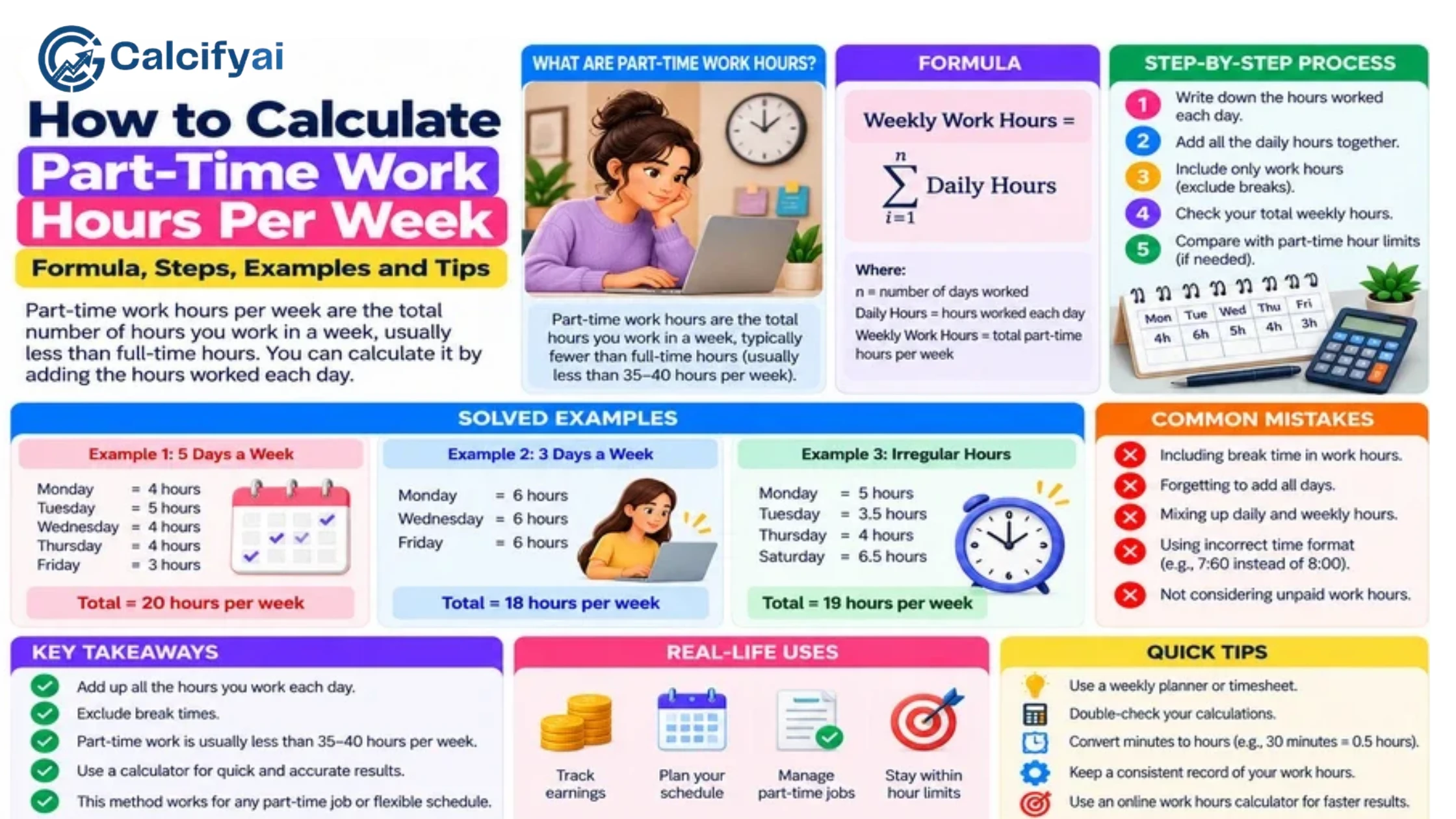
Example 2: Different Hours Each Day
Suppose your weekly schedule is:
Day | Hours Worked |
|---|---|
Monday | 4 hours |
Tuesday | 6 hours |
Wednesday | 5 hours |
Thursday | 4 hours |
Friday | 3 hours |
Add the daily hours:
4 + 6 + 5 + 4 + 3 = 22 hours
Your total is 22 part-time hours per week.
How to Calculate Weekly Hours From Start and End Times
If you know your start and end times, first calculate the hours worked during each shift.
The basic formula is:
Hours Worked = End Time − Start Time − Unpaid Breaks
For example, suppose you work from 9:00 AM to 2:00 PM with no unpaid break.
That is:
2:00 PM − 9:00 AM = 5 hours
If you work this schedule four days a week:
5 × 4 = 20 hours per week
You can also use a Work Hours Calculator to calculate daily and weekly work hours while accounting for breaks and working days.
How to Calculate Part-Time Hours With an Unpaid Break
Unpaid breaks should be removed when calculating actual working time, when the break is not counted as work time under the applicable rules.
For example:
Start: 9:00 AM
End: 4:00 PM
Unpaid break: 30 minutes
The total time between 9 AM and 4 PM is 7 hours.
Subtract the 30-minute break:
7 hours − 0.5 hours = 6.5 hours
So you worked 6 hours 30 minutes that day.
If you work four days:
6.5 × 4 = 26 hours per week
Your weekly total is 26 hours.
How to Calculate Part-Time Hours From a Weekly Schedule
A simple weekly schedule can be calculated by adding each day's working time.
For example:
Monday: 4 hours
Tuesday: 5 hours
Wednesday: 4.5 hours
Thursday: 6 hours
Friday: 3.5 hours
Add them:
4 + 5 + 4.5 + 6 + 3.5 = 23 hours
Therefore, you work 23 hours per week.
This method is especially useful when your part-time schedule is not the same every day.
How to Calculate Part-Time Hours for Multiple Shifts
Some part-time workers have two separate shifts on the same day. In that situation, calculate each shift separately and then add them.
For example:
Morning: 8:00 AM–12:00 PM = 4 hours
Evening: 4:00 PM–7:00 PM = 3 hours
Total:
4 + 3 = 7 hours
If you work this schedule three days a week:
7 × 3 = 21 hours per week
For more complicated schedules involving multiple shifts, overnight work, breaks, and weekly totals, see the guide on calculating hours worked across multiple shifts.
How to Calculate Part-Time Hours With Different Shifts
Consider this weekly schedule:
Day | Shift | Hours |
|---|---|---|
Monday | 9 AM–2 PM | 5 |
Tuesday | 10 AM–3 PM | 5 |
Wednesday | 4 PM–8 PM | 4 |
Thursday | 9 AM–2 PM | 5 |
Friday | Off | 0 |
Add the hours:
5 + 5 + 4 + 5 + 0 = 19 hours
The employee works 19 hours per week.
How to Convert Minutes to Decimal Hours
Payroll systems and timesheets may use decimal hours.
Use this formula:
Decimal Hours = Minutes ÷ 60
Common conversions include:
15 minutes = 0.25 hours
30 minutes = 0.50 hours
45 minutes = 0.75 hours
60 minutes = 1 hour
For example, if you work 5 hours 30 minutes:
30 ÷ 60 = 0.5
So:
5 hours 30 minutes = 5.5 hours
If you work 5.5 hours for four days:
5.5 × 4 = 22 hours per week
Important: 30 Minutes Is Not 0.30 Hours
A common mistake is writing 5 hours 30 minutes as 5.30 hours.
For decimal calculations, 30 minutes equals 0.50 hours, so the correct value is:
5.50 hours
How Many Hours Is Part-Time Work?
There is no universal weekly number that applies to every part-time job.
You may see schedules such as:
10 hours per week
15 hours per week
20 hours per week
24 hours per week
25 hours per week
30 hours per week
But the classification depends on the employer, workplace policy, benefits rules, contract terms, and applicable law. In the United States, the FLSA itself does not establish a specific number of weekly hours for part-time employment. U.S. Department of Labor
Therefore, if you need to know whether a particular job is officially considered part-time, check the employer's policy or the applicable program or agreement rather than assuming a fixed number.
Part-Time Hours vs. Full-Time Hours
It is useful to distinguish between calculating your hours and classifying your employment.
For example, someone could work 24 hours in one week and 30 hours the next week. The actual hours are easy to calculate, but whether the employee is officially classified as part-time depends on the applicable rules.
Your weekly calculation tells you how much you worked. It does not automatically determine your legal or employment classification.
How to Calculate Average Part-Time Hours Per Week
If your schedule changes from week to week, you can calculate an average.
Use:
Average Weekly Hours = Total Hours Worked ÷ Number of Weeks
For example:
Week 1: 18 hours
Week 2: 22 hours
Week 3: 20 hours
Week 4: 24 hours
First find the total:
18 + 22 + 20 + 24 = 84 hours
Then divide by four weeks:
84 ÷ 4 = 21 hours
Your average is 21 hours per week.
This can be useful when your work schedule changes regularly.
Common Mistakes When Calculating Part-Time Hours
1. Counting the Entire Time at Work
Being at the workplace for 7 hours does not necessarily mean you worked 7 hours if there was an unpaid break that should not be counted.
2. Forgetting One Workday
When adding weekly hours, check every day from Monday through Sunday or use the workweek defined by your employer.
3. Treating Minutes as Decimal Numbers
Remember:
30 minutes = 0.50 hours
not 0.30 hours.
4. Counting Time Between Split Shifts
If you work from 8 AM–12 PM and 4 PM–7 PM, the four hours between the shifts are not automatically working hours.
Calculate each shift separately.
5. Assuming a Fixed Definition of Part-Time
Do not assume that a particular number of hours always means part-time. Definitions can vary by employer and program.
Quick Formula for Part-Time Hours Per Week
For a consistent schedule:
Part-Time Hours Per Week = Hours Per Shift × Shifts Per Week
For example:
5 hours × 4 shifts = 20 hours per week
For a changing schedule:
Part-Time Hours Per Week = Monday Hours + Tuesday Hours + Wednesday Hours + ...
For schedules with breaks:
Weekly Hours = Total Scheduled Time − Applicable Unpaid Breaks
Frequently Asked Questions
How many hours is part-time per week?
There is no single universal number. A part-time schedule might be 10, 20, 25, or 30 hours per week, depending on the employer and applicable rules.
Is 20 hours a week part-time?
A 20-hour weekly schedule is commonly described as part-time, but the official classification depends on the employer or applicable rules.
Is 30 hours a week part-time?
It can be, depending on the employer's definition and the applicable program or agreement. There is no universal FLSA definition of part-time employment.
How do I calculate my weekly work hours?
Add the actual hours worked for each day of the week. If you have a consistent schedule, multiply your hours per shift by the number of shifts per week.
How do I calculate part-time hours with breaks?
Calculate the total shift duration and subtract applicable unpaid break time. Then add the working hours for each day.
How do I calculate average weekly hours?
Add the total hours worked over several weeks and divide by the number of weeks.
Average Weekly Hours = Total Hours Worked ÷ Number of Weeks
How many hours is 4 hours a day for 5 days?
4 × 5 = 20 hours per week.
How many hours is 6 hours a day for 3 days?
6 × 3 = 18 hours per week.
Conclusion
Calculating part time hours per week is straightforward once you separate each work period and account for applicable unpaid breaks.
For a regular schedule, multiply your hours per shift by the number of shifts you work each week. For an irregular schedule, calculate each day's working time and add the daily totals.
For example:
5 hours × 4 days = 20 hours per week
If your schedule changes frequently, calculating your weekly and average hours can make timesheets, payroll estimates, and schedule planning much easier.
For U.S. workers, remember that the number of hours that officially counts as “part-time” can depend on the employer and applicable rules rather than one universal federal threshold.
Disclaimer
The information provided in this article is for educational and informational purposes only. It should not be considered as professional financial, medical, or legal advice. Always consult with qualified professionals for specific guidance related to your situation.
Popular Calculators
Explore our most-used free calculators for finance, health, and everyday needs.