
Shared Values vs Shared Interests in Relationships
Learn the difference between shared values and shared interests in relationships, why each matters, and how they affect long-term compatibility.
Calcifyai Team
Expert calculators & financial tools
When two people start dating, they may quickly notice the things they have in common. Maybe they enjoy the same movies, love traveling, listen to similar music, or have the same hobbies. These shared interests can make spending time together fun and natural.
But long-term relationships involve more than having the same hobbies. Shared values are the deeper beliefs that influence how people make decisions, handle responsibilities, and think about the future.
So, what matters more: shared values or shared interests?
The short answer is that shared values often have more influence on long-term compatibility, while shared interests can make everyday connection and quality time easier. You do not need to be identical in either area. What matters is whether your important differences can work together respectfully.
What Are Shared Values in a Relationship?
Shared values are beliefs and principles that two people consider important.
They can influence decisions about:
Family
Marriage and commitment
Children
Money
Career
Personal freedom
Honesty
Lifestyle
Religion or spirituality
Work-life balance
Where to live
Responsibilities and relationships
For example, two people may both value financial stability, even if they have completely different spending habits. Or they may both value family but have different hobbies.
Values tend to affect important life decisions, so major differences can become more significant over time.
What Are Shared Interests?
Shared interests are activities, subjects, or hobbies that two people enjoy.
Examples include:
Watching movies
Cooking
Traveling
Playing sports
Gaming
Reading
Photography
Music
Fitness
Hiking
Trying new restaurants
Shared interests can create easy opportunities to spend time together.
For example, if both partners enjoy hiking, they can plan weekend trips together. If they both love cooking, preparing dinner can become a regular activity they enjoy as a couple.
But having different interests does not automatically create a relationship problem.
One person might enjoy gaming while the other prefers reading. They can still have a strong relationship if they respect each other's interests and find other ways to connect.
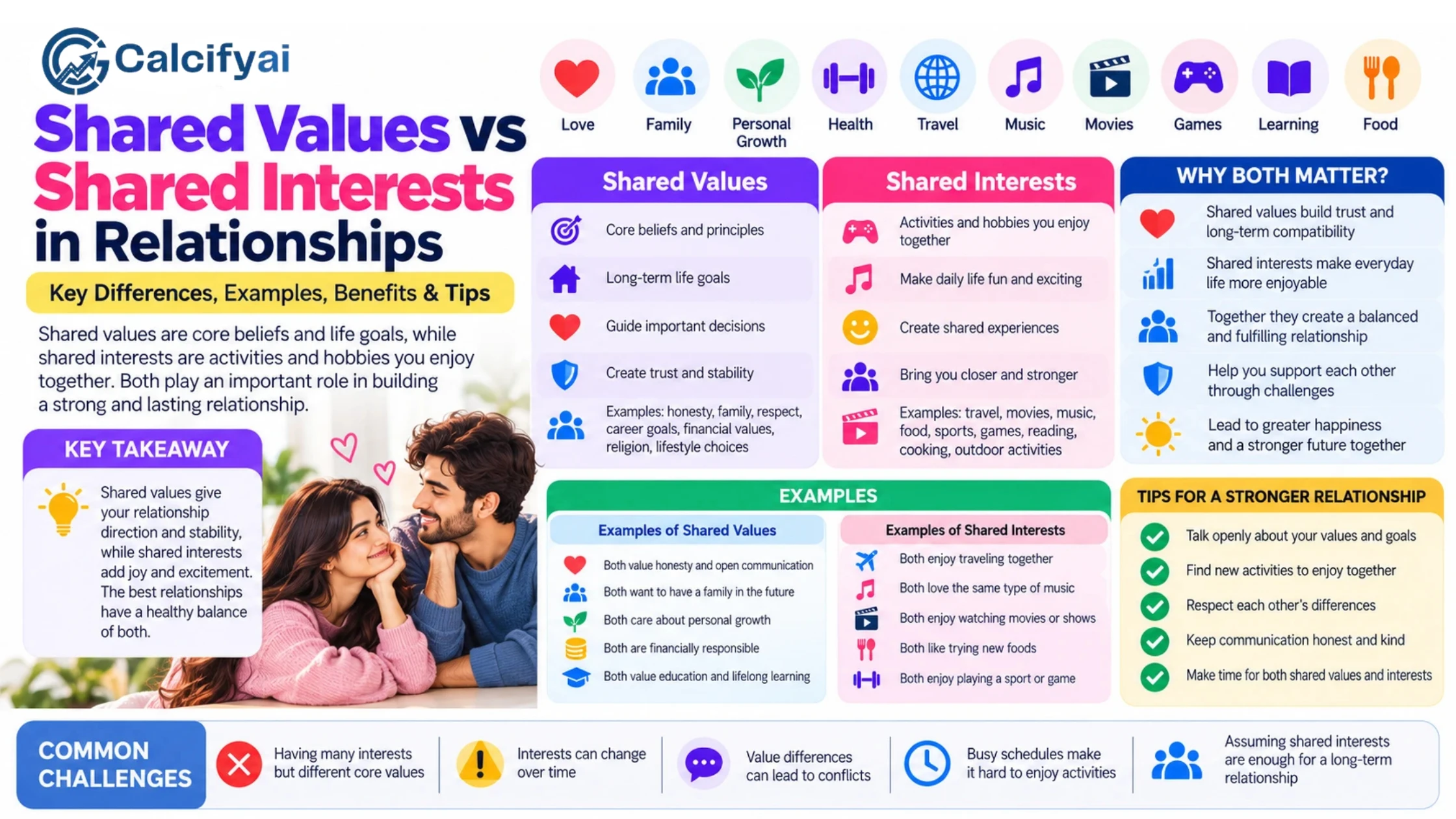
Shared Values vs Shared Interests: What's the Difference?
The simplest distinction is:
Shared values = what you believe is important.
Shared interests = what you enjoy doing.
Shared Values | Shared Interests |
|---|---|
Beliefs and principles | Hobbies and activities |
Influence important decisions | Create opportunities for fun |
Often connected to long-term goals | Often connected to daily activities |
Can affect family and financial decisions | Can make dates and free time easier |
Examples: honesty, family, commitment | Examples: travel, sports, movies |
Both can contribute to a healthy relationship, but they serve different purposes.
Why Shared Values Can Matter More
Shared values can become especially important when couples make major life decisions.
Imagine two people who both love traveling and watching movies. They have plenty of shared interests.
However, one wants children in the future while the other definitely does not.
Their hobbies may be compatible, but they have a major difference in what they want from life.
Another example involves money.
One person may value saving and financial security, while the other strongly prefers spending money on experiences. They can potentially find a compromise, but they need to understand and respect each other's priorities.
This is why relationship compatibility involves more than simply asking, "Do we like the same things?"
Why Shared Interests Still Matter
Shared interests should not be dismissed.
They can make it easier for couples to spend enjoyable time together and create shared experiences.
For example, a couple who enjoys cooking might:
Choose a recipe together.
Shop for ingredients.
Prepare the meal.
Eat together.
Try something new the following weekend.
These experiences can help create memories and strengthen the feeling of connection.
Shared interests can also make it easier to plan dates and activities.
The important point is that shared interests are helpful, but they are not the only foundation of compatibility.
Can a Relationship Work Without Shared Interests?
Yes.
You do not need to enjoy all the same activities as your partner.
For example:
You love hiking; your partner loves gaming.
You enjoy documentaries; your partner prefers comedy.
You like going to concerts; your partner prefers quiet evenings.
You enjoy cooking; your partner likes ordering food.
These differences can work when both people respect them.
A couple can also develop separate hobbies while maintaining shared activities that they both enjoy.
The question is not:
"Do we like everything the same?"
A better question is:
"Can we respect each other's interests and still enjoy our time together?"
Can Couples Have Different Values?
Yes, but the impact depends on which values differ and how important they are to each person.
Not every difference is a serious problem.
For example, one person may value career growth more strongly while the other places greater importance on free time. They may be able to create a lifestyle that accommodates both priorities.
However, differences involving major life decisions may require much more discussion.
Examples include:
Whether to have children
Views about marriage
Where to live
Financial priorities
Level of commitment
Family responsibilities
Personal boundaries
The issue is not simply having different opinions. The bigger question is whether both people can build a life that respects those differences.
Shared Values vs Shared Interests: Real-Life Examples
Example 1: Different Hobbies, Similar Values
Alex loves playing basketball.
Jordan prefers painting.
They rarely do the same hobbies, but both value:
Honesty
Family
Financial responsibility
Commitment
Personal growth
They may have different interests but strong areas of value alignment.
Their relationship does not require them to turn every hobby into a shared activity.
Example 2: Same Interests, Different Priorities
Sam and Taylor both love traveling.
They enjoy:
International trips
Trying new food
Hiking
Photography
However, Sam wants to save aggressively for a home, while Taylor wants to spend most available money on travel.
Their shared interest creates fun experiences, but their different financial priorities may create challenges if they do not discuss them.
This shows why having similar interests does not automatically mean having strong overall compatibility.
What Should Couples Have in Common?
There is no universal list that every couple must share.
However, it can be useful to compare your views on major areas of life.
Family
Ask:
How important is family to each of us?
How involved do we want to be with relatives?
Do we want children?
Money
Discuss:
Saving
Spending
Debt
Budgeting
Major purchases
Financial independence
Lifestyle
Consider:
Where you want to live
Social life
Work-life balance
Daily routines
Travel
Personal space
Commitment
Talk about what commitment means to each person and what each partner expects from the relationship.
Future Goals
Ask:
Where do we see ourselves in five or ten years?
What are our career goals?
What kind of lifestyle do we want?
Are our major plans compatible?
These conversations can reveal more about relationship compatibility than simply comparing hobbies.
How Shared Values and Interests Work Together
The two do not have to compete.
A healthy relationship can have:
Shared values + some shared interests + respect for differences
For example:
A couple may both value family, honesty, and financial stability.
At the same time:
One enjoys running.
One enjoys photography.
Both enjoy traveling.
They have common ground without needing identical personalities.
This balance can give couples both a shared foundation and individual freedom.
How to Find Out What You Share
Instead of assuming you and your partner have the same values, talk about them.
Try asking open-ended questions.
Questions About Values
What does a successful life look like to you?
How important is family?
What does financial security mean to you?
What does commitment mean to you?
Where would you like to live?
How important is career growth?
What kind of lifestyle do you want?
Questions About Interests
What do you enjoy doing on weekends?
What hobbies would you like to try?
What kind of vacations do you enjoy?
What movies, books, or music do you like?
What activities help you relax?
The goal is not to create a perfect score. It is to understand each other better.
What If Your Values Are Different?
Different values do not always mean a relationship cannot work.
Start by identifying how important the difference is.
Minor difference
You prefer saving more money, while your partner enjoys spending a little more on entertainment.
This may be manageable through budgeting and compromise.
Major difference
You want children, while your partner does not.
This is more difficult because it involves a major life decision.
The important step is to discuss the difference honestly rather than hoping it will disappear.
Healthy relationships benefit from honest communication, respectful disagreement, listening, boundaries, and compromise, all of which are included in the NIH guidance on healthy relationships.
What If You Have Few Shared Interests?
You can create new shared interests.
Try something neither person regularly does:
Take a cooking class.
Try a new restaurant.
Start a fitness activity.
Plan a weekend trip.
Watch a documentary series.
Learn a new skill together.
Volunteer for a local activity.
Try a new sport.
Start a shared reading challenge.
Explore a new place.
You do not need to discover a perfect hobby that both people already love.
Sometimes shared interests develop through shared experiences.
Common Mistakes When Comparing Compatibility
1. Assuming Similar Interests Mean Perfect Compatibility
Liking the same music or movies does not automatically mean your important life goals are aligned.
2. Assuming Different Hobbies Mean Incompatibility
Couples can have separate interests and still have a strong connection.
3. Ignoring Important Value Differences
Major disagreements about children, money, commitment, or lifestyle should not be ignored simply because the relationship has strong chemistry.
4. Expecting Complete Agreement
You do not need to agree about everything.
Healthy relationships can include different opinions.
5. Trying to Change Your Partner
A partner should not have to give up their personality or important interests simply to create the appearance of compatibility.
6. Focusing Only on a Compatibility Score
A number cannot fully describe trust, communication, values, emotional needs, or everyday relationship dynamics.
If you want a fun way to explore relationship compatibility, you can try the Love Calculator, but remember that a calculator result cannot measure real-life values, communication, or trust.
A Simple Shared Values and Interests Checklist
Use these questions to reflect on your relationship.
Shared Values
Do we have similar ideas about commitment?
Do we respect each other's priorities?
Can we discuss money openly?
Are our major future goals reasonably compatible?
Do we have similar expectations about family?
Can we compromise when our priorities differ?
Shared Interests
Do we enjoy some activities together?
Can we have fun without doing the same thing?
Do we respect each other's hobbies?
Are we willing to try each other's interests?
Do we have enough quality time together?
You do not need every answer to be "yes."
The goal is to identify where you naturally connect and where you may need more communication.
Shared Values vs Shared Interests: Which Is More Important?
There is no universal rule that says one matters in every relationship.
However, shared values tend to matter more when the topic involves major life decisions, while shared interests can be especially useful for creating enjoyable experiences and everyday connection.
A useful way to think about it is:
Values influence how you build a life together.
Interests influence how you enjoy time together.
Ideally, couples can have some of both while maintaining respect for their differences.
Shared values are one part of a bigger picture that also includes communication, trust, emotional needs, lifestyle, and future goals. For a broader look, see what makes two people compatible.
Frequently Asked Questions
Are shared values more important than shared interests?
Shared values can be particularly important for long-term compatibility because they influence major decisions about family, money, commitment, lifestyle, and the future. Shared interests can make spending time together more enjoyable.
Can couples be compatible without having the same hobbies?
Yes. Couples do not need identical hobbies. Different interests can coexist when both partners respect each other's preferences and maintain meaningful ways to connect.
What are examples of shared values in relationships?
Examples include honesty, family, commitment, financial responsibility, personal freedom, career priorities, respect, and views about the future.
What are examples of shared interests?
Shared interests can include travel, cooking, sports, gaming, music, movies, reading, fitness, photography, and outdoor activities.
What happens when partners have different values?
The effect depends on the importance of the values and whether the difference can be managed through honest discussion and compromise. Major differences involving children, marriage, money, or where to live may require especially careful discussion.
Do couples need shared interests?
No. Shared interests can be helpful, but they are not a requirement for a compatible relationship. Respect, communication, trust, and compatible expectations can matter more than having identical hobbies.
Can shared interests develop over time?
Yes. Couples can discover new activities together and turn shared experiences into new interests.
How can I compare my values with my partner's?
Have conversations about family, money, commitment, lifestyle, career, personal freedom, and future goals. Focus on understanding each person's priorities rather than trying to achieve perfect agreement.
Final Takeaway
Shared values and shared interests are not the same thing.
Shared interests are about the activities you enjoy. Shared values are about the beliefs and priorities that guide important decisions.
A couple does not need to share every hobby. In fact, having separate interests can give each person room to remain an individual.
What can matter more is whether the two people can respect each other's priorities, communicate openly, handle differences, and build a future that works for both.
In simple terms:
Shared interests can make time together more enjoyable.
Shared values can help create a compatible foundation for building a life together.
The strongest relationships do not require two people to be identical. They require enough common ground, mutual respect, communication, and flexibility to make their differences work.
Disclaimer
The information provided in this article is for educational and informational purposes only. It should not be considered as professional financial, medical, or legal advice. Always consult with qualified professionals for specific guidance related to your situation.
Popular Calculators
Explore our most-used free calculators for finance, health, and everyday needs.