
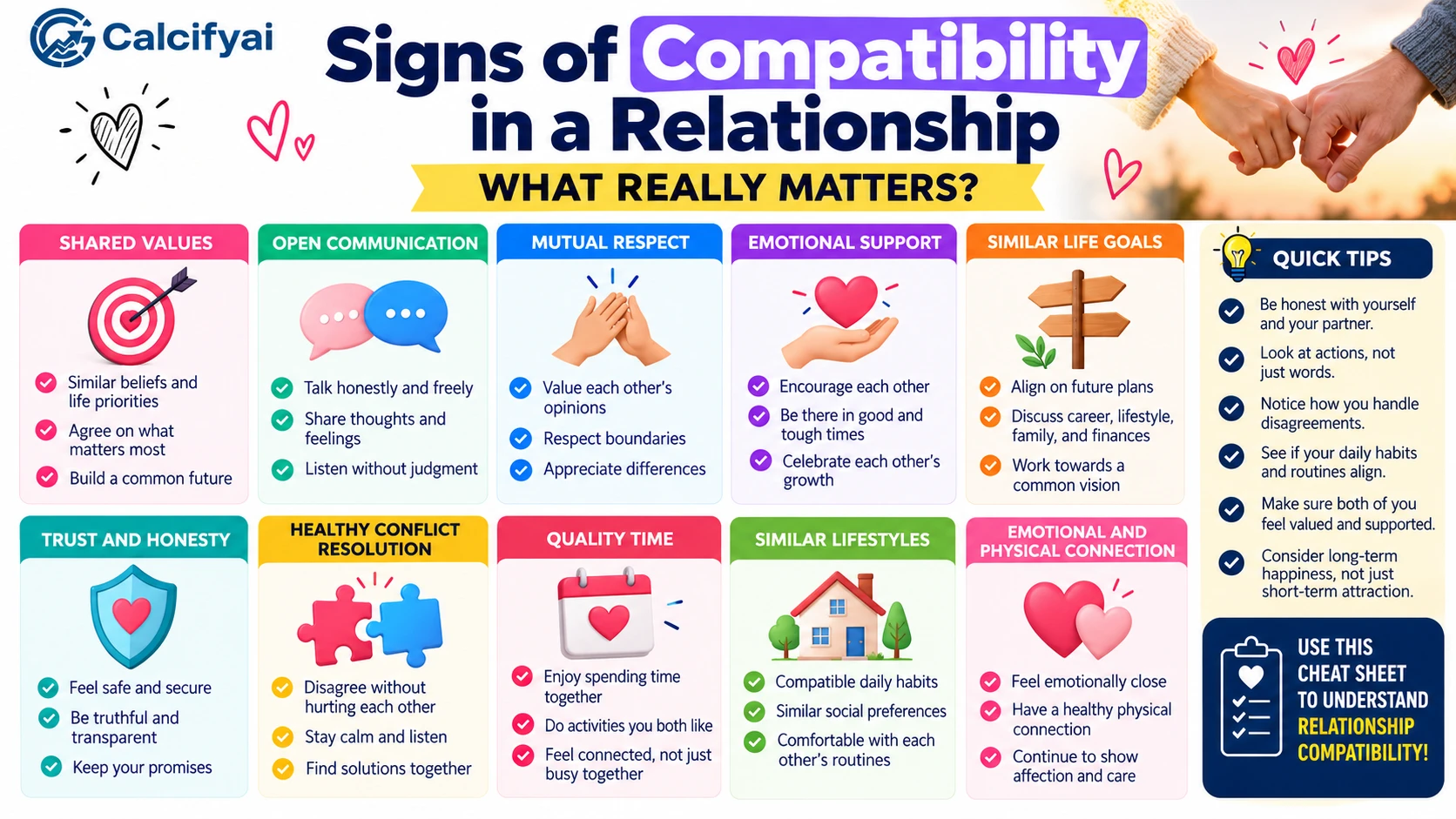
Signs of Compatibility in a Relationship: What Really Matters?
Learn the signs of compatibility in a relationship, from communication and trust to shared values, boundaries, lifestyle, and future goals.
Calcifyai Team
Expert calculators & financial tools
It is easy to think compatibility means having the same interests, liking the same things, or never arguing. In reality, it is much more practical than that.
The real signs of compatibility often show up in everyday situations. How do you communicate when something is bothering you? Can you respect each other's differences? Do you feel comfortable being yourself? Can you talk about money, family, and the future without avoiding difficult conversations?
You do not have to agree on everything to have a healthy relationship. What matters is whether your important needs, values, expectations, and goals can work together.
What Does Compatibility Mean in a Relationship?
Relationship compatibility means two people can build a life together while respecting each other's personalities, needs, boundaries, and differences.
Some common signs include:
You can talk openly with each other.
You feel comfortable being yourself.
You respect each other's opinions and boundaries.
Your important values are reasonably aligned.
You can work through disagreements.
You support each other's goals.
You have similar expectations about the relationship.
Your lifestyles can fit together.
You can make important decisions together.
Your long-term plans are not constantly pulling you in opposite directions.
None of these things means a relationship will be perfect. Every couple has disagreements. The difference is in how those disagreements are handled.
1. You Can Talk About Almost Anything
One of the strongest signs of compatibility is being able to communicate honestly.
You should feel comfortable talking about both the good stuff and the uncomfortable stuff. That might include money, family, jealousy, personal space, career plans, or something your partner did that bothered you.
You do not have to solve every problem immediately. Sometimes one person simply needs to be heard.
Good communication means being able to say what you feel, listen to the other person, and try to understand where they are coming from.
Open communication can play an important role in relationship quality. Research involving romantic couples has linked positive communication and emotional closeness with higher relationship satisfaction.
2. You Can Be Yourself Around Each Other
Do you feel like you have to act differently to keep your partner happy?
If you constantly worry about saying the wrong thing, hiding your interests, or changing your personality, it may be worth looking at why.
In a compatible relationship, both people should have room to be themselves.
You should be able to:
Share your opinions.
Talk about your interests.
Spend time with your own friends.
Enjoy some time alone.
Express your feelings.
Admit when you made a mistake.
Have preferences that are different from your partner's.
Being close to someone does not mean losing your individuality.
3. Your Important Values Are Similar
You do not need to have identical beliefs or personalities.
However, major differences in values can become difficult when they affect everyday life or major decisions.
Think about subjects such as:
Marriage
Children
Money
Family
Career
Lifestyle
Where you want to live
Work-life balance
For example, two people can have completely different hobbies but have similar ideas about commitment, family, and finances.
Those shared priorities may matter much more in the long run than having the same favorite music or movies.
4. You Respect Each Other's Differences
Being compatible does not mean being the same.
Maybe one person loves going out while the other prefers quiet evenings at home. Perhaps one person plans everything in advance while the other likes to be spontaneous.
These differences are not automatically a problem.
The bigger question is:
Can you accept the difference without constantly trying to change the other person?
If you can, the difference may be perfectly manageable.
Respect becomes especially important during disagreements. You can disagree with your partner without insulting them or making them feel small.
5. You Know How to Handle Arguments
Every relationship has disagreements. Even couples who get along extremely well will eventually see things differently.
So, never arguing is not necessarily a sign of compatibility.
Pay attention to how you argue.
A healthier disagreement might look like this:
Explain what is bothering you.
Listen to your partner's side.
Avoid personal attacks.
Take some space if emotions get too high.
Come back to the conversation.
Try to find a solution together.
For example, imagine one person wants to spend Saturday with friends while the other was hoping to spend the day together.
Instead of saying:
"You never care about me."
They might say:
"I was really hoping we could spend some time together this weekend. Can we plan another day for you to see your friends?"
The second approach focuses on the actual problem instead of attacking the person.
6. Your Expectations About the Relationship Match
People can have very different ideas about what a relationship should look like.
One person might love texting throughout the day. Another might be perfectly happy checking in a few times.
One person may want to spend every evening together, while the other needs regular alone time.
Neither preference is automatically wrong.
What matters is whether you can talk about those differences and find something that works for both of you.
It can help to discuss questions such as:
How much time do we want to spend together?
How much alone time do we need?
What does commitment mean to each of us?
How should we handle major decisions?
How do we prefer to communicate?
What do we expect from each other?
Sometimes compatibility is less about having identical expectations and more about being willing to understand each other's expectations.
7. You Feel Supported Emotionally
Everyone handles emotions differently.
When something goes wrong, one person might want to talk about it immediately. Another might need some quiet time first.
That does not automatically mean they are emotionally incompatible.
What matters is whether both people try to understand what the other needs.
Ask yourself:
Can I talk about my feelings?
Do I feel heard?
Can I ask my partner for support?
Does my partner respect my emotional boundaries?
Can we discuss difficult feelings without making each other feel ashamed?
You do not need to respond to emotions in exactly the same way.
8. There Is Trust Between You
Trust usually develops through small, consistent actions.
It comes from things like:
Keeping promises.
Being honest.
Respecting boundaries.
Following through.
Being dependable.
Giving each other reasonable independence.
You should not have to constantly check where your partner is or worry about every small interaction.
Trust also means understanding that both people can have their own friends, interests, and personal time.
9. Your Everyday Lifestyles Can Work Together
Compatibility also shows up in ordinary routines.
Think about your differences in:
Sleeping habits
Work schedules
Social life
Exercise
Food
Travel
Spending
Free time
Household responsibilities
You do not need to have exactly the same routine.
The important question is whether your differences can fit together without creating constant stress.
Money Is Part of Lifestyle Compatibility
Money can become a major source of tension in relationships, so it is worth talking about early.
Discuss things such as:
Saving
Spending
Debt
Shared expenses
Large purchases
Financial independence
Long-term financial goals
Being financially compatible does not mean earning the same amount.
It means being able to talk honestly about money and make decisions together.
10. Your Future Plans Can Work Together
A relationship may feel great today but still have serious differences when it comes to the future.
For example, one person might want children while the other does not. One person may want to move closer to family, while the other wants to live somewhere completely different.
These are not small lifestyle preferences.
That is why it helps to talk about the future honestly.
Ask:
"Can the future we each want realistically fit together?"
You do not need to have exactly the same dreams. But major goals should not constantly pull you in opposite directions.
11. You Can Make Decisions Together
Everyday decisions can reveal a lot about compatibility.
Maybe you are deciding where to go on vacation. One person cares most about the destination, while the other is more concerned about the budget.
A good compromise might consider both.
The goal is not for one person to always get their way.
It is being able to listen, consider each other's needs, and find solutions that feel fair.
12. You Respect Each Other's Boundaries
Everyone needs boundaries, even in a close relationship.
They can involve:
Personal space
Privacy
Friendships
Physical affection
Money
Family
Communication
Social media
Personal time
Your partner does not have to agree with every preference you have.
But they should be willing to listen and respect reasonable boundaries.
Likewise, you should be willing to respect theirs.
Compatibility vs. Chemistry: What's the Difference?
Chemistry and compatibility can feel similar, but they are not the same thing.
Chemistry often describes attraction, excitement, or that strong feeling you get when you connect with someone.
Compatibility is more about how well your lives and personalities work together over time.
For example, two people can have incredible chemistry but completely different views about:
Marriage
Children
Money
Commitment
Where to live
Lifestyle
On the other hand, two people may have a quieter relationship but be very compatible when it comes to communication, values, goals, and everyday life.
That is why attraction alone does not tell the whole story.
How to Check Your Compatibility
You do not need a complicated test to start thinking about compatibility.
Instead, look at a few important areas.
Step 1: Talk About Your Core Values
Ask each other what matters most.
Talk about family, money, career, commitment, lifestyle, and other issues that could affect your future.
Step 2: Look at How You Communicate
Ask:
"Can we talk about difficult things without immediately turning against each other?"
Good communication is not about agreeing all the time. It is about being able to have an honest conversation.
Step 3: Think About Everyday Life
Could your daily routines realistically work together?
Consider your work schedules, social lives, spending habits, personal space, and responsibilities.
Step 4: Pay Attention to Conflict
Think about what happens when you disagree.
Do you eventually listen and find a solution, or does the same argument keep happening without getting resolved?
Step 5: Talk About the Future
Discuss your major goals.
You may not have identical plans, but knowing what each person wants can help you see whether those plans can fit together.
Can a Love Calculator Measure Compatibility?
A love calculator can be a fun way to generate a compatibility percentage based on two names.
But a number cannot measure trust, communication, emotional support, shared values, or long-term goals.
If you want to try a fun compatibility check, you can use the Love Calculator. Think of the result as entertainment rather than a scientific measurement of your relationship.
For a deeper look at the topic, you can also read what makes two people compatible. That article covers broader compatibility factors, while this guide focuses more on practical signs you can notice in everyday life.
Common Mistakes When Judging Compatibility
Thinking You Have to Be Similar
You can have different hobbies, personalities, and interests and still get along well.
Confusing Chemistry With Compatibility
A strong attraction can feel powerful, but it does not automatically mean your long-term goals fit together.
Thinking Healthy Couples Never Argue
Disagreements happen. What matters is whether you can handle them respectfully.
Ignoring Major Differences
Disagreeing about your favorite restaurant is one thing.
Disagreeing about children, marriage, finances, or where to live can have a much bigger impact.
Relying Too Much on Compatibility Scores
An online percentage cannot understand the full story of a relationship.
Trying to Change Your Partner
A relationship becomes difficult when one person expects the other to completely change their personality or priorities.
A Simple Compatibility Checklist
Use these questions to think about your relationship:
Area | Question |
|---|---|
Communication | Can we talk honestly about difficult topics? |
Values | Do our important values fit together? |
Trust | Can we depend on each other? |
Emotional support | Do we understand each other's needs? |
Lifestyle | Can our daily routines work together? |
Boundaries | Do we respect each other's personal space? |
Conflict | Can we disagree without attacking each other? |
Money | Can we discuss financial decisions openly? |
Future | Can our major goals fit together? |
Independence | Can we maintain our own interests and friendships? |
You do not need to answer "yes" to everything.
The checklist is simply a way to notice where you already fit well and where you may need a deeper conversation.
Frequently Asked Questions
What are the biggest signs of compatibility in a relationship?
Some of the clearest signs are honest communication, mutual respect, trust, emotional support, compatible expectations, and long-term goals that can work together.
Can two people be compatible if they are very different?
Yes. Different personalities and interests do not automatically make two people incompatible. What matters is whether they can respect their differences and find ways to live with them.
Does compatibility mean agreeing on everything?
No. You can disagree about many things and still have a strong relationship. Compatibility is more about how you handle those disagreements.
Is chemistry the same as compatibility?
No. Chemistry is often about attraction and emotional excitement. Compatibility is about how well your values, needs, lifestyles, expectations, and goals work together.
Can compatibility change over time?
Yes. People change, and life circumstances change too. Career decisions, finances, family responsibilities, and personal goals can all affect a relationship.
How do you know if you are compatible with someone?
Look at how you communicate, handle conflict, respect boundaries, support each other, manage differences, and think about your future together.
Can a love calculator tell if two people are compatible?
No. A love calculator can be fun, but a name-based percentage cannot measure real factors such as trust, communication, values, or emotional compatibility.
Final Takeaway
The best signs of compatibility are not found in a single test or percentage.
They show up in everyday life.
Can you talk honestly? Can you disagree without tearing each other down? Can you respect each other's boundaries? Can you support each other's goals? Can your important values and future plans fit together?
You do not have to be exactly alike.
A compatible relationship is not about finding someone who agrees with everything you say. It is about finding ways to understand each other, respect your differences, and build a life that works for both people.
Disclaimer
The information provided in this article is for educational and informational purposes only. It should not be considered as professional financial, medical, or legal advice. Always consult with qualified professionals for specific guidance related to your situation.
Popular Calculators
Explore our most-used free calculators for finance, health, and everyday needs.