
Love Compatibility Tests: Fun Game or Real Relationship Measure?
Are love compatibility tests accurate? Learn what love scores mean, what they cannot predict, and which real-life relationship factors matter.
Calcifyai Team
Expert calculators & financial tools
A love compatibility test is a popular way to explore how well two people might match romantically. Some tests compare names and generate a love percentage, while others ask questions about personality, communication, values, and relationship expectations.
But can a love compatibility test really tell you whether two people are meant for each other?
The short answer: A simple online love test can be fun, but its score cannot reliably measure real relationship compatibility or predict whether a couple will stay together. More detailed questionnaires can help people reflect on their relationship, but their usefulness depends on what they measure and whether they have been properly tested.
A healthy relationship involves much more than a percentage. Trust, respect, communication, emotional support, shared priorities, and how two people handle differences all matter.
What Is a Love Compatibility Test?
A love compatibility test is a tool or questionnaire designed to explore how well two people may match in a romantic relationship.
Different tests use different methods. Some compare names, while others ask questions about personal preferences, emotional needs, personality traits, or future goals.
Common types include:
Name-based love tests: Compare two names and generate a love percentage.
Personality compatibility tests: Explore personality traits and preferences.
Relationship quizzes: Ask about communication, trust, affection, and expectations.
Values-based assessments: Compare views about family, commitment, money, and long-term plans.
These tests do not all measure the same thing. A name-based calculator that generates a percentage for entertainment is very different from a carefully developed psychological questionnaire.
Are Love Compatibility Tests Accurate?
The accuracy of a love compatibility test depends on how it works and what it claims to measure.
A simple online test may generate a number using a programmed formula. That number can be entertaining, but it does not establish how well two people will communicate, solve problems, or build a future together.
A more detailed questionnaire may help couples identify similarities and differences. However, even a well-designed assessment should not be treated as a guarantee of relationship success.
For example, a test might show an 85% match between two people. That does not mean they have an 85% chance of staying together.
To evaluate a test, consider three questions:
What does the test actually measure?
Is there evidence that the test measures that thing reliably?
Does the evidence support the specific claims the test makes?
If a test simply compares names, its percentage should be treated as a playful result rather than a scientific relationship measurement.
Love Compatibility Test: Fun Game or Real Relationship Measure?
A love test can be both a fun game and a starting point for a meaningful conversation. The difference lies in how you use the result.
As a fun game
A name-based love calculator gives you a playful percentage you can share with a crush, partner, or friend. It can make a lighthearted activity, but it does not measure the strength of your relationship.
As a conversation starter
A relationship questionnaire can encourage you to discuss values, expectations, communication styles, and future plans. Its value comes from the conversation, not simply the final score.
As a relationship assessment
A properly developed assessment may help explore specific relationship patterns. However, its usefulness depends on the quality of the questions and evidence supporting the tool. It cannot guarantee a particular outcome.
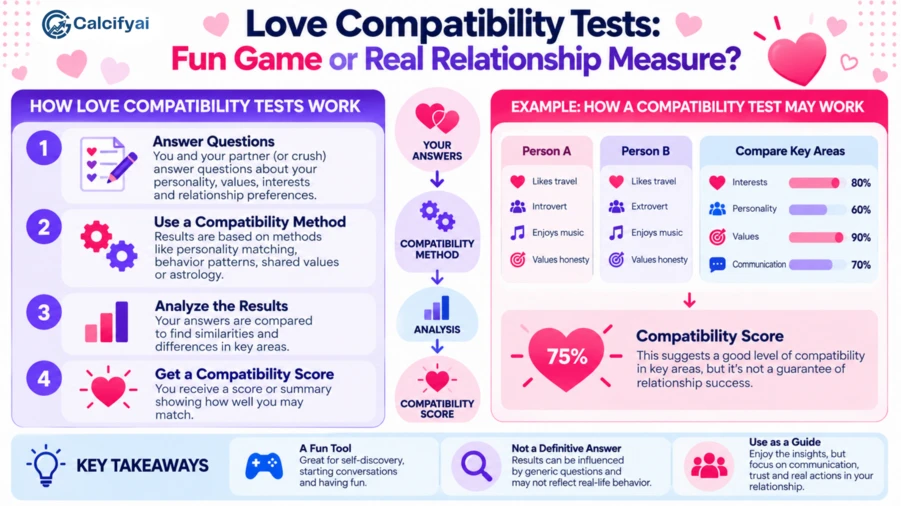
How Does a Love Compatibility Test Work?
The method depends on the type of test.
1. Name-Based Compatibility Tests
These tests ask for two names and use a programmed method to generate a love percentage.
For example, a result might look like this:
Illustrative result
82%
Fun compatibility score
This percentage is an example, not a measured probability of relationship success.
Different calculators may use different algorithms, so the same pair of names can receive different results from different tools.
2. Question-Based Compatibility Tests
These tests ask questions about how two people think, feel, and behave in relationships.
Questions may explore:
How you express affection
How you handle disagreements
How much personal space you prefer
What commitment means to you
How you approach money and family
What you want from the future
Answers can reveal subjects worth discussing. However, a questionnaire based on self-reported answers may not capture how someone actually behaves in everyday situations.
3. Personality-Based Tests
Some tests compare personality traits or preferences. These can help people describe differences in how they socialize, make decisions, or respond to stress.
But personality similarity alone does not prove that two people will have a successful relationship. The results should be interpreted within the limits of what the test was designed to measure.
What Does a Love Compatibility Percentage Mean?
A love compatibility percentage is a score generated by a particular test or calculator. Its meaning depends on the method used to produce it.
Example score | What you should understand |
|---|---|
90% | A high result according to that tool's rules |
75% | A result that may be fun to compare |
50% | A score that does not establish poor compatibility |
100% | Not proof of a perfect relationship |
Unless a test has been validated for a specific purpose, its score should not be treated as a scientific measurement.
For example, an 80% result does not mean that two people share 80% of their values or have an 80% chance of staying together.
What Actually Matters in Love Compatibility?
Real compatibility becomes clearer through interactions, decisions, and experiences over time.
Research on couples suggests that relationship satisfaction and communication are connected in complex ways, rather than following one simple rule. A longitudinal study published in Personal Relationships and Social Psychology Bulletin examined communication and satisfaction across three studies of couples. You can read the research on communication and relationship satisfaction for more context.
Here are several practical areas to consider.
1. Trust and Respect
Can you depend on each other? Do you respect personal boundaries, opinions, and independence?
Trust is built through consistent behavior, honesty, and reliability—not a matching percentage.
2. Communication
Can you express your feelings without being dismissed? Can you listen when your partner sees a situation differently?
Healthy communication does not mean avoiding every disagreement. It means trying to understand each other and discuss problems respectfully.
3. Shared Values
You do not need to agree on everything, but major differences about family, commitment, finances, or children may need honest discussion.
4. Emotional Support
Do you feel comfortable sharing your concerns? Can you support each other during stressful periods while respecting each other's needs?
5. Lifestyle and Future Goals
Think about daily routines, work, social activities, financial habits, and long-term plans.
Two people can have different hobbies and still be compatible. Differences in major life goals may require more careful consideration.
For a broader explanation of these factors, read what makes two people compatible in a relationship.
How to Use a Love Compatibility Test in a Healthy Way
You can enjoy a love compatibility test without allowing the result to influence important relationship decisions.
Step 1: Choose the Right Type of Test
If you want entertainment, a name-based calculator may be enough. If you want to explore your relationship, choose questions that focus on the areas you actually want to understand.
Step 2: Answer Honestly
For question-based tests, choose answers that reflect your real preferences rather than answers that might produce a higher score.
Step 3: Compare Your Answers
Notice where you agree and where you differ. Do not assume that every difference is a problem.
Step 4: Discuss Important Differences
Ask questions such as:
Why is this important to you?
How would we handle this situation?
What would a fair compromise look like?
Is this a preference or a firm boundary?
Step 5: Consider Real-Life Behavior
Compare your answers with how you treat each other in everyday life.
Do you keep promises? Can you talk about difficult subjects? Do you respect each other's boundaries?
These questions provide more useful context than a score alone.
Try a Love Calculator for Fun
If you want a quick, playful result, you can try the Love Calculator. Enter two names to generate a love percentage and enjoy comparing the result.
Remember that the calculator is intended for entertainment. It does not scientifically measure romantic compatibility or predict whether a relationship will last.
Common Mistakes to Avoid
Treating a High Score as a Guarantee
A high percentage cannot guarantee trust, happiness, commitment, or long-term success.
Treating a Low Score as a Warning
A low score from a name-based calculator is not evidence that two people are a poor match.
Confusing Attraction With Compatibility
Strong attraction can bring people together, but it does not automatically mean their expectations and goals align.
Expecting Partners to Be Identical
People can have different personalities, hobbies, and communication preferences while still building a healthy relationship.
Ignoring Real Problems Because of a High Score
A compatibility result should never be used to dismiss disrespect, dishonesty, boundary violations, or other serious concerns.
Making Major Decisions Based on a Quiz
Do not use a casual online result as the deciding factor in choices about commitment, marriage, or ending a relationship.
Frequently Asked Questions
Are love compatibility tests real?
They are real tools, but they do not all measure the same thing. A name-based test generally generates a playful score, while a properly developed questionnaire may help explore specific relationship patterns.
Is a love compatibility test scientifically accurate?
There is no single answer for every test. Accuracy depends on the tool, what it measures, and the evidence supporting its results. A simple name-based percentage is not a validated prediction of relationship success.
Can a love test predict marriage?
No. A casual love test cannot reliably predict whether two people will marry or remain together. Those outcomes depend on real-life choices, circumstances, and relationship experiences.
What is a good love compatibility percentage?
There is no universal percentage that defines a good match. Different calculators use different formulas, so their scores cannot be compared as though they were standardized measurements.
Can two people with a low love score be compatible?
Yes. A low score from a playful calculator does not establish anything meaningful about how two people communicate, trust each other, or share their goals.
Do name-based love calculators work?
They work in the sense that their algorithms can generate a result from names. However, that does not mean the percentage measures real romantic compatibility.
What is better than a love compatibility test?
Honest conversations, observing real-life behavior, discussing values and expectations, and learning how to handle differences can provide more useful insight into a relationship than a casual percentage.
Conclusion
A love compatibility test can be a fun game, a conversation starter, or a way to reflect on a relationship. Its usefulness depends on what it measures and how you interpret the result.
A name-based percentage cannot establish whether two people are meant to be together. More detailed questionnaires may help identify topics to discuss, but they cannot guarantee a successful relationship.
Instead of focusing only on a number, pay attention to trust, respect, communication, emotional support, and whether your important values and future goals can work together.
Enjoy the test for fun, but judge compatibility by the relationship you build together.
Disclaimer
The information provided in this article is for educational and informational purposes only. It should not be considered as professional financial, medical, or legal advice. Always consult with qualified professionals for specific guidance related to your situation.
Popular Calculators
Explore our most-used free calculators for finance, health, and everyday needs.