
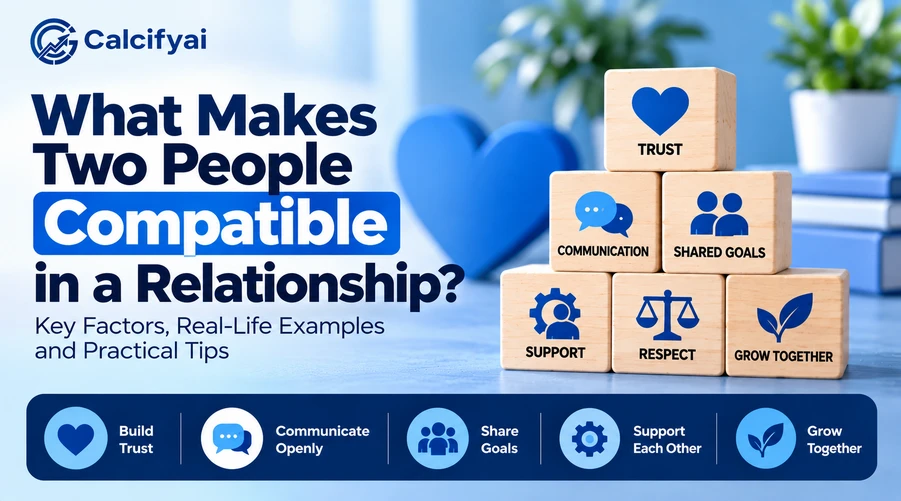
What Makes Two People Compatible in a Relationship?
Learn what makes two people compatible, including shared values, communication, trust, emotional needs, lifestyle, and future goals.
Calcifyai Team
Expert calculators & financial tools
Compatibility in relationships extends beyond having the same lifestyle, sharing the same hobbies, or watching the same movies. Two different people can build a healthy and comfortable relationship when they understand and respect each other.
What matters is how they communicate, deal with differences, support one another, and think about their future together.
Simply put, two people are compatible when their values, needs, expectations, communication styles, lifestyles, and future goals can work well together. They do not have to agree on everything. A healthy relationship can include different views, opinions, and personalities as long as those differences are respected.
What Is Relationship Compatibility?
Relationship compatibility is about how well two people fit together as partners. It can be seen in everyday situations, including decision-making, conflict resolution, spending time together, and providing emotional support.
Some key areas of compatibility include:
Shared values
Communication
Trust
Emotional needs
Lifestyle
Financial habits
Family expectations
Long-term goals
Personal boundaries
Conflict resolution
For instance, two people may have completely different hobbies but similar opinions about family, commitment, finances, and the future. In many cases, these common goals can matter more than having the same interests.
1. Shared Core Values
Values are beliefs that influence important decisions in life. They can affect choices involving family, finances, work, lifestyle, and the future.
One person may focus on financial stability, while another may prefer spending money on travel and experiences. This does not automatically mean they are incompatible. What matters is whether they can communicate their priorities and make decisions together.
Values Worth Discussing
Some values that couples may want to discuss include:
Family
Marriage
Children
Career
Money
Religion or spirituality
Personal freedom
Lifestyle
Work-life balance
You do not have to have exactly the same values. However, major differences can become difficult when they are ignored instead of discussed openly.
2. Good Communication
Communication is one of the most important parts of relationship compatibility. It is not simply about talking a lot. It involves expressing your ideas and feelings, listening to the other person's perspective, and discussing difficult topics without becoming defensive.
For instance, some people want to resolve a conflict right away, while others need some quiet time to think. That does not automatically mean they do not fit together. They can agree to take a short break and return to the conversation later.
The American Psychological Association provides information about healthy relationships, communication, and ways to manage disagreements.
Why Honest Communication Matters
Honesty is an important part of good communication. Instead of assuming that your partner knows what you want or need, explain it clearly.
Being able to say what is bothering you can prevent small misunderstandings from becoming bigger problems.
3. Emotional Compatibility
People have different emotional needs, and they may express affection in different ways.
Some people need frequent reassurance, while others naturally show love through their actions. Some people want to talk about their emotions immediately, while others need time to process what they are feeling.
Emotional compatibility means learning how to give and receive support from your partner.
Questions to Ask About Emotional Compatibility
Ask yourself:
Can we express our emotions freely?
Do I feel heard?
Can we support each other when facing challenges?
Do we respect each other's emotional boundaries?
Can we express our needs without feeling judged?
Your emotional styles do not have to match perfectly. Understanding how they differ can be more important than being emotionally identical.
4. Similar Relationship Expectations
Relationships can have different meanings for different people.
One person may want to spend a lot of time together every evening, while the other may need more time alone. One person may prefer frequent texting, while the other is comfortable checking in less often.
There is not necessarily a right or wrong approach. Problems can occur when both people assume their expectations are already understood.
Questions Couples Can Discuss
It can help to talk openly about questions such as:
How much time do we want to spend together?
How much personal space do we need?
What does commitment mean to us?
How should we make important decisions?
What do we expect from one another?
Discussing expectations early can help prevent unnecessary misunderstandings.
5. Compatible Long-Term Goals
Strong chemistry can exist between two people who want very different futures.
For example, one person may want to move to another city for a job, while the other prefers to remain close to family. One person may want children, while the other does not.
These are important life decisions and deserve honest discussion.
Why Future Goals Matter
Long-term compatibility does not require having an identical life plan. It means understanding where the other person wants to go and asking whether there is a realistic way to build that future together.
Talking about major goals can help both people understand whether their plans can work side by side.
6. How You Handle Conflict
All relationships have conflicts. Two people who rarely argue are not necessarily more compatible than a couple who disagrees from time to time.
What matters is how they approach problems.
A Constructive Approach to Conflict
Some helpful approaches include:
Describe the problem clearly.
Listen to your partner's feelings and perspective.
Avoid insults and personal attacks.
Give both people a chance to speak.
Focus on solving the problem instead of winning.
Take a break if emotions become overwhelming.
Return to the discussion when both people are calmer.
A disagreement does not have to become a competition. Sometimes the goal is simply to understand why the other person sees things differently.
7. Trust and Reliability
Trust is built over time through everyday actions.
Keeping your word, being honest, respecting boundaries, and doing what you say you will do can help create trust.
When you know your partner is reliable and follows through on their promises, it becomes easier to feel secure in the relationship.
Trust and Personal Freedom
Trust also allows both people to have some independence. A healthy relationship does not require constantly checking up on your partner to make sure everything is okay.
It is possible to feel close to someone while still giving each other personal space and freedom.
8. Lifestyle Compatibility
You do not need to enjoy everything your partner enjoys.
One person may prefer going out on the weekend, while the other prefers quiet nights at home. One person may be highly organized, while the other is more relaxed and spontaneous.
These differences can work when both people respect each other's preferences.
Money Topics to Discuss
Useful topics include:
Saving goals
Debt
Major purchases
Shared expenses
Budgeting
Financial independence
Future financial plans
Financial compatibility does not mean earning the same amount. It means being able to discuss financial decisions and find an approach that both people can accept.
9. Respect for Individual Differences
A compatible relationship does not require two people to become the same.
Both partners can have separate hobbies, friendships, interests, and opinions. Personal space can also be healthy. Spending every moment together is not the only way to show love.
Respect means allowing your partner to remain an individual while still creating a shared life.
You can disagree with your partner's opinion without disrespecting the person.
Are Similar People More Compatible?
Not necessarily.
Some similarities can make a relationship easier, especially when they involve important values and future plans. However, differences can also bring balance.
For example, an organized person and a spontaneous person may approach weekends very differently. If they respect each other's preferences, they may find a routine that works for both.
Instead of asking, "Are we similar enough?", it may be more useful to ask:
"Can our differences work well together?"
This focuses on how the relationship works in real life rather than trying to find a perfect personality match.
Can a Love Calculator Measure Compatibility?
Online love calculators can be fun. They may compare two names and generate a percentage as a playful compatibility result.
However, a number cannot measure whether two people trust each other, communicate well, share important values, or handle disagreements.
For entertainment, you can use the Love Calculator, but a name-based result should not be treated as a scientific measurement of relationship compatibility.
Real compatibility becomes clearer through everyday conversations, choices, and experiences.
Common Mistakes When Judging Compatibility
Focusing Only on Chemistry
Strong attraction can be exciting, but chemistry alone does not tell you whether your values or long-term goals fit together.
Expecting Complete Agreement
No two people will agree on everything. Different opinions are a normal part of relationships.
Ignoring Major Differences
Different hobbies are usually easier to manage than major disagreements about children, marriage, finances, or where to live.
Trying to Change Your Partner
A relationship should not depend on one person completely changing their personality or values.
Relying Only on a Compatibility Score
A percentage may be entertaining, but it cannot describe the full reality of a relationship.
A Simple Compatibility Checklist
To think about relationship compatibility in a practical way, ask yourself:
Values: Do we respect the things that matter most to each other?
Communication: Can we talk honestly, even when the subject is uncomfortable?
Emotions: Do we understand and support each other's emotional needs?
Lifestyle: Can our everyday routines work together?
Trust: Can we depend on each other?
Future: Are our major long-term goals reasonably aligned?
Conflict: Can we disagree without repeatedly hurting or disrespecting each other?
You do not need perfect answers to every question. The purpose is to understand where you naturally fit together and where you may need more communication or compromise.
Frequently Asked Questions
What is relationship compatibility?
Relationship compatibility is how well two people's values, expectations, communication styles, emotional needs, lifestyles, and future goals work together.
What makes two people compatible?
Shared values, honest communication, trust, emotional understanding, respect, compatible lifestyles, and reasonably aligned future goals can all contribute to compatibility.
Can two people be compatible if they are very different?
Yes. Differences do not automatically mean incompatibility. What matters is whether both people can respect those differences and find ways to manage them.
Does compatibility mean never arguing?
No. Disagreements are normal. What matters is how people communicate during disagreements and whether they can work toward solutions.
Can relationship compatibility change?
Yes. People and circumstances change over time. Careers, family responsibilities, finances, and personal goals can all change, so couples may need to adjust together.
Can a love calculator determine real compatibility?
No. A name-based love calculator can be fun, but it cannot scientifically measure trust, communication, emotional connection, or long-term relationship success.
Final Takeaway
Relationship compatibility is not about finding someone who is exactly like you. It is about finding ways for two different people to build a relationship that works for both of them.
Shared values, honest communication, trust, emotional understanding, compatible lifestyles, and reasonably aligned future goals can all make a relationship easier to navigate.
Disclaimer
The information provided in this article is for educational and informational purposes only. It should not be considered as professional financial, medical, or legal advice. Always consult with qualified professionals for specific guidance related to your situation.
Popular Calculators
Explore our most-used free calculators for finance, health, and everyday needs.