
How to Calculate Hours Worked Across Multiple Shifts
Learn how to calculate hours worked across multiple shifts, including overnight shifts, split shifts, breaks, decimal hours, and weekly totals.
Calcifyai Team
Expert calculators & financial tools
Calculating work hours is pretty easy when you work one regular shift, such as 9 AM to 5 PM. If you work two or more shifts, work overnight, have split shifts, or breaks, it can become a little confusing.
For instance, you could be at work between 8AM and 12pm, then off for a couple of hours, and back between 5pm and 10pm. Or you may begin at 10 PM and end at 6 AM the following morning.
Best approach to these scenarios is to do each shift individually and then sum the working time.
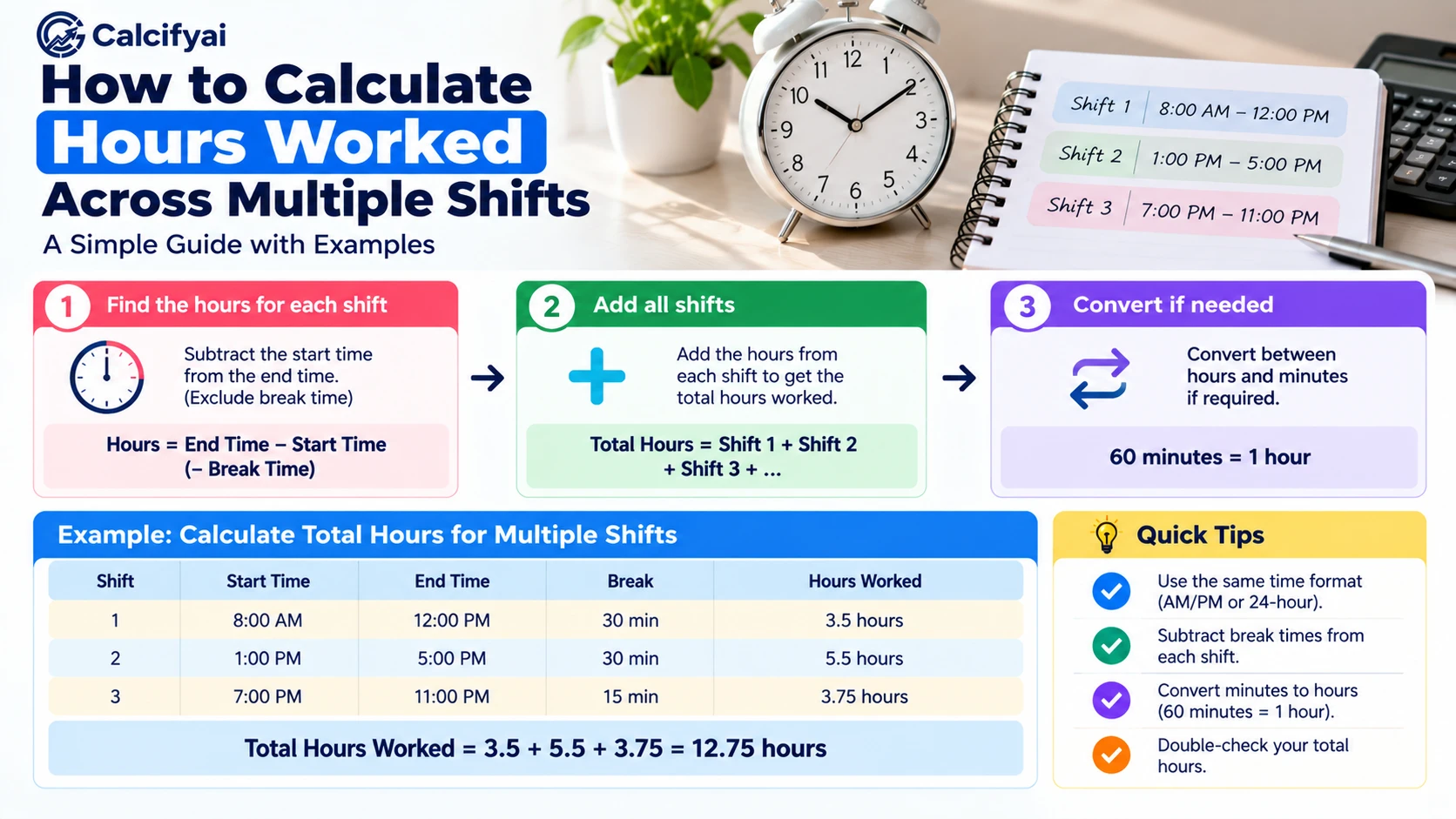
The basic idea is:
Total Hours Worked = Hours at each shift – Applicable Unpaid Breaks
If you can split the schedule into smaller chunks, then the calculation is much easier.
What is meant by ‘Hours Worked’?
Hours Worked: These are the hours you actually work on your shift.
The time for a normal shift can be calculated as follows:
Hours Worked = End Time - Start Time.
If there is break without pay, deduct it from the total.
If you work from 9am to 5pm and have a 30 minute lunch break that is not paid then for example that would be the equivalent of working from 9am to 4:30pm.
The full shift is:
8 hours
Subtract the break:
8 hours − 0.5 hours = 7.5 hours
So, the actual working time is 7.5 hours.
The meaning of the working time can vary depending on different types of break, workplace policy and existing labor rules. The U.S. Department of Labor describes federal regulations regarding hours of work and breaks in the Hours Worked under the FLSA.
Calculating hours worked over two or more shifts.
If you have multiple shifts in a day, try not to calculate everything all at once.
Rather, in each shift work out separately.
Step 1: Write Down Each Shift
Imagine your work schedule looks like this:
Shift 1: 8:00 AM to 12:00 PM
Shift 2: 4:00 PM to 9:00 PM
There are two separate working periods, so calculate them individually.
Step 2: Calculate the First Shift
The first shift runs from 8 AM to 12 PM.
That's:
4 hours
So, Shift 1 = 4 hours.
Step 3: Calculate the Second Shift
The second shift runs from 4 PM to 9 PM.
That's:
5 hours
So, Shift 2 = 5 hours.
Step 4: Add the Two Shifts
Now add them together:
4 + 5 = 9 hours
The total working time is 9 hours.
Example: Multiple Shifts With a Break
Let's say we want to make a little bit more realistic.
Suppose someone works:
Shift 1: 7:00 AM to 11:30 AM
Shift 2: 2:00 PM to 7:00 PM
A 30 minute break is also provided during the second shift, but this is not paid.
First, calculate Shift 1:
7:00 AM to 11:30 AM = 4 hours 30 minutes
Now calculate Shift 2:
2:00 PM to 7:00 PM = 5 hours
Take away the 30 minute unpaid break:
5 hours − 30 minutes = 4 hours 30 minutes
Now add both shifts:
4 hours 30 minutes + 4 hours 30 minutes = 9 hours
Thus the worker worked 9 hours.
The power of the Hourglass.Overnight Shift Math.
Confused by the use of 'over night' shifts, as they cross over midnight.
For example:
10:00 PM to 6:00 AM
You can not subtract 10 from 6, because the shift goes over to the next day.
Rather, divide the turn at 12 a.m.
Before Midnight
During the evening from 10 PM to midnight:
2 hours
After Midnight
Between midnight and 6 AM:
6 hours
Now add the 2 parts together:
2 + 6 = 8 hours
The length of the overnight shift is 8 hours.
Overnight Shift With a Break
Suppose that someone works from:
9:00 PM to 5:00 AM
and receives a 30 minute lunch break that doesn't count toward their work hours.
First divide the shift at midnight.
Between 9 PM and 12 midnight:
3 hours
At nighttime from midnight to 5 AM:
5 hours
Total time:
3 + 5 = 8 hours
Then subtract the 30 minutes for the break:
8 − 0.5 = 7.5 hours
The employee worked 7.5 decimal hours or 7 hours 30 minutes.
How to Calculate Split Shifts
Split shift occurs when two different shifts of work are performed with several hours in between.
For example:
Morning: 6:00 AM to 10:00 AM
Evening: 4:00 PM to 9:00 PM
The morning shift starts at:
4 hours
The time for the evening shift is:
5 hours
Add them:
4 + 5 = 9 hours
Thus, it turns out that the employee worked 9 hours.
Notice that an employee was not at work from 10AM till 4PM. The six hour period is not considered to be working time.
That is why it is important to find the working time for each individual period rather than just working out the time that starts and ends.
How to Add Hours and Minutes
If you have multiple shifts, your totals can be both hours and minutes.
For example:
Shift 1 = 4 hours 45 minutes
Shift 2 = 5 hours 30 minutes
Shift 3 = 2 hours 15 minutes
First, total up the hours:
4 + 5 + 2 = 11 hours
Next, add the minutes:
45 + 30 + 15 = 90 minutes
Now, there are 90 minutes in 1 hour and 30 minutes:
11 hours + 1 hour 30 minutes = 12 hours 30 minutes
Therefore, a total working time is:
12 hours 30 minutes
To convert minutes into decimal hours
Timesheets and payroll systems often use decimal hours instead of hours and minutes.
Some timesheets and payroll programs do not work with hours and minutes, but rather with decimal hours. For a detailed explanation, see our guide on How to Convert Minutes to Decimal Hours for Payroll.
The simple rule is:
Decimal Hours = Minutes ÷ 60
The following are a few common conversions:
15 minutes = 0.25 hours
30 minutes = 0.50 hours
45 minutes = 0.75 hours
60 minutes = 1 hour
For example:
7 hours 30 minutes = 7.5 hours
An important point to note here is one hour and 30 minutes is NOT 7.30 hours.
Convert the 30 minutes into a fraction of an hour:
30 ÷ 60 = 0.50
Therefore, the answer is 7.50 hours.
Example: Full Day With Three Shifts
This is an example of a Full Day With Three Shifts.
Example: FdWTS: Full Day With Three Shifts.
Assume that an employee has the following schedule:
Assignments made during the shift, starting and ending time, and time worked.
1 7:30 AM 11:45 AM 4 hr 15 min
2 1:00 PM 5:30 PM 4 hr 30 min
3 7:00 PM 9:15 PM 2 hr 15 min
Add the hours:
4 + 4 + 2 = 10 hours
Now add the minutes:
15 + 30 + 15 = 60 minutes
60 minutes is also one hour.
So:
10 hours + 1 hour = 11 hours
The employee had a total of 11 hours worked that day.
Calculate the weekly hours worked from multiple shifts.
If you have different shifts on different days of the week, find each day's total before adding up the weekly total.
For example:
Day Total Hours
Monday 8 hours
Tuesday 9 hours
Wednesday 7.5 hours
Thursday 8.5 hours
Friday 9 hours
Then, add up the totals for the day:
8 + 9 + 7.5 + 8.5 + 9 = 42 hours
Thus, the employee had worked 42 hours in the week.
The applicable labor rules, employee classification and location are all factors in determining whether some of those hours qualify for overtime. Overtime for covered nonexempt employees under the U.S. FLSA is computed for hours worked in excess of 40 per workweek (with applicable rules and exemptions).
A simple formula for multiple shifts.
If there are multiples shifts, the calculation can be thought of as:
Total Work Hours = Shift 1 + Shift 2 + Shift 3 + ... – Applicable Unpaid Breaks
For example:
4 hours + 5 hours + 3 hours = 12 hours
If there was an unpaid break of 30 minutes:
12 − 0.5 = 11.5 hours
Total working time: 11.5 hrs.
Mistakes that are often made in calculating multiple shifts.
The Overnight Shift is like the Same-Day Shift, but at night.
Midnight occurs when the time changes from 10 p.m. to 6 a.m.
Break down subtraction of numbers into two steps:
10 PM to midnight
Midnight to 6 AM
Time Between Split Shifts
If you work from 8 AM to noon and from 5 PM to 9 PM, then you were not working from 5 to 8 PM or from noon to 5 PM.
Work out each jump one at a time.
Forgetting Unpaid Breaks
If an appropriate unpaid break is not to be recorded as working time, then be sure to deduct it from the total of the shift.
This is often a confusing one.
This is a tricky one.
This is one of the most frequent time sheet errors with which I encounter.
For example:
30 minutes = 0.50 hours
not:
0.30 hours
Mixing Time Formats
It can be easy to make mistakes if you are using 12 hour time in one calculation and 24 hour time in another.
For example:
10:00 PM = 22:00
6:00 AM = 06:00
If you always use one format, it will be easier to calculate.
Rounding Too Early
While switching shifts, stick to the original hours and minutes. Afterwards if needed, convert the final result to decimal hours.
Should lunch breaks be included in hours worked?
Depending on the rules of the workplace and the type of break, it may be paid or unpaid. Qualifying meal breaks are generally considered to be different from short rest breaks under U.S. federal law.
How to work out multiple shifts on one day?
Work out each working period individually, sum them up and deduct any unpaid breaks.
What is 30 minutes as a decimal of an hour?
Divide 30 by 60:
30 ÷ 60 = 0.5
So, 30 minutes are equal to 0.50 decimal hours.
What is the formula to use when computing weekly hours with several shifts?
Total up the working days for each shift in the week.
For example:
The number of hours worked each week is equal to Monday + Tuesday + Wednesday + Thursday + Friday.
How to manage several shifts?
Record the beginning time, ending time and applicable break for each shift. For those with a big or fluctuating workload, a work hours calculator can simplify the process of calculating the totals.
Conclusion
It doesn't take complicated to figure out hours worked over multiple shifts.
The simplest way to do this is to calculate each shift, and then sum up the working time.
If you are having an overnight shift, divide up the calculation at midnight. Split shifts: Do not add up hours between periods of work. If you have unpaid breaks which are not to be counted as working time, deduct the time from the correct shift.
The fundamental procedure is:
Record each change.
Work out the length of each shift.
Work at night, between midnight and 8am.
Add up any unpaid breaks that are applicable.
Count all the working periods.
If necessary, change to decimal hours.
Review final total and check timesheet.
After you've become accustomed to working through each shift individually, even a complex shift schedule becomes an easy-to-understand and track.
Disclaimer
The information provided in this article is for educational and informational purposes only. It should not be considered as professional financial, medical, or legal advice. Always consult with qualified professionals for specific guidance related to your situation.
Popular Calculators
Explore our most-used free calculators for finance, health, and everyday needs.