
How to Calculate the Area of Irregular Shapes: Step-by-Step Guide
Learn how to calculate the area of irregular shapes using simple methods, formulas, examples, and step-by-step explanations.
Calcifyai Team
Expert calculators & financial tools
Calculating the area of irregular shapes can seem difficult because an irregular figure usually does not have one simple formula. The good news is that you can often solve the problem by breaking the shape into smaller, familiar shapes.
Rectangles, squares, triangles, trapezoids, and semicircles can be calculated separately. You can then add their areas together or subtract a missing section to find the total area.
What Is the Area of an Irregular Shape?
Area is the amount of surface covered by a two-dimensional shape. It is measured in square units, such as:
Square centimeters (cm²)
Square meters (m²)
Square inches (in²)
Square feet (ft²)
An irregular shape does not have one standard formula that works for every figure. Instead, the shape can often be divided into smaller sections that are easier to measure.
For irregular figures made from familiar geometric shapes, you can split the figure into simpler shapes and calculate the area of each section separately. OpenStax uses this same approach when explaining how to find the area of irregular figures.
The main idea is simple:
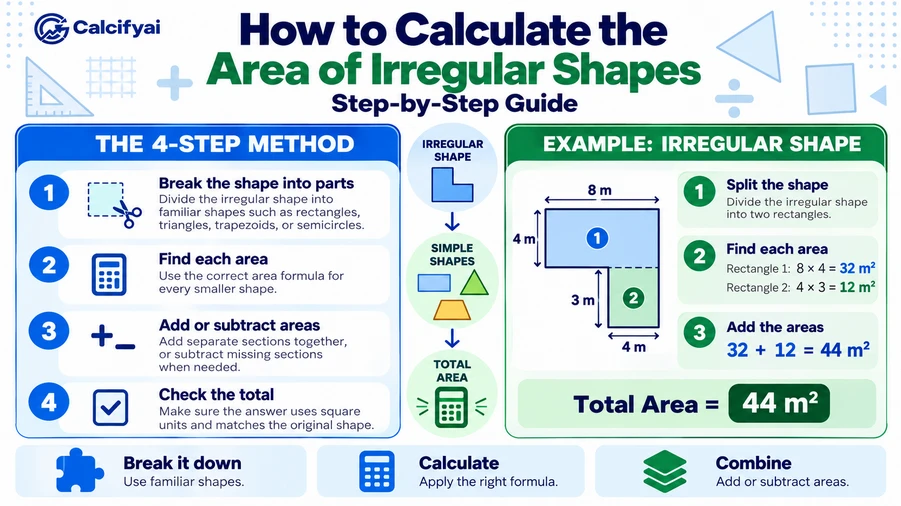
Break the shape into smaller parts → Find each area → Add or subtract the areas.
How to Find the Area of an Irregular Shape
Follow these steps to calculate the area of an irregular figure.
Step 1: Examine the Shape
First, look carefully at the entire figure.
Try to identify familiar shapes inside it, such as:
Rectangles
Squares
Triangles
Trapezoids
Parallelograms
Semicircles
The goal is to find shapes with area formulas you already know.
Step 2: Divide the Shape Into Smaller Parts
Draw lines through the figure to separate it into simpler shapes.
You can use actual lines on a diagram or imagine where the shape could be divided.
For example, an L-shaped figure can often be divided into two rectangles.
A more complicated figure might contain a rectangle, triangle, and trapezoid.
Step 3: Record the Measurements
Write down the measurements needed for each smaller shape.
Depending on the shape, you may need:
Length
Width
Base
Height
Radius
Make sure the measurements use the same unit before starting the calculation.
Step 4: Calculate Each Area
Use the appropriate formula for every section.
For a quick reference to standard area formulas for common geometric shapes, see the Area Formula Cheat Sheet.
For example:
Rectangle:
Area = length × width
Triangle:
Area = 1/2 × base × height
Square:
Area = side × side
Trapezoid:
Area = 1/2 × (base 1 + base 2) × height
Step 5: Add or Subtract the Areas
If all the smaller shapes make up the entire figure, add their areas together.
If the irregular shape is created by removing a smaller section from a larger shape, subtract the missing area.
Step 6: Check Your Answer
Before writing your final answer, check:
Are all measurements in the same unit?
Did you use the correct formula?
Did you count every section only once?
Did you subtract any missing section?
Is your final answer written in square units?
Method 1: Divide an Irregular Shape Into Rectangles
Dividing an irregular figure into rectangles is one of the simplest methods.
Example: Two Rectangles
Suppose an irregular shape can be divided into two rectangles.
Rectangle 1
Length = 8 m
Width = 4 m
Area = 8 × 4 = 32 m²
Rectangle 2
Length = 5 m
Width = 3 m
Area = 5 × 3 = 15 m²
Now add the two areas:
Total area = 32 + 15 = 47 m²
Therefore, the total area of the irregular shape is 47 m².
Method 2: Divide the Shape Into a Rectangle and Triangle
Some irregular shapes contain both rectangular and triangular sections.
Calculate the area of each section separately and then add the results.
Rectangle Area
Area = length × width
Triangle Area
Area = 1/2 × base × height
Example: Rectangle and Triangle
Suppose:
Rectangle length = 10 cm
Rectangle width = 6 cm
Triangle base = 10 cm
Triangle height = 4 cm
First calculate the rectangle:
10 × 6 = 60 cm²
Now calculate the triangle:
1/2 × 10 × 4 = 20 cm²
Add the two areas:
60 + 20 = 80 cm²
Therefore, the total area is 80 cm².
Method 3: Subtract a Missing Section
Another useful method is to imagine the irregular figure as a large simple shape with a smaller section removed.
Calculate the complete shape first, then subtract the missing part.
Example: Missing Rectangle
Suppose the large rectangle has:
Length = 12 m
Width = 10 m
Large area:
12 × 10 = 120 m²
Now suppose a smaller rectangle is removed.
Missing rectangle:
Length = 4 m
Width = 3 m
Missing area:
4 × 3 = 12 m²
Subtract the missing area:
120 − 12 = 108 m²
Therefore, the area of the irregular shape is 108 m².
Method 4: Add Several Triangles
Some irregular figures can be divided into multiple triangles.
Example: Three Triangles
Suppose the three sections have these areas:
Triangle 1 = 20 cm²
Triangle 2 = 12 cm²
Triangle 3 = 15 cm²
Add them:
20 + 12 + 15 = 47 cm²
Therefore, the total area is 47 cm².
How to Find the Area of an L-Shaped Figure
An L-shaped figure is a common example of an irregular shape.
There are two common ways to calculate its area:
Divide the figure into two rectangles.
Find the area of the large rectangle and subtract the missing rectangle.
Example: L-Shaped Figure
Suppose the large rectangle has:
Length = 10 m
Width = 8 m
Large area:
10 × 8 = 80 m²
The missing section has:
Length = 4 m
Width = 3 m
Missing area:
4 × 3 = 12 m²
Now subtract:
80 − 12 = 68 m²
Therefore, the area of the L-shaped figure is 68 m².
How to Calculate the Area of Irregular Shapes With Curved Parts
Some irregular figures contain curved sections. If the curved section is a semicircle, you can calculate it using the circle formula.
Area of a Circle
Area = π × radius × radius
Area of a Semicircle
Area = 1/2 × π × radius × radius
If an irregular figure contains a rectangle and a semicircle, calculate both areas separately and then add them.
For school-level calculations, π is often approximated as 3.14, unless the problem provides another value.
How to Find the Area of an Irregular Polygon
An irregular polygon has sides and angles that do not follow the regular pattern of shapes such as squares or regular pentagons.
Before using a more advanced method, check whether the polygon can be divided into familiar shapes.
For example, a polygon might be separated into:
Rectangles
Triangles
Trapezoids
Calculate each section and add the results.
Using Coordinates for Complex Polygons
If the vertices of an irregular polygon are given on a coordinate plane, coordinates can also be used to calculate its area.
This approach is useful for more advanced geometry problems. For basic problems, however, dividing the figure into simpler shapes is often easier to understand.
Is There a General Formula for Irregular Shapes?
There is no single area formula that works for every irregular shape.
The method depends on the structure of the figure and the measurements provided.
When Dividing the Shape
Use:
Total area = Area 1 + Area 2 + Area 3 + ...
This method works when the smaller shapes together form the entire figure.
When Removing a Section
Use:
Total area = Large area − Missing area
This method works when the irregular figure can be created by removing a smaller shape from a larger one.
More Complex Irregular Shape Example
Consider a figure divided into three sections:
Rectangle 1: 12 m × 5 m
Rectangle 2: 6 m × 3 m
Triangle: base 6 m and height 4 m
Step-by-Step Calculation
Rectangle 1:
12 × 5 = 60 m²
Rectangle 2:
6 × 3 = 18 m²
Triangle:
1/2 × 6 × 4 = 12 m²
Now add the three sections:
60 + 18 + 12 = 90 m²
Therefore, the total area is 90 m².
What If a Measurement Is Missing?
Sometimes an irregular-shape problem does not provide every measurement directly.
You may need to calculate a missing length before finding the area.
For example, suppose the total length is 15 m and one section measures 6 m.
Missing length:
15 − 6 = 9 m
Once the missing measurement is known, you can use it in the appropriate area formula.
Why Is Area Measured in Square Units?
Area measures the surface covered by a two-dimensional figure.
For example:
1 cm × 1 cm = 1 cm²
The multiplication of two lengths produces a square unit.
Common area units include:
cm²
m²
in²
ft²
Remember that cm and m are units of length, while cm² and m² are units of area.
Common Mistakes When Finding the Area of Irregular Shapes
Adding Lengths Instead of Areas
Adding the side lengths calculates the perimeter, not the area.
Using the Wrong Formula
Identify each smaller shape before choosing its formula.
Forgetting to Subtract a Missing Section
If you calculate the area of a large rectangle first, make sure you subtract any part that has been removed.
Mixing Measurement Units
Do not use centimeters and meters in the same calculation without converting them first.
Forgetting Square Units
Always express the final area using square units.
Double-Counting a Section
When dividing a figure, make sure every section is counted exactly once.
Quick Method to Remember
A simple way to remember how to calculate the area of an irregular shape is:
Break It → Calculate It → Combine It
Break It
Divide the irregular figure into familiar shapes.
Calculate It
Find the area of each smaller section.
Combine It
Add the areas or subtract the missing section.
Real-Life Uses of Irregular Shape Area
Calculating irregular areas is useful in many everyday situations.
Examples include:
Measuring unusual rooms
Planning gardens
Estimating flooring materials
Measuring land
Planning outdoor spaces
Estimating construction materials
Designing buildings
Measuring irregular fields
Frequently Asked Questions
What Is the Easiest Way to Find the Area of an Irregular Shape?
The easiest method is usually to divide the figure into smaller familiar shapes, calculate each area, and then add the results.
Can I Calculate an Irregular Shape by Subtraction?
Yes. If the figure can be placed inside a larger simple shape, calculate the larger area and subtract the section that is not part of the figure.
What Units Are Used for Irregular Shape Area?
Area is measured in square units, including cm², m², ft², and in².
Can an Irregular Shape Contain Triangles and Rectangles?
Yes. An irregular figure can often be divided into triangles, rectangles, squares, trapezoids, and other familiar shapes.
What Is the Difference Between Area and Perimeter?
Area measures the space inside a shape, while perimeter measures the distance around its outside boundary.
Can Coordinates Be Used to Find the Area of an Irregular Polygon?
Yes. Coordinate-based methods can be used for polygons when the coordinates of their vertices are known. For beginner-level problems, decomposition into familiar shapes is often simpler.
Final Takeaway
The easiest way to calculate the area of irregular shapes is to avoid looking for one complicated formula. Instead, break the figure into smaller shapes that you already know how to calculate.
Disclaimer
The information provided in this article is for educational and informational purposes only. It should not be considered as professional financial, medical, or legal advice. Always consult with qualified professionals for specific guidance related to your situation.
Popular Calculators
Explore our most-used free calculators for finance, health, and everyday needs.