
Area Formula Cheat Sheet: Essential Geometry Formulas You Should Know
Learn every important area formula with this easy cheat sheet. Find formulas, examples, tips, and calculate areas quickly for common geometric shapes.
Calcifyai Team
Expert calculators & financial tools
Whether you're solving math problems, preparing for exams, planning a home improvement project, or measuring land, knowing the correct area formula makes calculations much easier. This Area Formula Cheat Sheet brings together the most commonly used formulas in one place, so you can quickly find the right equation whenever you need it.
Instead of memorizing every formula, bookmark this guide for quick reference and practical examples.
What Is Area?
Area is the amount of space inside a two-dimensional (2D) shape. It is measured in square units, such as square centimeters (cm²), square meters (m²), square feet (ft²), or square inches (in²).
Each geometric shape has its own formula for calculating area. Understanding these formulas is useful for students, teachers, engineers, architects, contractors, and anyone working with measurements.
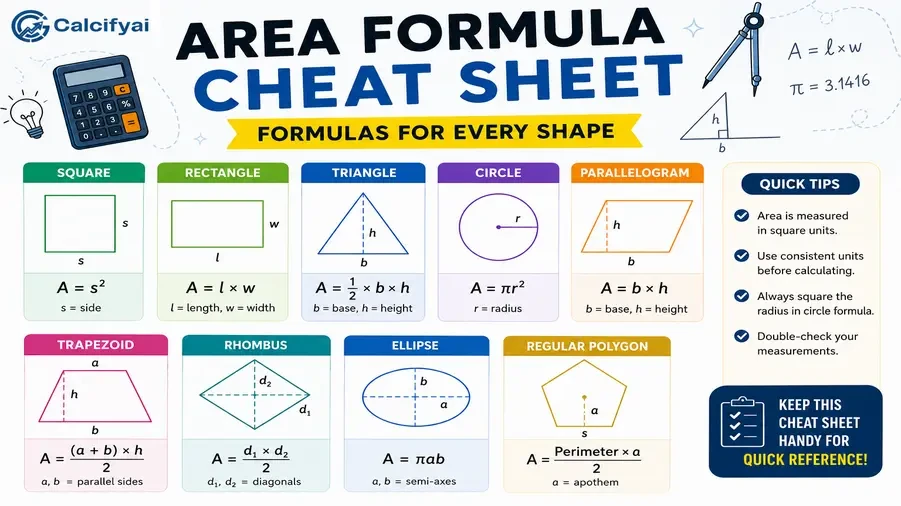
Area Formula Cheat Sheet
Shape | Formula |
Square | A = s² |
Rectangle | A = l × w |
Triangle | A = ½ × b × h |
Circle | A = πr² |
Parallelogram | A = b × h |
Trapezoid | A = ((a + b) × h) ÷ 2 |
Rhombus | A = (d₁ × d₂) ÷ 2 |
Ellipse | A = πab |
Regular Polygon | A = (Perimeter × Apothem) ÷ 2 |
Rectangle Area Formula
The area of a rectangle is found by multiplying its length by its width.
Formula
Area = Length × Width
Example
Length = 12 m
Width = 8 m
Area = 12 × 8 = 96 m²
If you want to calculate the area of rectangles, squares, circles, triangles, and many other shapes without doing the math yourself, try our Area Calculator. It provides instant and accurate results, making geometry calculations much faster.
Square Area Formula
A square has four equal sides.
Formula
Area = Side²
Example
Side = 7 cm
Area = 49 cm²
Triangle Area Formula
The area of a triangle is half the product of its base and height.
Formula
Area = ½ × Base × Height
Example
Base = 10 cm
Height = 6 cm
Area = 30 cm²
Circle Area Formula
The area of a circle depends on its radius.
Formula
Area = πr²
Example
Radius = 5 cm
Area ≈ 78.54 cm²
Parallelogram Area Formula
Formula
Area = Base × Height
Example
Base = 15 m
Height = 9 m
Area = 135 m²
Trapezoid Area Formula
Formula
Area = ((a + b) × h) ÷ 2
Example
Parallel sides = 8 cm and 12 cm
Height = 5 cm
Area = 50 cm²
Rhombus Area Formula
Formula
Area = (Diagonal₁ × Diagonal₂) ÷ 2
Example
Diagonal₁ = 10 cm
Diagonal₂ = 12 cm
Area = 60 cm²
Ellipse Area Formula
Formula
Area = πab
Example
Semi-major axis = 8 cm
Semi-minor axis = 5 cm
Area ≈ 125.66 cm²
Common Mistakes to Avoid
Many calculation errors happen because of small mistakes. Keep these points in mind:
Don't confuse perimeter with area.
Always write the answer in square units.
Use the radius not the diameter in the circle formula.
Make sure all measurements use the same unit before calculating.
Double-check your multiplication before writing the final answer.
When working with different measurement units such as square feet, square meters, acres, hectares, inches, or centimeters, convert them first using our Unit Converter Calculator. It helps ensure your area calculations remain accurate and consistent.
Where Are Area Formulas Used?
Area calculations are used in many everyday situations, including:
Measuring rooms before installing flooring
Estimating paint coverage
Planning gardens and landscaping
Buying construction materials
Surveying land
Engineering and architectural drawings
School assignments and competitive exams
Manual Calculation vs Online Calculator
Manual Calculation | Online Calculator |
Requires remembering formulas | No formulas to memorize |
Takes more time | Instant results |
Higher chance of mistakes | More accurate calculations |
Good for learning | Ideal for everyday use |
Related Reading: If you're learning geometry and basic mathematics, you may also enjoy reading What Is a Factor in Math? A Beginner's Guide, where you'll learn how factors work, why they're important, and how they apply to everyday math problems.
Frequently Asked Questions
What is the easiest area formula to remember?
The rectangle formula (Length × Width) is usually the simplest and serves as the basis for understanding many other area formulas.
Why is area measured in square units?
Because area measures a two-dimensional surface, it is always expressed in square units such as cm², m², or ft².
What is the difference between area and perimeter?
Area measures the space inside a shape, while perimeter measures the total distance around the shape.
Which area formulas are used most often?
The formulas for rectangles, squares, triangles, and circles are the most commonly used in schools, construction, engineering, and everyday measurements.
Can I calculate area without memorizing formulas?
Yes. Online calculators make it easy to calculate the area of different shapes in seconds, even if you don't remember every formula.
Conclusion
Having an Area Formula Cheat Sheet makes geometry much easier to understand and apply. Whether you're studying for an exam, working on a construction project, or simply measuring spaces around your home, these formulas help you calculate areas quickly and accurately.
For even faster results, use the Area Calculator to find the area of various shapes instantly, and the Unit Converter Calculator whenever you need to convert measurement units before calculating.
Disclaimer
The information provided in this article is for educational and informational purposes only. It should not be considered as professional financial, medical, or legal advice. Always consult with qualified professionals for specific guidance related to your situation.
Popular Calculators
Explore our most-used free calculators for finance, health, and everyday needs.