
Prime Factors vs Common Factors Explained
Learn the difference between prime factors and common factors with simple examples, definitions, comparisons, and easy methods to solve math problems.
Calcifyai Team
Expert calculators & financial tools
Mathematics is full of concepts that sound similar but have different meanings. One common point of confusion is the difference between prime factors and common factors. Although both involve factors, they are used for different purposes and appear in different types of math problems.
Understanding this difference can help you simplify fractions, solve algebra problems, find the Greatest Common Factor (GCF), and work with prime factorization more confidently.
In this guide, you'll learn what prime factors and common factors are, how to find them, when to use each one, and why they matter in everyday mathematics.
What Are Prime Factors?
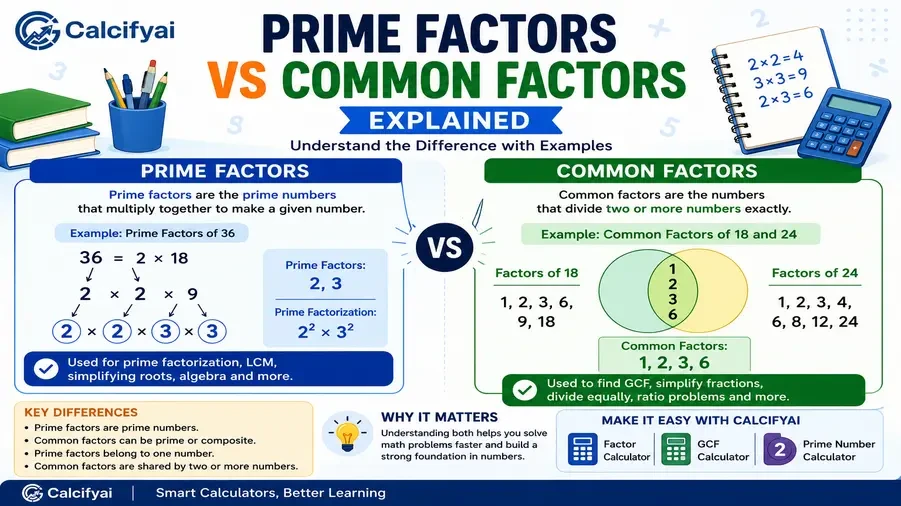
A prime factor is a factor of a number that is also a prime number.
A prime number has exactly two positive factors: 1 and itself.
Example: Prime Factors of 36
Let's break down 36 into prime numbers.
36 = 2 × 18
18 = 2 × 9
9 = 3 × 3
So,
36 = 2 × 2 × 3 × 3
Therefore, the prime factors of 36 are:
2 and 3
Notice that we only list the unique prime numbers, while the complete prime factorization is:
2² × 3²
If you need to verify whether a number is prime before factorizing it, our Prime Number Calculator makes it quick and easy.
What Are Common Factors?
A common factor is a number that divides two or more numbers exactly.
Instead of looking at a single number, common factors compare multiple numbers.
Example: Common Factors of 18 and 24
Factors of 18:
1, 2, 3, 6, 9, 18
Factors of 24:
1, 2, 3, 4, 6, 8, 12, 24
The numbers that appear in both lists are:
1, 2, 3, and 6
These are the common factors of 18 and 24.
Prime Factors vs Common Factors
Prime Factors | Common Factors |
Belong to one number | Compare two or more numbers |
Must always be prime numbers | Can be prime or composite numbers |
Used in prime factorization | Used to find common divisors |
Help simplify mathematical expressions | Help calculate the Greatest Common Factor (GCF) |
Key Differences Explained
Prime Factors
Prime factors answer the question:
"Which prime numbers multiply together to make this number?"
Example:
Prime factorization of 60
60 = 2 × 2 × 3 × 5
Prime factors:
2, 3, and 5
Common Factors
Common factors answer a different question:
"Which numbers divide all of these numbers evenly?"
Example:
Numbers: 20 and 30
Factors of 20
1, 2, 4, 5, 10, 20
Factors of 30
1, 2, 3, 5, 6, 10, 15, 30
Common factors:
1, 2, 5, and 10
How to Find Prime Factors
Finding prime factors is simple.
Step 1
Start with the smallest prime number (2).
Step 2
Keep dividing until the quotient becomes 1.
Example
Prime factorization of 72
72
↓
2 × 36
↓
2 × 18
↓
2 × 9
↓
3 × 3
↓
3 × 1
Final answer:
72 = 2³ × 3²
How to Find Common Factors
To find common factors:
Step 1
List all factors of each number.
Step 2
Identify the numbers that appear in every list.
Example
Numbers:
28 and 42
Factors of 28
1, 2, 4, 7, 14, 28
Factors of 42
1, 2, 3, 6, 7, 14, 21, 42
Common factors:
1, 2, 7, and 14
If you frequently solve these types of problems, our Factor Calculator can instantly list every factor of any number, making comparisons much faster.
When Do You Use Prime Factors?
Prime factors are commonly used for:
Prime factorization
Simplifying square roots
Finding LCM and GCF
Algebra
Number theory
Cryptography
When Do You Use Common Factors?
Common factors are useful for:
Simplifying fractions
Finding the Greatest Common Factor
Dividing quantities equally
Solving ratio problems
Geometry
Algebra
Real-Life Example
Imagine two ropes measuring 18 meters and 24 meters.
You want to cut both into equal-length pieces without any leftover rope.
The possible lengths are the common factors:
1, 2, 3, and 6
The longest possible equal length is 6 meters, which is the Greatest Common Factor.
You can quickly find this value using our Greatest Common Factor Calculator when working with larger numbers.
Common Mistakes
Thinking Prime Factors and Common Factors Are the Same
They are related but solve different problems.
Assuming Every Factor Is Prime
Composite numbers like 4, 6, and 12 are factors but not prime factors.
Forgetting the Number 1
Every whole number includes 1 as a factor.
However, 1 is not a prime number, so it is never considered a prime factor.
Practice Questions
1. What are the prime factors of 45?
Answer:
45 = 3 × 3 × 5
Prime factors:
3 and 5
2. What are the common factors of 12 and 18?
Factors of 12
1, 2, 3, 4, 6, 12
Factors of 18
1, 2, 3, 6, 9, 18
Common factors:
1, 2, 3, and 6
3. Which is a prime factor of 56?
56 = 2 × 2 × 2 × 7
Answer:
2 and 7
Frequently Asked Questions
What is the difference between prime factors and common factors?
Prime factors are prime numbers that multiply together to form a single number. Common factors are numbers that divide two or more numbers exactly.
Can a common factor also be a prime factor?
Yes. For example, 2 is a prime factor of 12 and is also a common factor of 12 and 18.
Is 1 a prime factor?
No. Although 1 is a factor of every whole number, it is not a prime number.
Why are common factors important?
They help simplify fractions, divide quantities equally, and calculate the Greatest Common Factor (GCF).
What is prime factorization?
Prime factorization is the process of expressing a number as the product of only prime numbers.
Final Thoughts
Understanding the difference between prime factors and common factors makes many areas of mathematics easier, from simplifying fractions to solving algebraic equations. While prime factors explain how a single number is built using prime numbers, common factors help compare two or more numbers and identify values they share.
Disclaimer
The information provided in this article is for educational and informational purposes only. It should not be considered as professional financial, medical, or legal advice. Always consult with qualified professionals for specific guidance related to your situation.
Popular Calculators
Explore our most-used free calculators for finance, health, and everyday needs.