
Area vs Perimeter: What's the Difference?
Learn the difference between area and perimeter with simple formulas, examples, real-life uses, and tips to solve geometry problems accurately.
Calcifyai Team
Expert calculators & financial tools
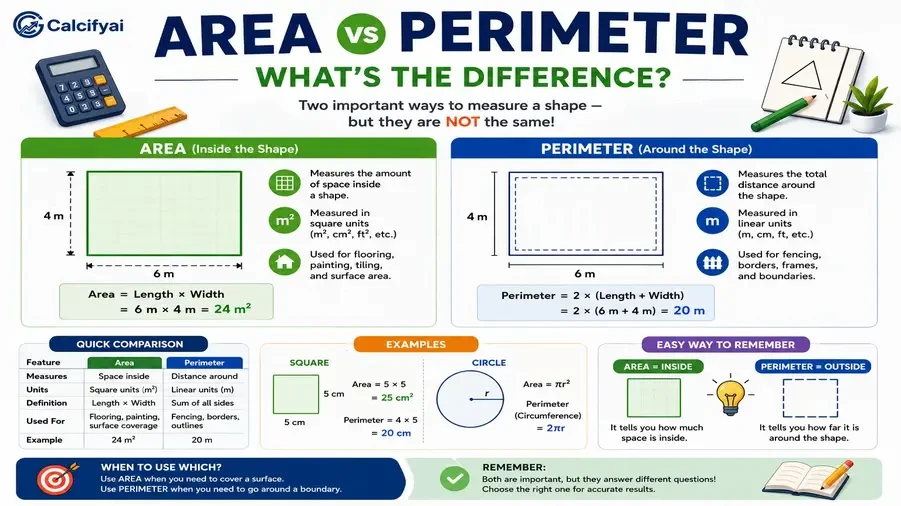
Area and perimeter are two of the most fundamental concepts in geometry, yet they're often confused because they both involve measuring shapes. The key difference is simple: area measures the space inside a shape, while perimeter measures the distance around its boundary.
Whether you're solving a math problem, installing flooring, painting a room, or building a fence, knowing when to use area or perimeter helps you make accurate calculations. In this guide, you'll learn the differences, formulas, practical examples, and real-world uses of both concepts.
What Is Area?
Area is the amount of space enclosed within a two-dimensional shape. It tells you how much surface a shape covers and is always measured in square units.
Examples of square units include:
Square centimeters (cm²)
Square meters (m²)
Square feet (ft²)
Square inches (in²)
You use area whenever you need to know how much surface needs to be covered, such as flooring, paint, tiles, or grass.
If you want to skip manual calculations, try our Area Calculator, which instantly calculates the area of rectangles, circles, triangles, trapezoids, and many other shapes.
What Is Perimeter?
Perimeter is the total distance around the outside edge of a two-dimensional shape. Unlike area, perimeter is measured in linear units, not square units.
Common units include:
Centimeters (cm)
Meters (m)
Feet (ft)
Inches (in)
Perimeter is useful when measuring boundaries, borders, or edges.
For example, you calculate perimeter when determining:
The length of a fence
The border around a garden
The frame around a picture
The edge of a swimming pool
Area vs Perimeter: Key Differences
Feature | Area | Perimeter |
Measures | Space inside a shape | Distance around a shape |
Unit | Square units (cm², m², ft²) | Linear units (cm, m, ft) |
Used For | Flooring, painting, tiling | Fencing, borders, framing |
Formula Example | Length × Width | 2 × (Length + Width) |
Common Formulas
Rectangle
Area
Length × Width
Perimeter
2 × (Length + Width)
Example
Length = 12 m
Width = 8 m
Area = 96 m²
Perimeter = 40 m
Square
Area
Side × Side
Perimeter
4 × Side
Example
Side = 6 cm
Area = 36 cm²
Perimeter = 24 cm
Triangle
Area
½ × Base × Height
Perimeter
Side₁ + Side₂ + Side₃
Example
Base = 10 cm
Height = 8 cm
Sides = 10 cm, 9 cm, 7 cm
Area = 40 cm²
Perimeter = 26 cm
Circle
Area
π × Radius²
Perimeter (Circumference)
2 × π × Radius
Example
Radius = 7 cm
Area ≈ 153.94 cm²
Circumference ≈ 43.98 cm
When Should You Use Area?
Area is used whenever you need to measure a surface.
Common examples include:
Installing tiles
Buying carpet
Painting walls
Measuring farmland
Planning a garden
Roofing projects
When Should You Use Perimeter?
Perimeter is used whenever you're measuring the boundary or edge of something.
Examples include:
Building a fence
Installing decorative borders
Framing artwork
Measuring property boundaries
Designing running tracks
Simple Trick to Remember the Difference
A quick way to remember is:
Area = Inside
Perimeter = Outside
Think of a swimming pool.
The water inside the pool represents the area.
The fence surrounding the pool represents the perimeter.
This simple comparison makes it much easier to remember which calculation to use.
Common Mistakes to Avoid
Many students and beginners make similar mistakes when learning geometry. Here are a few to watch out for:
Using the perimeter formula when the question asks for area.
Forgetting that area uses square units.
Mixing different measurement units in one calculation.
Using the diameter instead of the radius for circle area.
Forgetting to add all sides when calculating perimeter.
Before performing calculations, make sure all measurements use the same unit. If your values are in different units, use our Unit Converter Calculator to convert them accurately before calculating area or perimeter.
Area vs Perimeter in Everyday Life
Situation | Use Area | Use Perimeter |
Buying flooring | ✅ | ❌ |
Painting a room | ✅ | ❌ |
Installing carpet | ✅ | ❌ |
Building a fence | ❌ | ✅ |
Measuring garden borders | ❌ | ✅ |
Calculating land coverage | ✅ | ❌ |
Measuring picture frame length | ❌ | ✅ |
Why Understanding the Difference Is Important
Knowing the difference between area and perimeter helps you:
Solve geometry questions accurately.
Avoid purchasing too much or too little material.
Improve math and engineering skills.
Complete DIY and home improvement projects confidently.
Make better construction and landscaping estimates.
If you'd like to learn more geometry formulas, check out our Area Formula Cheat Sheet, where you'll find formulas for squares, rectangles, circles, triangles, trapezoids, rhombuses, ellipses, and many other shapes in one convenient guide.
Frequently Asked Questions
What is the main difference between area and perimeter?
Area measures the amount of space inside a shape, while perimeter measures the total distance around its outer boundary.
Why is area measured in square units?
Because area represents a two-dimensional surface, it is always expressed in square units such as cm², m², or ft².
Is perimeter ever measured in square units?
No. Perimeter is a one-dimensional measurement and is always measured using linear units such as centimeters, meters, feet, or inches.
Can two shapes have the same perimeter but different areas?
Yes. Different shapes can have the same perimeter while enclosing different amounts of space.
Which is more useful in daily life?
Both are important. Area is commonly used for flooring, painting, and landscaping, while perimeter is essential for fencing, framing, and measuring boundaries.
Conclusion
Although area and perimeter are closely related, they measure two completely different aspects of a shape. Area tells you how much space is inside, while perimeter tells you how far it is around the outside.
Understanding this distinction helps you solve geometry problems correctly and make accurate decisions in everyday situations, from home improvement projects to construction planning.
Disclaimer
The information provided in this article is for educational and informational purposes only. It should not be considered as professional financial, medical, or legal advice. Always consult with qualified professionals for specific guidance related to your situation.
Popular Calculators
Explore our most-used free calculators for finance, health, and everyday needs.