
What Is Factorization in Mathematics?
Learn what factorization is in mathematics, how to factorize numbers and expressions, explore prime factorization, examples, and practical uses.
Calcifyai Team
Expert calculators & financial tools
Factorization is one of the most important concepts in mathematics because it helps break numbers and algebraic expressions into smaller, simpler parts. Whether you're simplifying fractions, solving equations, finding the Greatest Common Factor (GCF), or learning algebra, understanding factorization in mathematics is an essential skill.
Simply put, factorization means expressing a number or an algebraic expression as the product of its factors.
For example:
24 = 2 × 2 × 2 × 3
Here, 24 has been factorized into its prime factors.
In this guide, you'll learn what factorization is, why it's important, different methods of factorization, real-life examples, and common mistakes to avoid.
What Is Factorization?
Factorization is the process of breaking a number or expression into smaller factors that multiply together to produce the original value.
For example:
12 = 2 × 6
12 = 3 × 4
Prime Factorization of 12 = 2 × 2 × 3
Similarly, algebraic expressions can also be factorized.
Example:
x² + 5x + 6
can be factorized as:
(x + 2)(x + 3)
Factorization makes complex calculations much easier and is widely used in mathematics, engineering, finance, and computer science.
Why Is Factorization Important?
Learning factorization helps you:
Solve algebraic equations
Simplify fractions
Find the Greatest Common Factor (GCF)
Calculate the Least Common Multiple (LCM)
Understand prime numbers
Simplify square roots
Improve problem-solving skills
Because factorization is used throughout mathematics, it's considered one of the foundational topics students should master.
Types of Factorization
There are several ways to factorize numbers and expressions.
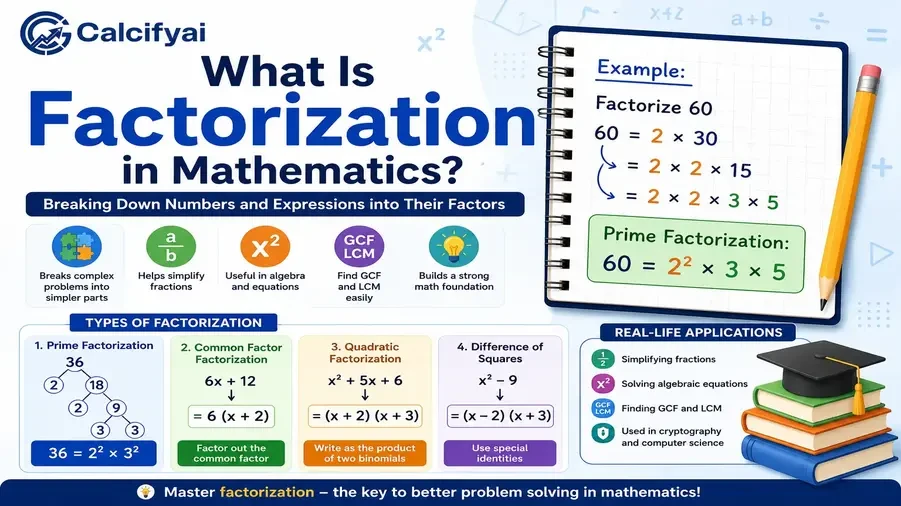
1. Prime Factorization
Prime factorization expresses a number as the product of only prime numbers.
Example
Factorize 60.
60
↓
2 × 30
↓
2 × 15
↓
3 × 5
Final Answer:
60 = 2² × 3 × 5
If you want to verify prime numbers before factorizing, our Prime Number Calculator can quickly determine whether a number is prime.
2. Factorization Using Common Factors
When working with algebraic expressions, you often factor out the greatest common factor.
Example:
6x + 12
Both terms contain 6.
Factorized form:
6(x + 2)
3. Factorization of Quadratic Expressions
Quadratic expressions can often be written as the product of two binomials.
Example:
x² + 7x + 12
Factorized form:
(x + 3)(x + 4)
This method is commonly used in algebra and equation solving.
How to Factorize a Number
Follow these simple steps.
Step 1
Start with the smallest prime number, which is 2.
Step 2
Divide the number until it is no longer divisible.
Step 3
Continue dividing by the next prime numbers (3, 5, 7, etc.).
Example
Factorize 84.
84 = 2 × 42
42 = 2 × 21
21 = 3 × 7
Final Answer:
84 = 2² × 3 × 7
Factorization Examples
Number | Factorized Form |
18 | 2 × 3² |
24 | 2³ × 3 |
36 | 2² × 3² |
45 | 3² × 5 |
72 | 2³ × 3² |
100 | 2² × 5² |
Real-Life Applications of Factorization
Factorization is used in many practical situations.
Simplifying Fractions
Example:
24/36
Prime factorization helps cancel common factors.
Final Answer:
2/3
Solving Algebra Problems
Many quadratic equations become easier after factorization.
Example:
x² − 9
↓
(x − 3)(x + 3)
Finding the Greatest Common Factor
Finding common factors is much easier after factorization. If you're comparing multiple numbers, our factoring calculator instantly lists all factors, making the process faster and more accurate.
Cryptography and Computer Science
Prime factorization is widely used in encryption algorithms that protect online banking, passwords, and secure communications.
Common Mistakes During Factorization
Forgetting Prime Numbers
Prime factorization must end with only prime numbers.
Incorrect:
24 = 4 × 6
Correct:
24 = 2³ × 3
Missing Common Factors
Always check whether every term has a common factor before factorizing algebraic expressions.
Confusing Factors and Multiples
Factors divide a number exactly.
Multiples are obtained by multiplication.
Stopping Too Early
Continue dividing until every remaining factor is a prime number.
Practice Questions
1. Factorize 48.
Answer:
48 = 2⁴ × 3
2. Factorize 90.
Answer:
90 = 2 × 3² × 5
3. Factorize x² + 9x + 20.
Answer:
(x + 4)(x + 5)
4. Factorize 54.
Answer:
54 = 2 × 3³
Frequently Asked Questions
What is factorization in mathematics?
Factorization is the process of expressing a number or algebraic expression as the product of smaller factors.
What is prime factorization?
Prime factorization breaks a number into prime numbers that multiply together to produce the original number.
Why is factorization important?
It helps simplify fractions, solve algebraic equations, calculate GCF and LCM, simplify square roots, and understand number relationships.
What is the difference between factors and factorization?
Factors are the numbers that divide another number exactly, while factorization is the process of finding and expressing those factors.
Can algebraic expressions be factorized?
Yes. Expressions such as quadratics, polynomials, and algebraic equations can often be rewritten as the product of simpler expressions.
Final Thoughts
Understanding factorization in mathematics builds a strong foundation for arithmetic, algebra, and advanced mathematical concepts. Whether you're working with numbers or algebraic expressions, knowing how to factorize helps simplify calculations and solve problems more efficiently.
Disclaimer
The information provided in this article is for educational and informational purposes only. It should not be considered as professional financial, medical, or legal advice. Always consult with qualified professionals for specific guidance related to your situation.
Popular Calculators
Explore our most-used free calculators for finance, health, and everyday needs.