
What Is a Factor in Math? A Beginner's Guide
Learn what a factor is in math, how to find factors, factor pairs, and prime factors with simple examples. Master the basics with this beginner-friendly guide.
Calcifyai Team
Expert calculators & financial tools
If you're learning basic math, you've probably come across the word factor. Understanding what is a factor in math is one of the first steps toward mastering multiplication, division, fractions, algebra, and many other mathematical concepts.
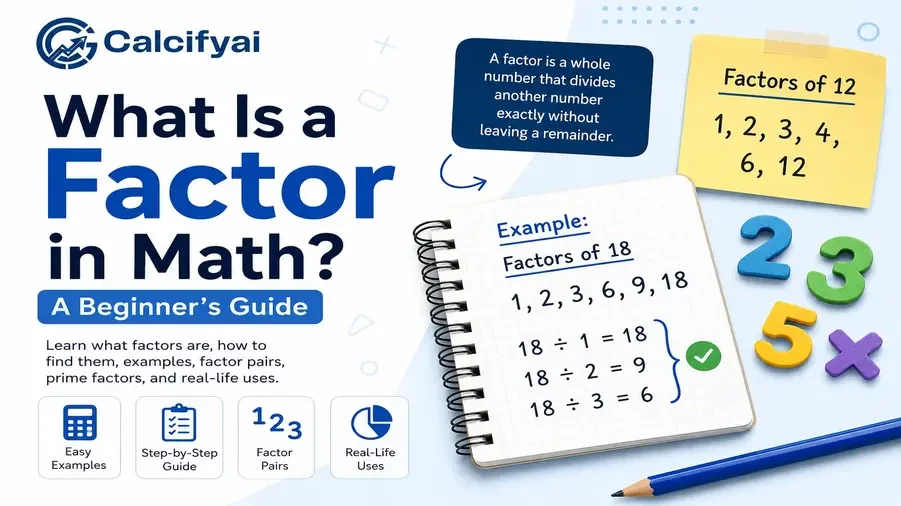
Simply put, a factor is a whole number that divides another number exactly without leaving a remainder. Once you understand how factors work, solving math problems becomes much easier.
In this beginner-friendly guide, you'll learn what factors are, how to find them, factor pairs, prime factors, common mistakes, practical examples, and real-life applications.
What Is a Factor in Math?
A factor is a whole number that divides another whole number evenly, meaning the remainder is always zero.
For example, the factors of 12 are:
1, 2, 3, 4, 6, and 12
Each of these numbers divides 12 exactly:
12 ÷ 1 = 12
12 ÷ 2 = 6
12 ÷ 3 = 4
12 ÷ 4 = 3
12 ÷ 6 = 2
12 ÷ 12 = 1
Since none of these divisions leaves a remainder, they are all factors of 12.
Another way to think about factors is through multiplication.
For example:
4 × 5 = 20
Both 4 and 5 are factors of 20 because they multiply together to produce 20.
Simple Examples of Factors
Number | Factors |
6 | 1, 2, 3, 6 |
8 | 1, 2, 4, 8 |
10 | 1, 2, 5, 10 |
15 | 1, 3, 5, 15 |
18 | 1, 2, 3, 6, 9, 18 |
24 | 1, 2, 3, 4, 6, 8, 12, 24 |
How to Find the Factors of a Number
Finding factors is straightforward if you follow these simple steps.
Step 1: Start with 1
Every whole number has 1 as a factor.
Step 2: Divide the Number
Divide the number by each whole number one at a time.
If the remainder is 0, that number is a factor.
Step 3: Continue Until the Square Root
Once the factor pairs begin repeating, you've found all the factors.
Example: Find the Factors of 24
24 ÷ 1 = 24 ✅
24 ÷ 2 = 12 ✅
24 ÷ 3 = 8 ✅
24 ÷ 4 = 6 ✅
24 ÷ 5 = 4.8 ❌
So the factors of 24 are:
1, 2, 3, 4, 6, 8, 12, 24
If you want to save time or verify your answer, try our Factor Calculator, which instantly finds all factors of any number.
What Are Factor Pairs?
A factor pair consists of two numbers that multiply together to produce a given number.
For example, the factor pairs of 36 are:
1 × 36
2 × 18
3 × 12
4 × 9
6 × 6
Learning factor pairs helps with multiplication, algebra, geometry, and simplifying equations.
What Are Prime Factors?
Some factors are prime numbers, meaning they can only be divided by 1 and themselves.
These are called prime factors.
Example: Prime Factorization of 60
60
↓
2 × 30
↓
2 × 2 × 15
↓
2 × 2 × 3 × 5
Prime factorization:
60 = 2² × 3 × 5
Every Number Has at Least Two Factors
Every whole number greater than 1 always has at least two factors:
1
The number itself
For example, the factors of 17 are:
1 and 17
Since it has only two factors, 17 is a prime number.
Factors vs Multiples
Many beginners confuse factors and multiples.
Factors | Multiples |
Divide a number exactly | Are obtained by multiplying a number |
Limited in quantity | Continue forever |
Always less than or equal to the number | Usually greater than or equal to the number |
For example, using 12:
Factors
1, 2, 3, 4, 6, 12
Multiples
12, 24, 36, 48, 60...
Real-Life Uses of Factors
Although factors are introduced in school mathematics, they are useful in many everyday situations.
Sharing Items Equally
Suppose you have 24 chocolates.
You can divide them equally into:
2 groups of 12
3 groups of 8
4 groups of 6
6 groups of 4
Factors help determine every possible equal grouping.
Simplifying Fractions
Consider the fraction:
18/24
The greatest common factor is 6.
Dividing both numbers by 6 gives:
3/4
Finding the greatest common factor becomes much easier with our GCF Calculator, especially when working with larger numbers.
Algebra and Geometry
Factoring is widely used to solve algebraic equations, simplify expressions, and calculate dimensions in geometry.
Common Mistakes Beginners Make
Using Decimals as Factors
Factors must always be whole numbers.
For example:
2.5 is not a factor of 10.
Forgetting 1
Every whole number has 1 as a factor.
Mixing Up Factors and Multiples
Remember:
Factors divide.
Multiples multiply.
Forgetting the Number Itself
Every number is always a factor of itself.
For example:
20 is a factor of 20.
Practice Questions
1. Find the factors of 16.
Answer:
1, 2, 4, 8, 16
2. Is 7 a factor of 42?
42 ÷ 7 = 6
Yes.
3. How many factors does 25 have?
Factors:
1, 5, 25
Answer: 3
4. Which number is not a factor of 30?
2
3
7
10
Answer: 7
Frequently Asked Questions
What is a factor in math?
A factor is a whole number that divides another whole number exactly without leaving a remainder.
How do you find factors?
Divide the number by whole numbers starting from 1. Any number that leaves a remainder of zero is a factor.
What is a factor pair?
A factor pair is a pair of numbers whose product equals a given number.
Example:
5 × 8 = 40
So, 5 and 8 are a factor pair of 40.
What are prime factors?
Prime factors are factors that are themselves prime numbers and cannot be divided further except by 1 and themselves.
What is the difference between a factor and a divisor?
There is no practical difference. A divisor is simply another name for a factor.
Final Thoughts
Understanding what is a factor in math provides a strong foundation for many mathematical concepts, including multiplication, division, fractions, algebra, and number theory. Once you learn how to identify factors and factor pairs, solving math problems becomes much easier.
Whether you're a student, parent, or teacher, practicing factors regularly will improve your mathematical confidence. And if you ever need quick, accurate results, CalcifyAI offers helpful tools like the Factor Calculator and GCF Calculator to make calculations faster and easier.
Disclaimer
The information provided in this article is for educational and informational purposes only. It should not be considered as professional financial, medical, or legal advice. Always consult with qualified professionals for specific guidance related to your situation.
Popular Calculators
Explore our most-used free calculators for finance, health, and everyday needs.