
How to Divide a Quantity in a Given Ratio (With Examples)
Learn how to divide in a ratio with simple formulas, step-by-step methods, real-life examples, and easy tips for solving ratio problems accurately.
Calcifyai Team
Expert calculators & financial tools
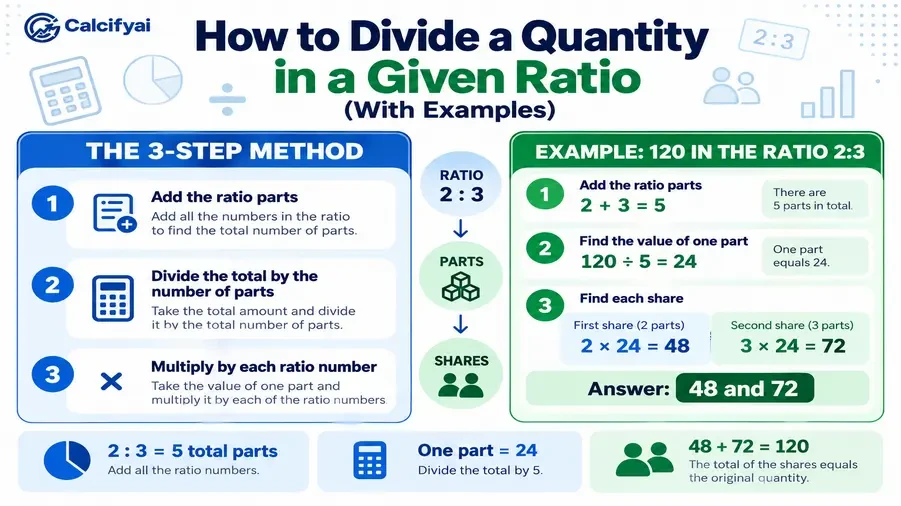
To divide a quantity in a given ratio is to split the total amount into parts that are in a specific proportional relationship.
For instance, when $120 is divided between two people in the ratio 2:3, the amounts they receive are not the same; the first person gets 2 parts and the second gets 3 parts.
The simplest method is to add up the parts of the ratio, divide the total by that sum, and then multiply each ratio number by this figure.
How to Divide a Quantity in a Ratio
Use these three steps:
Add all the numbers in the ratio.
Take the total amount and divide it by the number of parts.
Take the value of one part and multiply it by each of the ratio numbers.
If you want to check ratio relationships or work through related ratio calculations, you can also use the ratio calculator for quick and convenient calculations.
Formula
If a total quantity T is divided in the ratio a:b:
First Share = (a × T) ÷ (a + b)
Second Share = (b × T) ÷ (a + b)
When there are three or more parts, add up all the ratio values before dividing.
The method of working from the part to the whole is likewise applied in ordinary lessons on ratios when a certain quantity is to be divided in a given ratio.
Example 1: Divide $100 in the Ratio 2:3
Imagine that you have to split $100 between A and B in the ratio 2:3.
Step 1: Add the ratio parts
2 + 3 = 5
There are 5 parts in total.
Step 2: Find the value of one part
100 ÷ 5 = 20
Therefore, one portion is worth $20.
Step 3: Find each share
A receives 2 parts:
2 × 20 = 40
B receives 3 parts:
3 × 20 = 60
Answer
A = $40
B = $60
Check:
40 + 60 = 100
The total is correct.
Example 2: Divide 80 in the Ratio 3:5
Let's split 80 in the ratio 3:5.
Step 1: Add the parts
3 + 5 = 8
Step 2: Divide the total by 8
80 ÷ 8 = 10
One part equals 10.
Step 3: Multiply by each ratio number
First share:
3 × 10 = 30
Second share:
5 × 10 = 50
Answer
Dividing 80 in the ratio 3:5 results in 30 and 50.
Check:
30 + 50 = 80
Example 3: Divide $900 in the Ratio 2:3:4
A ratio may have three or more parts.
Let us divide $900 among three people in the ratio 2:3:4.
Step 1: Add all ratio parts
2 + 3 + 4 = 9
The number of parts is 9.
Step 2: Find the value of one part
900 ÷ 9 = 100
The value of one part is $100.
Step 3: Calculate each share
First person:
2 × 100 = 200
Second person:
3 × 100 = 300
Third person:
4 × 100 = 400
Answer
First person = $200
Second person = $300
Third person = $400
Check:
200 + 300 + 400 = 900
Example 4: Divide 75 in the Ratio 2:3
Suppose the total is 75 and the ratio is 2:3.
First, add the parts:
2 + 3 = 5
Then:
75 ÷ 5 = 15
One part is 15.
The two shares are:
2 × 15 = 30
and
3 × 15 = 45
Therefore:
75 = 30 + 45
So, 75 divided in the ratio 2:3 is 30 and 45.
A Quick Formula for Dividing a Quantity in a Ratio
A formula can also be used to solve ratio-sharing problems directly.
For a total T divided in the ratio a:b:
First Share = (a × T) ÷ (a + b)
Second Share = (b × T) ÷ (a + b)
Example
Split 500 in the ratio 3:2.
First share:
(3 × 500) ÷ (3 + 2) = 1,500 ÷ 5 = 300
Second share:
(2 × 500) ÷ (3 + 2) = 1,000 ÷ 5 = 200
Therefore, the answer is 300 and 200.
How to Divide a Quantity in a Ratio Using Fractions
A different way of understanding ratio division is to convert each number in the ratio into a fraction of the total.
For a ratio of 3:7:
The total number of parts is:
3 + 7 = 10
The first share represents:
3/10 of the total.
The second share represents:
7/10 of the total.
If the total is 200:
3/10 × 200 = 60
7/10 × 200 = 140
Hence, the two shares are 60 and 140.
This is useful if you want to understand why the ratio method works rather than just memorizing a formula.
What If You Know One Share but Not the Total?
At times, a problem will give you only one person's share rather than the total.
For example:
The money is shared between A and B in the ratio 4:5, and A gets $80. How much does B get?
The ratio shows that A consists of four parts.
If 4 parts = $80:
80 ÷ 4 = 20
So one part is $20.
B has 5 parts:
5 × 20 = 100
Therefore, B receives $100.
This is a bit different from dividing a known total, but it involves the same idea of dividing things into equal-sized ratio parts.
Dividing a Quantity in a Ratio With Decimals
It is usually simpler to convert the ratio into whole numbers before carrying out the division, although you can use decimals in a ratio.
For example:
1.5:2.5
Multiply both parts by 2:
1.5 × 2 = 3
2.5 × 2 = 5
So:
1.5:2.5 = 3:5
Imagine that the total is 80.
3 + 5 = 8
80 ÷ 8 = 10
The shares are:
3 × 10 = 30
5 × 10 = 50
Thus, the answer is 30 and 50.
Dividing a Quantity in a Ratio With Fractions
Fractions can likewise be changed into an equivalent ratio expressed by whole numbers.
Suppose the ratio is:
1/2 : 3/4
The number 4 can be used as a common denominator.
Convert the ratio:
1/2 = 2/4
Therefore:
1/2 : 3/4 = 2:3
The problem is now a typical ratio question.
If the total is 100:
2 + 3 = 5
100 ÷ 5 = 20
The shares are:
2 × 20 = 40
3 × 20 = 60
So the shares are 40 and 60.
Real-Life Uses of Ratio Division
It is useful in many ordinary situations to divide quantities in a ratio.
Sharing Money
Money can be divided by friends or business partners according to an agreed ratio.
Recipes
Ingredients can be divided or adjusted while keeping the same proportions.
Business
Profits, investments, or expenses can be distributed using different contribution ratios.
Mixtures
Paint, ingredients, and other materials can be mixed according to specified proportions.
Maps and Models
It is possible to divide or scale lengths while maintaining a fixed relationship.
Ratio problems are frequently used in real-world situations involving sharing, quantities, recipes, and proportional relationships.
For more practice with different types of ratio questions, see the ratio problems and solutions article.
Common Mistakes When Dividing in a Ratio
1. Omitting the Ratio Components
For a ratio of 2:5, you need:
2 + 5 = 7
You should not divide the total by 2 or 5 individually.
2. Reversing the Ratio
A ratio of 2:3 is not the same as a ratio of 3:2.
Make sure to follow the order specified in the question.
3. Failing to Verify the Total
Once you have calculated the shares, add them all together.
For example:
30 + 50 = 80
If the answer doesn't match the original total, check your calculation.
4. Mixing Different Units
Before you use a ratio, make sure the quantities use the same units.
For instance, you should convert meters into centimeters when comparing a measurement that is in centimeters.
5. Rounding Too Early
When a ratio results in a decimal, do not round off the figures at any intermediate stage. Instead, round only at the end if appropriate.
Quick Method to Remember
When you see a question asking you to divide a quantity in a given ratio, remember:
Add → Divide → Multiply
For example, divide 240 in the ratio 3:5.
Add:
3 + 5 = 8
Divide:
240 ÷ 8 = 30
Multiply:
3 × 30 = 90
5 × 30 = 150
Answer: 90 and 150.
The total of all the shares will always equal the original quantity.
Frequently Asked Questions
How do you split a quantity into a given ratio?
Add up the numbers in the ratio, divide the total amount by their sum, and then multiply the resulting figure by each of the ratio numbers.
What is the formula for dividing a quantity in the ratio a:b?
For total T:
First Share = (a ÷ (a + b)) × T
Second Share = (b ÷ (a + b)) × T
How do you split 100 in the ratio 2:3?
Add the parts:
2 + 3 = 5
Then:
100 ÷ 5 = 20
The shares are:
2 × 20 = 40
and
3 × 20 = 60
Therefore, the solution is 40 and 60.
How do you split a quantity in a 3:2:1 ratio?
Add the parts:
3 + 2 + 1 = 6
To find one part, divide the total by 6. Next, multiply that value by 3, 2, and 1 to calculate the three shares.
What is the reason for adding the ratio numbers first?
The numbers in the ratio represent equal-sized parts. When you add them together, you get the total number of parts that make up the whole quantity.
Is it possible to divide money in a ratio?
Certainly. The method of ratio division is generally used when distributing money, investments, profits, expenses, and other quantities according to their proportional shares.
Final Takeaway
It is simpler to divide a quantity in a given ratio if you consider the ratio as a number of equal parts.
The process is:
Add the ratio parts.
Take the total and divide it by the number of parts.
Multiply each number by the ratio.
Make sure that the total of all the shares equals the original total.
After you understand the concept of “one part,” solving problems involving ratio sharing becomes much simpler.
Disclaimer
The information provided in this article is for educational and informational purposes only. It should not be considered as professional financial, medical, or legal advice. Always consult with qualified professionals for specific guidance related to your situation.
Popular Calculators
Explore our most-used free calculators for finance, health, and everyday needs.