
Fixed vs Variable Rate Mortgage: Which Is Better for UK Homebuyers?
Compare fixed-rate and variable-rate mortgages in the UK. Learn the pros, cons, costs, and how to choose the right mortgage for your financial situation.
Calcifyai Team
Expert calculators & financial tools
Choosing a mortgage is one of the biggest financial decisions you'll make when buying a property. While many buyers focus on finding the best interest rate, it's equally important to understand the type of mortgage you're choosing.
One of the most common questions homebuyers ask is:
Should I choose a fixed-rate mortgage or a variable-rate mortgage?
Both options have advantages and disadvantages. The right choice depends on your financial goals, risk tolerance, and expectations about future interest rates.
A UK Mortgage Calculator can help you compare repayment scenarios under both mortgage types and understand how rate changes could affect your monthly payments.
In this guide, we'll explain the differences between fixed and variable mortgages, compare their pros and cons, and help you decide which option may be best for you.
What Is a Fixed-Rate Mortgage?
A fixed-rate mortgage has an interest rate that remains unchanged for a specific period.
Common fixed-rate periods include:
2 years
3 years
5 years
10 years
During the fixed period, your monthly mortgage payment remains the same regardless of changes to market interest rates.
Example
Mortgage Amount: £250,000
Interest Rate: 4.5%
Fixed Period: 5 Years
Monthly repayments remain unchanged for five years, even if the Bank of England changes interest rates.
Many buyers use a UK Mortgage Calculator to estimate monthly payments before choosing a fixed-rate product.
Advantages of Fixed-Rate Mortgages
Predictable Monthly Payments
Your repayments remain consistent throughout the fixed term.
This makes budgeting easier and reduces financial uncertainty.
Protection Against Interest Rate Increases
If market rates rise, your mortgage rate remains locked in.
This can save thousands of pounds during periods of rising interest rates.
Easier Financial Planning
Fixed payments make it easier to plan household budgets and long-term expenses.
Peace of Mind
Many homeowners prefer knowing exactly what they'll pay each month.
Disadvantages of Fixed-Rate Mortgages
Higher Initial Rates
Fixed-rate mortgages sometimes have slightly higher rates than variable products.
Early Repayment Charges
Many fixed-rate mortgages charge fees if you repay the loan early or switch products before the fixed term ends.
Limited Benefit if Rates Fall
If market rates decrease, your fixed rate remains unchanged.
You won't automatically benefit from lower borrowing costs.
What Is a Variable-Rate Mortgage?
A variable-rate mortgage has an interest rate that can change over time.
Unlike fixed mortgages, your monthly payments may increase or decrease depending on interest rate movements.
Common variable mortgage types include:
Standard Variable Rate (SVR)
Tracker Mortgages
Discount Mortgages
Because rates can fluctuate, monthly repayments are less predictable.
Types of Variable-Rate Mortgages
Standard Variable Rate (SVR)
The lender sets the interest rate.
Rates can change at any time.
Tracker Mortgage
The mortgage follows the Bank of England base rate.
For example:
Base Rate + 1%
If the base rate increases, your mortgage rate also increases.
Discount Mortgage
Provides a discount on the lender's standard variable rate for a specified period.
Advantages of Variable-Rate Mortgages
Potentially Lower Interest Rates
Variable mortgages sometimes offer lower starting rates than fixed products.
Benefit From Falling Rates
If interest rates decrease, your monthly payments may also decrease.
Greater Flexibility
Many variable mortgages have fewer restrictions and lower early repayment charges.
Potential Cost Savings
If rates remain low, borrowers may save money compared to fixed-rate products.
A mortgage repayment calculator UK can help compare potential savings under different rate scenarios.
Disadvantages of Variable-Rate Mortgages
Unpredictable Payments
Your monthly repayments may increase unexpectedly.
Budgeting Challenges
Changing mortgage costs can make household budgeting more difficult.
Higher Risk During Rising Rates
Interest rate increases can significantly increase monthly repayments.
Financial Stress
Some borrowers find payment uncertainty uncomfortable.
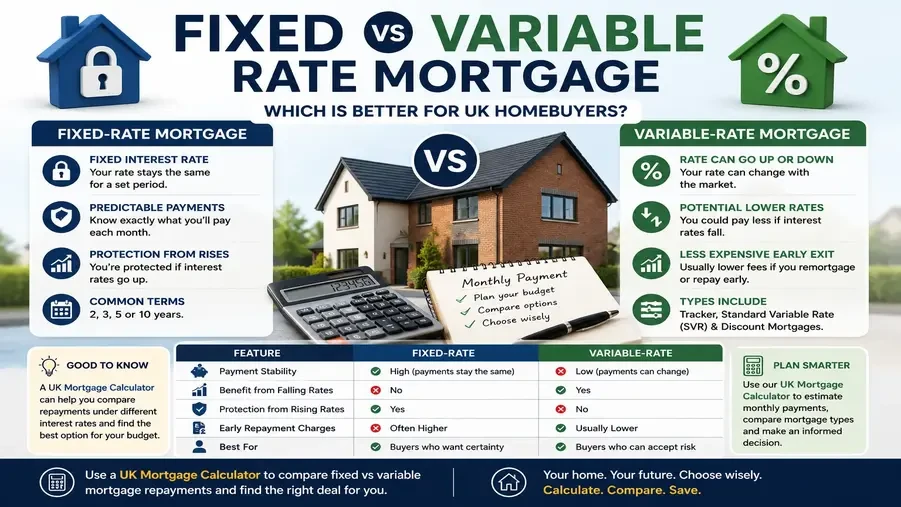
Fixed vs Variable Mortgage Comparison
Feature | Fixed Rate Mortgage | Variable Rate Mortgage |
Monthly Payment Stability | High | Low |
Budgeting Ease | Excellent | Moderate |
Protection Against Rate Rises | Yes | No |
Benefit From Falling Rates | No | Yes |
Early Repayment Charges | Often Higher | Often Lower |
Payment Flexibility | Lower | Higher |
Which Mortgage Is Better for First-Time Buyers?
Many first-time buyers choose fixed-rate mortgages because they offer certainty.
Benefits for first-time buyers include:
Easier budgeting
Predictable payments
Reduced risk
Greater financial confidence
However, some buyers prefer variable rates if they believe interest rates may fall in the future.
Using a UK Mortgage Calculator can help first-time buyers compare repayment scenarios under both options.
How Interest Rates Affect Mortgage Repayments
Even small rate changes can significantly impact monthly costs.
Example
Mortgage: £250,000
Term: 25 Years
Interest Rate | Monthly Payment |
3% | £1,186 |
4% | £1,320 |
5% | £1,462 |
6% | £1,611 |
This demonstrates why understanding interest rates is so important when choosing a mortgage.
A monthly mortgage calculator can help visualize these differences before committing to a loan.
When a Fixed-Rate Mortgage May Be Better
A fixed mortgage may be suitable if:
You want predictable payments.
You have a tight monthly budget.
You expect interest rates to rise.
You prefer financial certainty.
Many homeowners value the stability offered by fixed monthly repayments.
When a Variable-Rate Mortgage May Be Better
A variable mortgage may be suitable if:
You are comfortable with risk.
You expect interest rates to fall.
You want more flexibility.
You may repay the mortgage early.
Borrowers willing to accept some uncertainty may benefit from lower rates when market conditions are favourable.
How a UK Mortgage Calculator Can Help
A UK Mortgage Calculator is one of the best tools for comparing mortgage options.
You can use it to:
Calculate mortgage repayments
Compare fixed and variable rates
Estimate long-term borrowing costs
Assess affordability
Understand interest expenses
Compare mortgage terms
Whether you're purchasing your first home or remortgaging, a mortgage affordability can help you make more informed decisions.
Frequently Asked Questions
Is a fixed-rate mortgage safer?
Generally, yes. Fixed-rate mortgages provide predictable monthly payments and protection against rising interest rates.
Are variable mortgages cheaper?
They can be, especially if interest rates remain low or decrease.
Can I switch from a fixed mortgage to a variable mortgage?
Yes, although early repayment charges may apply during the fixed period.
Which mortgage type is best for first-time buyers?
Many first-time buyers prefer fixed-rate mortgages because they offer stability and easier budgeting.
How can I compare mortgage costs?
Using a UK Mortgage Calculator allows you to compare repayments, interest costs, and affordability across different mortgage products.
Final Thoughts
Both fixed-rate and variable-rate mortgages have advantages and disadvantages.
Fixed mortgages provide certainty and protection against rising rates, while variable mortgages offer flexibility and the potential to benefit from lower interest rates.
The best choice depends on your financial goals, risk tolerance, and expectations about future interest rates.
Before choosing a mortgage, use our UK Mortgage Calculator to compare repayment scenarios, estimate borrowing costs, and determine which mortgage option best fits your budget and long-term financial plans.
Disclaimer
The information provided in this article is for educational and informational purposes only. It should not be considered as professional financial, medical, or legal advice. Always consult with qualified professionals for specific guidance related to your situation.
Popular Calculators
Explore our most-used free calculators for finance, health, and everyday needs.