
Mortgage Deposit Explained: How Much Deposit Do You Need in the UK?
Learn how mortgage deposits work in the UK, minimum deposit requirements, loan-to-value ratios, and how a larger deposit can reduce your monthly mortgage payments.
Calcifyai Team
Expert calculators & financial tools
If you're planning to buy a home in the UK, one of the biggest financial hurdles is saving for a mortgage deposit.
Many first-time buyers ask:
"How much deposit do I need for a mortgage?"
The answer depends on the property value, mortgage lender requirements, and the type of mortgage you choose.
Understanding how deposits work can help you save more effectively, improve your chances of mortgage approval, and potentially secure better interest rates.
A UK Mortgage Calculator can also help you see how different deposit amounts affect your monthly mortgage repayments and total borrowing costs.
In this guide, we'll explain everything you need to know about mortgage deposits in the UK.
What Is a Mortgage Deposit?
A mortgage deposit is the upfront amount of money you contribute toward purchasing a property.
The remaining amount is borrowed from a mortgage lender.
Example
Let's say you're buying a home worth £300,000.
Property Price | £300,000 |
Deposit (10%) | £30,000 |
Mortgage Required | £270,000 |
In this example, you would pay £30,000 yourself and borrow £270,000 through a mortgage.
The larger your deposit, the smaller the mortgage you'll need.
Why Do Mortgage Lenders Require a Deposit?
Mortgage deposits reduce risk for lenders.
When you contribute your own money toward the purchase, lenders have greater confidence that you'll maintain repayments.
A larger deposit generally means:
Lower risk for the lender
Better mortgage rates
Lower monthly repayments
More mortgage options
Higher approval chances
This is why buyers with larger deposits often receive more competitive mortgage offers.
What Is the Minimum Mortgage Deposit in the UK?
Most UK lenders require a minimum deposit of 5% of the property's value.
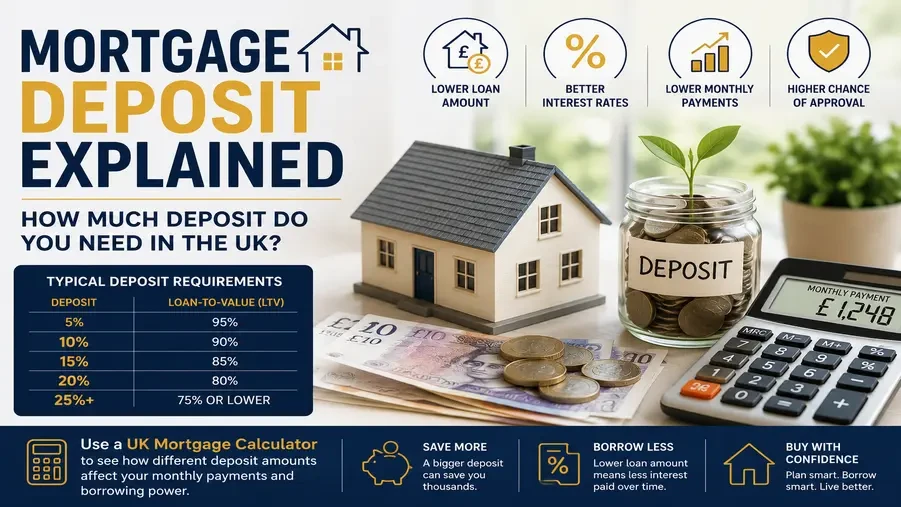
Typical Deposit Requirements
Deposit | Loan-to-Value (LTV) |
5% | 95% |
10% | 90% |
15% | 85% |
20% | 80% |
25% | 75% |
40% | 60% |
Loan-to-Value (LTV) measures how much you borrow compared to the property's value.
Lower LTV mortgages usually come with lower interest rates.
How Much Deposit Do I Need?
The amount you need depends entirely on the property's purchase price.
Example Property Prices
Property Price | 5% Deposit | 10% Deposit | 20% Deposit |
£200,000 | £10,000 | £20,000 | £40,000 |
£300,000 | £15,000 | £30,000 | £60,000 |
£400,000 | £20,000 | £40,000 | £80,000 |
£500,000 | £25,000 | £50,000 | £100,000 |
Before making an offer on a property, many buyers use a Mortgage Calculator UK to understand how their deposit size affects borrowing requirements.
How a Larger Deposit Saves You Money
Many buyers focus solely on reaching the minimum deposit threshold.
However, increasing your deposit can save thousands of pounds over the life of a mortgage.
Benefits of a Larger Deposit
Lower Monthly Payments
A smaller loan means lower monthly repayments.
Better Interest Rates
Lenders usually offer lower rates for lower LTV mortgages.
Less Interest Paid Overall
Borrowing less means paying less interest over time.
Improved Mortgage Approval Chances
Lenders often view larger deposits more favourably.
Using a mortgage repayment calculator UK can help you compare repayment costs across different deposit levels.
What Is Loan-to-Value (LTV)?
Loan-to-Value is one of the most important mortgage terms you'll encounter.
LTV Formula
LTV = Mortgage Amount ÷ Property Value × 100
Example
Property Value = £300,000
Mortgage = £240,000
Deposit = £60,000
LTV = 80%
Generally:
Lower LTV = Lower Risk
Lower LTV = Better Rates
Lower LTV = More Mortgage Options
Many lenders offer their most competitive rates at 60% to 75% LTV.
Can I Get a Mortgage With a 5% Deposit?
Yes.
Many lenders offer 95% LTV mortgages that require only a 5% deposit.
These products are particularly popular among:
First-time buyers
Young professionals
Buyers using government support schemes
However, 5% deposit mortgages typically come with:
Higher interest rates
Stricter affordability checks
Higher monthly repayments
A UK Mortgage Calculator can help you compare the long-term cost difference between a 5%, 10%, or 20% deposit.
Can Family Help With My Deposit?
Yes.
Many buyers receive financial support from family members.
Common options include:
Gifted Deposits
Parents or relatives provide money toward the deposit.
Family Mortgages
Some lenders allow family members to use savings as security.
Joint Borrower Arrangements
Family members contribute income to improve affordability.
Always check lender requirements regarding gifted deposits.
Ways to Save for a Mortgage Deposit
Saving for a deposit can take time, but several strategies can help.
Open a Lifetime ISA (LISA)
The government adds a 25% bonus to eligible savings.
Set a Dedicated Savings Goal
Automate monthly contributions to a separate account.
Reduce Unnecessary Expenses
Small monthly savings can make a significant difference over time.
Increase Income
Side income, bonuses, and freelance work can accelerate savings.
Create a Property Budget
Use a mortgage affordability to determine your target property price and required deposit amount.
Common Mortgage Deposit Mistakes
Waiting for a Huge Deposit
Many buyers delay purchasing unnecessarily while trying to save 20%.
A 5% or 10% deposit may still provide suitable options.
Ignoring Additional Costs
Remember to budget for:
Stamp Duty
Solicitor fees
Survey costs
Moving expenses
Not Comparing Mortgage Rates
The cheapest mortgage isn't always the best option.
Focusing Only on Property Price
Consider monthly affordability as well.
A UK Mortgage Calculator can help balance deposit size, loan amount, and monthly repayments.
How a UK Mortgage Calculator Helps When Saving a Deposit
A UK Mortgage Calculator allows buyers to model different scenarios before purchasing a property.
You can:
Estimate monthly repayments
Compare deposit amounts
Calculate borrowing requirements
Understand loan-to-value ratios
Compare mortgage terms
Plan a realistic home-buying budget
Whether you're saving for your first home or moving property, a UK Mortgage Calculator provides valuable insight into how your deposit affects your mortgage.
Frequently Asked Questions
What is the minimum mortgage deposit in the UK?
Most lenders require a minimum deposit of 5% of the property's value.
Is a 10% deposit better than 5%?
Yes. A 10% deposit often provides access to lower interest rates and better mortgage products.
Can I use a gifted deposit?
Yes. Many lenders accept gifted deposits from close family members.
Does a larger deposit reduce monthly repayments?
Yes. A larger deposit reduces the mortgage amount, resulting in lower repayments.
Should I save a bigger deposit or buy sooner?
This depends on your circumstances. A larger deposit usually reduces borrowing costs, but delaying a purchase may not always be beneficial.
Final Thoughts
Your mortgage deposit plays a major role in determining how much you can borrow, the interest rate you'll receive, and your monthly repayments.
While many buyers focus on reaching the minimum 5% deposit requirement, saving a larger deposit can significantly reduce borrowing costs and improve mortgage options.
Before purchasing a property, use our UK Mortgage Calculator to compare deposit scenarios, estimate mortgage repayments, and understand how much home you can realistically afford.
Disclaimer
The information provided in this article is for educational and informational purposes only. It should not be considered as professional financial, medical, or legal advice. Always consult with qualified professionals for specific guidance related to your situation.
Popular Calculators
Explore our most-used free calculators for finance, health, and everyday needs.