
How to Calculate Ratios Step by Step (Complete Beginner's Guide)
Learn how to calculate ratios step by step with simple formulas, real-life examples, and easy explanations. Understand ratio calculations, simplification methods, and practical applications.
Calcifyai Team
Expert calculators & financial tools
Ratios are one of the most useful mathematical concepts used in everyday life. Whether you're comparing prices while shopping, analyzing business performance, following a recipe, or solving school math problems, ratios help you compare quantities quickly and accurately.
If you've ever wondered how to calculate ratios, this guide will walk you through everything you need to know, from the basic ratio formula to real-world examples and common mistakes to avoid.
By the end of this article, you'll be able to calculate, simplify, and interpret ratios with confidence.
What Is a Ratio?
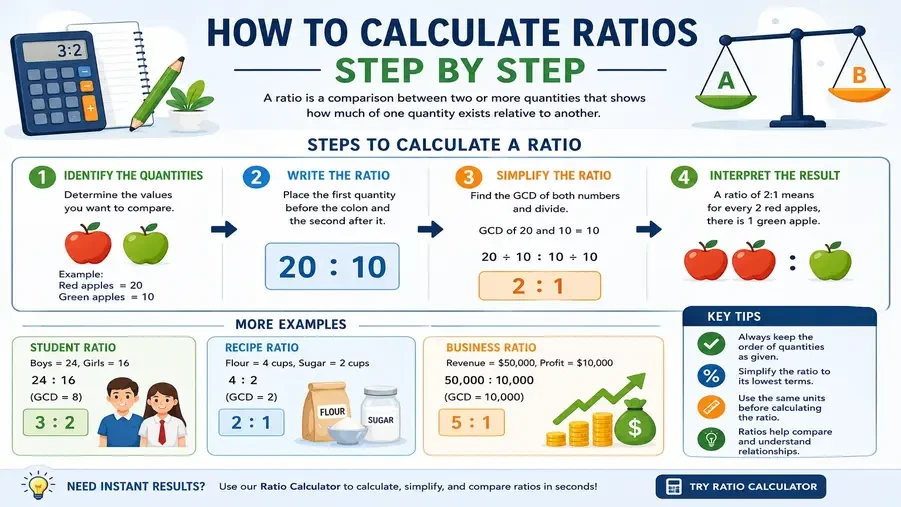
A ratio is a comparison between two or more quantities that shows how much of one quantity exists relative to another.
Ratios are commonly written in three formats:
3:2
3 to 2
3/2
For example:
If a classroom has 15 boys and 10 girls, the ratio of boys to girls is:
15:10
This means there are 15 boys for every 10 girls in the class.
Why Are Ratios Important?
Ratios help us compare values and understand relationships between quantities.
Common uses of ratios include:
Comparing financial data
Following cooking recipes
Mixing paint colors
Analyzing sports statistics
Creating maps and blueprints
Calculating business performance metrics
Understanding probability and statistics
Without ratios, comparing quantities accurately would be much more difficult.
Ratio Formula
The basic ratio formula is:
Ratio = Quantity A : Quantity B
For example:
Apples = 12
Oranges = 6
Ratio = 12:6
This compares apples to oranges.
How to Calculate Ratios Step by Step
Step 1: Identify the Quantities
Determine the values you want to compare.
Example:
Red balls = 20
Blue balls = 10
Step 2: Write the Ratio
Place the first quantity before the colon and the second quantity after it.
Ratio:
20:10
Step 3: Simplify the Ratio
Find the greatest common divisor (GCD) of both numbers.
For 20 and 10:
GCD = 10
Divide both numbers by 10:
20 ÷ 10 = 2
10 ÷ 10 = 1
Simplified ratio:
2:1
Step 4: Interpret the Result
A ratio of 2:1 means:
For every 2 red balls, there is 1 blue ball.
Example 1: Student Ratio
A class contains:
24 boys
16 girls
Calculate the Ratio
24:16
Find the GCD:
GCD = 8
Divide both numbers by 8:
24 ÷ 8 = 3
16 ÷ 8 = 2
Final Ratio:
3:2
Interpretation:
For every 3 boys, there are 2 girls.
Example 2: Recipe Ratio
A cake recipe requires:
4 cups flour
2 cups sugar
Ratio:
4:2
Simplify:
2:1
This means:
For every 2 cups of flour, use 1 cup of sugar.
Example 3: Business Ratio
A company earns:
$50,000 revenue
$10,000 profit
Ratio:
50,000:10,000
Simplify:
5:1
Interpretation:
The company generates $5 in revenue for every $1 in profit.
How to Simplify Ratios
Simplifying a ratio means reducing it to its smallest equivalent form.
Example
Ratio:
36:24
Find GCD:
12
Divide both values:
36 ÷ 12 = 3
24 ÷ 12 = 2
Simplified Ratio:
3:2
Quick Simplification Method
Find common factors.
Divide both numbers by the largest common factor.
Continue until no common factors remain.
How to Calculate Ratios With Decimals
Sometimes ratios involve decimal values.
Example:
2.5 : 1.5
Step 1
Multiply both values by 10:
25 : 15
Step 2
Simplify:
Divide by 5:
5 : 3
Final ratio:
5:3
How to Calculate Ratios With Fractions
Example:
1/2 : 1/4
Convert to common denominators:
2/4 : 1/4
Remove denominators:
2 : 1
Final ratio:
2:1
How to Calculate Ratios as Percentages
Ratios and percentages are closely related.
Example:
Ratio = 3:2
Total parts:
3 + 2 = 5
Percentage of first value:
(3 ÷ 5) × 100
= 60%
Percentage of second value:
(2 ÷ 5) × 100
= 40%
So:
3:2 = 60% : 40%
Real-Life Applications of Ratios
Education
Teachers use ratios for:
Grade analysis
Student performance comparisons
Probability calculations
Finance
Investors use ratios such as:
Debt-to-equity ratio
Current ratio
Profit margin ratio
Cooking
Recipes often use ingredient ratios to maintain consistency.
Construction
Builders use ratios for:
Concrete mixing
Blueprint scaling
Material calculations
Sports
Sports analysts use ratios to compare:
Wins and losses
Goals scored
Performance metrics
Common Ratio Calculation Mistakes
Reversing the Order
Incorrect:
Girls:Boys
Correct:
Boys:Girls
Always follow the specified order.
Forgetting to Simplify
Incorrect:
20:10
Correct:
2:1
Simplified ratios are easier to interpret.
Mixing Units
Incorrect:
5 meters : 100 centimeters
Convert units first:
5 meters = 500 centimeters
Ratio:
500:100
Simplified:
5:1
Using Different Measurement Systems
Always use the same unit before calculating ratios.
Ratio vs Proportion
Many people confuse ratios and proportions.
Ratio
Compares quantities.
Example:
4:2
Proportion
States that two ratios are equal.
Example:
4:2 = 8:4
All proportions contain ratios, but not all ratios are proportions.
Benefits of Using Ratios
Makes comparisons easier
Helps identify relationships
Simplifies large numbers
Useful in mathematics and finance
Improves decision-making
Widely used in science and business
Frequently Asked Questions
What is the easiest way to calculate a ratio?
Divide both values by their greatest common divisor (GCD) to obtain the simplest ratio.
Can ratios have decimals?
Yes. Convert decimals into whole numbers first, then simplify the ratio.
How do you simplify a ratio?
Find the greatest common divisor and divide both values by it.
What is the ratio formula?
Ratio = Quantity A : Quantity B
Why are ratios important?
Ratios help compare quantities, analyze relationships, and solve practical problems in everyday life.
Conclusion
Understanding how to calculate ratios is an essential math skill that applies far beyond the classroom. Whether you're comparing quantities, analyzing data, following recipes, managing finances, or solving exam questions, ratios provide a simple and effective way to understand relationships between numbers.
The process is straightforward:
Identify the quantities.
Write the ratio.
Simplify it using the greatest common divisor.
Interpret the result.
If you want to calculate ratios instantly without doing manual calculations, try our Ratio Calculator to get accurate results in seconds.
Disclaimer
The information provided in this article is for educational and informational purposes only. It should not be considered as professional financial, medical, or legal advice. Always consult with qualified professionals for specific guidance related to your situation.
Popular Calculators
Explore our most-used free calculators for finance, health, and everyday needs.