
Scientific Notation vs Standard Form: Key Differences, Examples & Conversions
Learn the difference between scientific notation and standard form with simple examples, conversion methods, and real-world uses.
Calcifyai Team
Expert calculators & financial tools
Numbers can be written in several ways depending on their size and purpose. Two of the most commonly used formats are scientific notation and standard form. Although both represent the same numerical value, they are designed for different situations.
Understanding when to use each format is an important skill for students, scientists, engineers, and anyone who works with large or small numbers. Whether you're comparing astronomical distances or everyday measurements, knowing the difference can make calculations and data interpretation much easier.
If you need to quickly switch between these formats, our Scientific Notation Calculator can convert values instantly and accurately.
Understanding the Two Number Formats
Before comparing scientific notation and standard form, it's helpful to understand the fundamentals of scientific notation, including coefficients, exponents, and powers of ten.
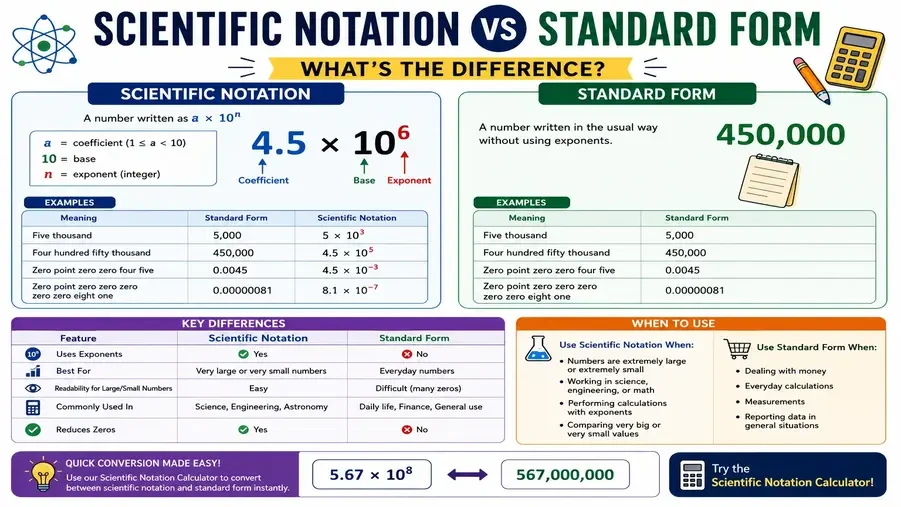
Scientific notation expresses numbers in a compact format:
a × 10ⁿ
Where:
a is a number between 1 and 10
n is an exponent
10 is the base
This format is commonly used when numbers become too large or too small to write conveniently in standard form.
Scientific Notation Examples
Standard Form | Scientific Notation |
5,000 | 5 × 10³ |
450,000 | 4.5 × 10⁵ |
0.0045 | 4.5 × 10⁻³ |
0.00000081 | 8.1 × 10⁻⁷ |
What Is Standard Form?
Standard form is the regular way numbers are written in everyday life.
Examples include:
5,000
450,000
0.0045
0.00000081
Most people encounter standard form in school, business, banking, shopping, and daily calculations.
While standard form is easy to understand for common numbers, it becomes less practical when numbers contain many zeros.
Scientific Notation vs Standard Form
The primary difference lies in how the number is displayed.
Scientific Notation
Uses exponents and powers of ten.
Example:
4.5 × 10⁵
Standard Form
Displays the complete number.
Example:
450,000
Although they look different, both values represent exactly the same quantity.
Comparison Table
Feature | Scientific Notation | Standard Form |
Uses exponents | Yes | No |
Easier for very large numbers | Yes | No |
Easier for very small numbers | Yes | No |
Common in science | Yes | Rarely |
Common in daily life | No | Yes |
Reduces zeros | Yes | No |
When Scientific Notation Is Better
Scientific notation becomes extremely useful when working with numbers that contain many digits.
Large Numbers
Instead of writing:
4,500,000,000
You can write:
4.5 × 10⁹
Small Numbers
Instead of writing:
0.0000000045
You can write:
4.5 × 10⁻⁹
These shortened formats improve readability and reduce mistakes.
Many students use an online scientific notation calculator to quickly verify conversions when working with large or small values.
When Standard Form Is Better
Standard form is usually preferred when:
Working with money
Reading measurements
Tracking population data
Performing basic arithmetic
Communicating everyday values
For example:
₹50,000
is generally easier to understand than
5 × 10⁴
for most people.
Converting Between Scientific Notation and Standard Form
One of the most important skills is learning how to move between these two formats.
If you need a complete walkthrough, our guide on converting large and small numbers into scientific notation explains the process step by step.
Example
Convert:
450,000
Move the decimal point:
450,000 → 4.5
Count the number of places moved:
5
Answer:
4.5 × 10⁵
Converting Scientific Notation Back to Standard Form
The reverse process involves moving the decimal point based on the exponent.
Example
4.5 × 10⁵
Move the decimal:
5 places right
Answer:
450,000
Example
4.5 × 10⁻⁴
Move the decimal:
4 places left
Answer:
0.00045
A scientific notation converter can perform these calculations instantly.
Common Mistakes
Many students make errors when converting between formats.
Using the Wrong Exponent Direction
Positive exponents move the decimal right.
Negative exponents move the decimal left.
Miscounting Decimal Places
Incorrect counting results in incorrect exponents.
Breaking Scientific Notation Formatting Rules
Remember that the coefficient must always remain between 1 and 10.
If you're unsure about proper formatting, reviewing the core rules of scientific notation can help prevent these mistakes.
Why Scientists Prefer Scientific Notation
Scientists frequently work with values that are impossible to manage comfortably in standard form.
Examples include:
Astronomy
Distance from Earth to the Sun:
1.496 × 10⁸ km
Biology
Average bacterium size:
2 × 10⁻⁶ m
Physics
Speed of light:
3 × 10⁸ m/s
These fields rely on scientific notation because it makes calculations and comparisons significantly easier.
Scientific Notation and Mathematical Operations
Another advantage of scientific notation is that multiplication and division become much simpler.
Instead of working with long strings of zeros, scientists can use exponent rules to solve problems quickly.
If you're interested in calculations, our guide on multiplying and dividing numbers in scientific notation explains the process with detailed examples.
Benefits of Using a Scientific Notation Calculator
A Scientific Notation Calculator can help you:
Convert numbers instantly
Switch between standard form and scientific notation
Verify homework answers
Reduce calculation mistakes
Save time during exams and assignments
Whether you're learning scientific notation for the first time or working on advanced calculations, a calculator can make the process much easier.
Final Thoughts
Scientific notation and standard form represent the same numbers but serve different purposes. Standard form is ideal for everyday use, while scientific notation makes extremely large and small values easier to read, compare, and calculate.
To deepen your understanding, explore our guides covering:
scientific notation basics
converting numbers into scientific notation
core scientific notation rules
multiplying and dividing numbers in scientific notation
And whenever you need quick conversions, use our Scientific Notation Calculator for instant results.
Disclaimer
The information provided in this article is for educational and informational purposes only. It should not be considered as professional financial, medical, or legal advice. Always consult with qualified professionals for specific guidance related to your situation.
Popular Calculators
Explore our most-used free calculators for finance, health, and everyday needs.