
How to Multiply and Divide Scientific Notation (Step-by-Step Guide)
Learn how to multiply and divide scientific notation with simple rules, formulas, and examples. Use our Scientific Notation Calculator to verify answers instantly.
Calcifyai Team
Expert calculators & financial tools
Scientific notation is one of the most useful mathematical tools for working with extremely large and extremely small numbers. Instead of dealing with lengthy values filled with zeros, scientific notation allows you to simplify calculations and solve problems more efficiently.
One of the biggest advantages of scientific notation is how easily it handles multiplication and division. By understanding a few simple exponent rules, you can perform complex calculations in seconds.
You can also use our Scientific Notation Calculator to instantly verify answers, convert values, and solve scientific notation problems accurately.
What Is Scientific Notation?
Scientific notation is a method of expressing numbers in the following format:
a × 10ⁿ
Where:
a is a coefficient greater than or equal to 1 and less than 10
10 is the base
n is an exponent
Examples:
Standard Form | Scientific Notation |
5,000 | 5 × 10³ |
0.0045 | 4.5 × 10⁻³ |
72,000,000 | 7.2 × 10⁷ |
If you're unfamiliar with coefficients and exponents, our guide on What Is Scientific Notation? explains these concepts in detail with beginner-friendly examples.
Why Multiplication and Division Are Easier in Scientific Notation
Large numbers can be difficult to multiply and divide using standard form.
For example:
3,000,000 × 2,000
Writing all the zeros and performing the calculation manually can be time-consuming.
Using scientific notation:
(3 × 10⁶) × (2 × 10³)
The problem becomes much easier because you only need to multiply the coefficients and apply exponent rules.
Before solving these types of problems, it's important to understand how numbers are converted into scientific notation. If needed, review our article on How to Convert Numbers into Scientific Notation before continuing.
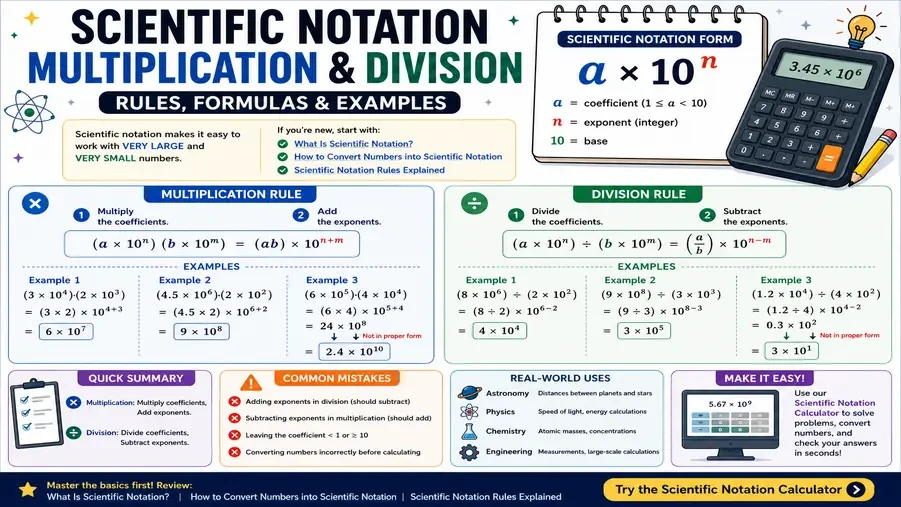
Scientific Notation Multiplication Rule
When multiplying numbers written in scientific notation:
Step 1
Multiply the coefficients.
Step 2
Add the exponents.
Formula
(a × 10ⁿ)(b × 10ᵐ)
=
(ab) × 10ⁿ⁺ᵐ
This multiplication rule comes directly from the exponent principles covered in our Scientific Notation Rules Explained guide.
Multiplication Example 1
Multiply:
(3 × 10⁴)(2 × 10³)
Solution
Multiply coefficients:
3 × 2 = 6
Add exponents:
10⁴ × 10³ = 10⁷
Answer:
6 × 10⁷
Multiplication Example 2
Multiply:
(4.5 × 10⁶)(2 × 10²)
Solution
4.5 × 2 = 9
10⁶ × 10² = 10⁸
Answer:
9 × 10⁸
Multiplication Example 3
Multiply:
(6 × 10⁵)(4 × 10⁴)
Solution
6 × 4 = 24
10⁵ × 10⁴ = 10⁹
Result:
24 × 10⁹
However, this answer is not written in proper scientific notation because the coefficient is greater than 10.
According to the rules discussed in Scientific Notation Rules Explained, the coefficient must always be between 1 and 10.
Correct answer:
2.4 × 10¹⁰
Scientific Notation Division Rule
Division follows a similar process.
Step 1
Divide the coefficients.
Step 2
Subtract the exponents.
Formula
(a × 10ⁿ) ÷ (b × 10ᵐ)
=
(a ÷ b) × 10ⁿ⁻ᵐ
Common Mistakes When Multiplying and Dividing Scientific Notation
Students often make the following mistakes:
Using the Wrong Exponent Operation
When multiplying:
Add exponents
When dividing:
Subtract exponents
Forgetting Scientific Notation Rules
Many answers are mathematically correct but not properly written in scientific notation.
Example:
24 × 10⁹
Correct format:
2.4 × 10¹⁰
Incorrect Number Conversion
Some mistakes occur before calculations even begin because the original number was converted incorrectly.
A Scientific Notation Calculator can also help identify conversion errors instantly.
Benefits of Using a Scientific Notation Calculator
While learning scientific notation manually is important, online tools can help speed up calculations and improve accuracy.
A Scientific Notation Calculator can help you:
Multiply scientific notation instantly
Divide scientific notation accurately
Convert scientific notation to standard form
Convert standard numbers into scientific notation
Verify homework answers
Reduce calculation mistakes
Final Thoughts
Scientific notation multiplication and division become much easier once you understand coefficients, exponents, and conversion rules. By applying the correct exponent operations and following proper formatting guidelines, you can solve scientific notation problems quickly and accurately.
To build a complete understanding of scientific notation, be sure to explore:
What Is Scientific Notation?
How to Convert Numbers into Scientific Notation
Scientific Notation Rules Explained
Together, these guides provide the foundation needed for more advanced topics such as scientific notation calculations, significant figures, and scientific notation practice problems.
For quick calculations and answer verification, try our Scientific Notation Calculator and solve scientific notation problems in seconds.
Disclaimer
The information provided in this article is for educational and informational purposes only. It should not be considered as professional financial, medical, or legal advice. Always consult with qualified professionals for specific guidance related to your situation.
Popular Calculators
Explore our most-used free calculators for finance, health, and everyday needs.