
What Is Scientific Notation? A Beginner's Guide to Understanding Large and Small Numbers
Learn what scientific notation is, how it works, and why it's used in science and math. Explore examples, rules, and convert numbers easily with a Scientific Notation Calculator.
Calcifyai Team
Expert calculators & financial tools
Scientific notation is a mathematical method used to write extremely large or extremely small numbers in a simpler and more manageable format. Instead of writing long strings of zeros, scientific notation expresses a number as a coefficient multiplied by a power of ten.
Scientists, engineers, students, mathematicians, and researchers use scientific notation every day because it makes calculations faster, reduces errors, and improves readability. If you frequently work with large or tiny numbers, a Scientific Notation Calculator can help you convert values quickly and accurately.
Whether you're studying math, working in science, or simply trying to understand exponents, learning scientific notation is an essential skill.
What Is Scientific Notation?
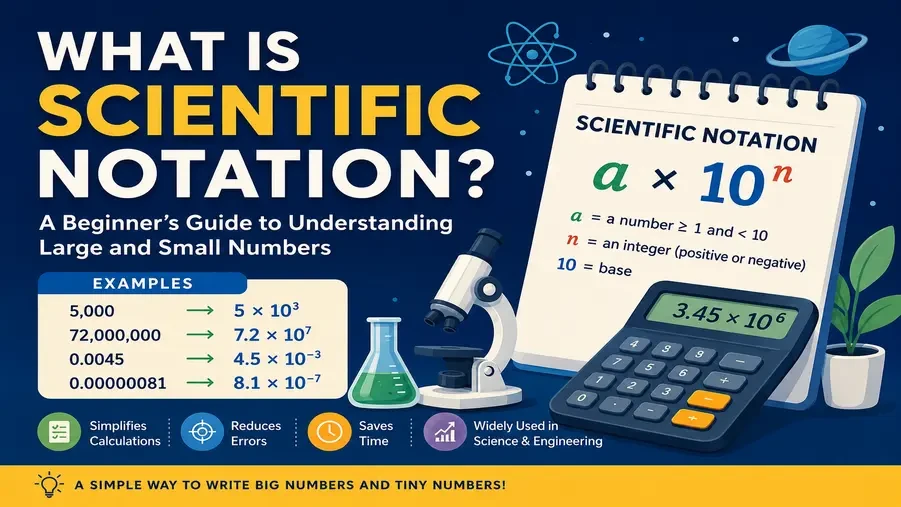
Scientific notation is a way of expressing numbers in the following format:
a × 10ⁿ
Where:
a is a number greater than or equal to 1 and less than 10
n is an integer exponent
10 is the base
This notation allows numbers to be written in a compact form while preserving their exact value.
Examples of Scientific Notation
Standard Number | Scientific Notation |
5,000 | 5 × 10³ |
72,000,000 | 7.2 × 10⁷ |
0.0045 | 4.5 × 10⁻³ |
0.00000081 | 8.1 × 10⁻⁷ |
Instead of counting zeros manually, many students use a scientific notation converter to transform numbers instantly and avoid mistakes.
Why Is Scientific Notation Important?
Scientific notation helps simplify calculations involving very large or very small numbers.
Benefits of Scientific Notation
Makes numbers easier to read
Simplifies multiplication and division
Reduces writing errors
Saves time during calculations
Commonly used in science, engineering, and technology
Makes comparing values much easier
Modern tools such as an online scientific notation calculator make it even easier to work with powers of ten when solving math and science problems.
Where Is Scientific Notation Used?
Scientific notation is widely used across many fields.
Astronomy
Astronomers work with enormous distances that would be difficult to write in standard form.
Example:
Distance from Earth to the Sun:
149,600,000 km
Scientific notation:
1.496 × 10⁸ km
Biology
Scientists use scientific notation to measure microscopic organisms.
Example:
0.000002 meters
Scientific notation:
2 × 10⁻⁶ meters
Chemistry
Atoms and molecules are incredibly small.
Example:
Mass of a hydrogen atom:
1.67 × 10⁻²⁷ kg
Physics
Scientific notation is commonly used when working with large constants.
Example:
Speed of light:
3 × 10⁸ m/s
Understanding Positive and Negative Exponents
Exponents determine how many places the decimal point moves.
Positive Exponents
A positive exponent indicates a number greater than 1.
Example:
7.5 × 10⁴
Move the decimal point four places to the right:
75,000
Negative Exponents
A negative exponent indicates a number less than 1.
Example:
7.5 × 10⁻⁴
Move the decimal point four places to the left:
0.00075
If you're unsure whether you've moved the decimal point correctly, you can verify your answer using a Scientific Notation Calculator before continuing with more complex calculations.
How to Identify Scientific Notation
A number is written in scientific notation if:
The coefficient is between 1 and 10
It is multiplied by a power of ten
The exponent may be positive, negative, or zero
Correct Examples
3.4 × 10⁵
8.1 × 10⁻³
1.25 × 10⁸
Incorrect Examples
15 × 10³
0.7 × 10⁴
25 × 10²
The coefficient must always be at least 1 and less than 10.
Convert Numbers to Scientific Notation Instantly
Converting large and small numbers manually can become time-consuming, especially when working with multiple values.
Instead of counting decimal places and determining exponents by hand, you can use a Scientific Notation Calculator to convert numbers accurately in seconds.
A scientific notation conversion tool can help you:
Convert decimal numbers to scientific notation
Convert scientific notation to standard form
Verify homework answers
Reduce calculation errors
Save time during exams and assignments
Whether you're a student, teacher, engineer, or researcher, using a scientific notation calculator online can make working with exponents much easier.
Real-World Examples of Scientific Notation
World Population
Approximate world population:
8,000,000,000
Scientific notation:
8 × 10⁹
Computer Storage
1 Terabyte:
1,000,000,000,000 bytes
Scientific notation:
1 × 10¹² bytes
Virus Size
0.00000012 meters
Scientific notation:
1.2 × 10⁻⁷ meters
These examples show why scientific notation is often preferred over standard form when dealing with extreme values.
Scientific Notation vs Standard Form
Scientific Notation | Standard Form |
5 × 10⁶ | 5,000,000 |
4.8 × 10⁻⁴ | 0.00048 |
1.25 × 10⁸ | 125,000,000 |
Scientific notation reduces clutter and makes calculations easier, while standard form displays the complete number.
Common Scientific Notation Mistakes
Many students make the same mistakes when first learning scientific notation.
Incorrect Decimal Placement
Wrong:
45 × 10³
Correct:
4.5 × 10⁴
Wrong Exponent Sign
Wrong:
4.2 × 10³
Correct:
4.2 × 10⁻³
Coefficient Larger Than 10
Wrong:
25 × 10⁴
Correct:
2.5 × 10⁵
Using a scientific notation converter calculator can help catch these common errors before submitting assignments or completing calculations.
Who Should Learn Scientific Notation?
Scientific notation is useful for:
Students
Teachers
Scientists
Engineers
Researchers
Data Analysts
Mathematicians
Anyone who works with large or small numbers can benefit from understanding scientific notation.
Frequently Asked Questions
What is scientific notation in simple terms?
Scientific notation is a shorter way to write very large or very small numbers using powers of ten.
Why do scientists use scientific notation?
Scientists use scientific notation because it simplifies calculations and makes numbers easier to read.
How do I convert a number into scientific notation?
Move the decimal point until only one non-zero digit remains to the left of the decimal point. Then count how many places the decimal moved to determine the exponent. You can also use a Scientific Notation Calculator to convert values instantly.
Can scientific notation have negative exponents?
Yes. Negative exponents represent numbers smaller than 1.
What is the standard scientific notation format?
The format is:
a × 10ⁿ
where a is between 1 and 10.
Final Thoughts
Scientific notation is one of the most useful mathematical concepts for representing extremely large and small numbers. It simplifies calculations, improves readability, and is used extensively in science, engineering, technology, and education.
Once you understand how exponents work, scientific notation becomes much easier to use. For faster conversions and error-free calculations, try our Scientific Notation Calculator to convert numbers between standard form and scientific notation instantly.
Disclaimer
The information provided in this article is for educational and informational purposes only. It should not be considered as professional financial, medical, or legal advice. Always consult with qualified professionals for specific guidance related to your situation.
Popular Calculators
Explore our most-used free calculators for finance, health, and everyday needs.