
Scientific Notation Rules Explained: Everything You Need to Know
Learn the essential scientific notation rules with simple explanations and examples. Understand coefficients, exponents, conversions, and use a Scientific Notation Calculator for quick verification.
Calcifyai Team
Expert calculators & financial tools
Scientific notation is one of the most useful mathematical tools for expressing very large and very small numbers. It simplifies calculations, reduces writing errors, and makes complex values easier to understand.
However, many students struggle because they don't fully understand the rules behind scientific notation. Knowing these rules is essential for converting numbers correctly, performing calculations, and avoiding common mistakes.
In this guide, we'll explain all the important scientific notation rules with examples and practical tips. If you want to quickly verify your answers, a Scientific Notation Calculator can help you check conversions and calculations instantly.
What Is Scientific Notation?
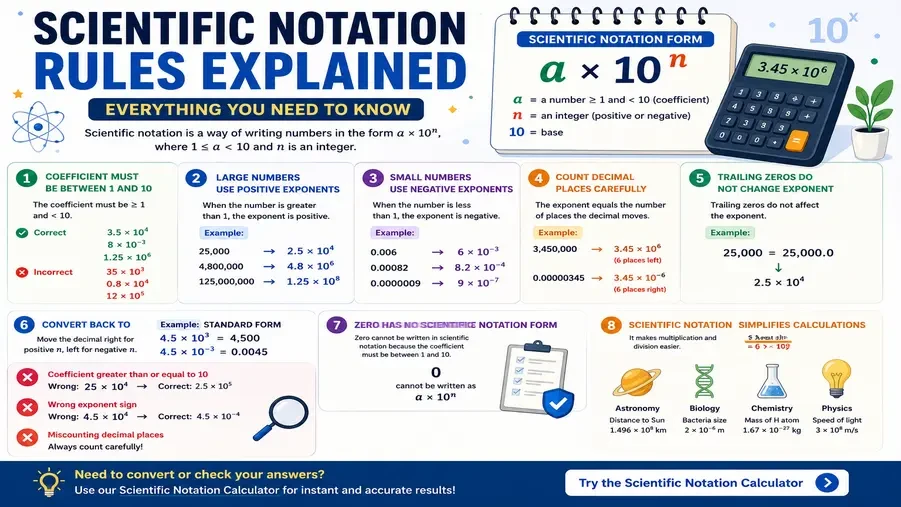
Scientific notation is a way of expressing numbers in the following format:
a × 10ⁿ
Where:
a is the coefficient
10 is the base
n is the exponent
The coefficient must always follow specific rules, which we'll discuss below.
Examples
Standard Form | Scientific Notation |
5,000 | 5 × 10³ |
72,000,000 | 7.2 × 10⁷ |
0.0045 | 4.5 × 10⁻³ |
0.00000081 | 8.1 × 10⁻⁷ |
Understanding these examples becomes much easier once you know the rules.
Rule 1: The Coefficient Must Be Between 1 and 10
The first and most important scientific notation rule is:
The coefficient must be greater than or equal to 1 and less than 10.
Correct Examples
3.5 × 10⁴
8 × 10⁻³
1.25 × 10⁶
Incorrect Examples
35 × 10³
0.8 × 10⁴
12 × 10⁵
Whenever the coefficient is less than 1 or greater than or equal to 10, the number is not written in proper scientific notation.
A scientific notation converter can help identify and correct improperly formatted values.
Rule 2: Large Numbers Use Positive Exponents
When converting numbers greater than 1, the exponent will be positive.
Example
Convert:
25,000
Move decimal:
25,000 → 2.5
Decimal moved:
4 places left
Answer:
2.5 × 10⁴
Because the decimal moved left, the exponent is positive.
More Examples
Number | Scientific Notation |
8,000 | 8 × 10³ |
450,000 | 4.5 × 10⁵ |
7,200,000 | 7.2 × 10⁶ |
Rule 3: Small Numbers Use Negative Exponents
When converting numbers less than 1, the exponent becomes negative.
Example
Convert:
0.00045
Move decimal:
0.00045 → 4.5
Decimal moved:
4 places right
Answer:
4.5 × 10⁻⁴
Since the decimal moved right, the exponent is negative.
More Examples
Number | Scientific Notation |
0.006 | 6 × 10⁻³ |
0.00082 | 8.2 × 10⁻⁴ |
0.0000009 | 9 × 10⁻⁷ |
Many students accidentally use positive exponents here, which is one of the most common scientific notation mistakes.
Rule 4: Count Decimal Places Carefully
The exponent always equals the number of places the decimal point moves.
Example
Convert:
3,450,000
Move decimal:
3.45
Count places:
6
Answer:
3.45 × 10⁶
Example
Convert:
0.00000345
Move decimal:
3.45
Count places:
6
Answer:
3.45 × 10⁻⁶
If you're unsure about your answer, an online scientific notation calculator can verify the exponent instantly.
Rule 5: Trailing Zeros Do Not Change the Exponent
Trailing zeros are often included for measurement accuracy, but they do not affect the scientific notation exponent.
Example
25,000
and
25,000.0
Both become:
2.5 × 10⁴
The exponent remains the same.
Rule 6: Scientific Notation Can Be Converted Back to Standard Form
Scientific notation isn't just for converting numbers you can also convert back.
Positive Exponent
4.5 × 10³
Move decimal:
3 places right
Answer:
4,500
Negative Exponent
4.5 × 10⁻³
Move decimal:
3 places left
Answer:
0.0045
Many students use a scientific notation to decimal converter when checking homework or assignments.
Rule 7: Zero Has No Scientific Notation Form
Scientific notation requires a coefficient between 1 and 10.
Because zero cannot satisfy this requirement, it cannot be expressed in standard scientific notation.
This is one of the lesser-known scientific notation rules.
Rule 8: Scientific Notation Simplifies Calculations
One reason scientific notation is so powerful is that it makes calculations easier.
Example
Instead of multiplying:
3,000,000 × 2,000
You can write:
(3 × 10⁶) × (2 × 10³)
Multiply coefficients:
3 × 2 = 6
Add exponents:
10⁶ × 10³ = 10⁹
Answer:
6 × 10⁹
This is significantly easier than working with long strings of zeros.
Common Scientific Notation Mistakes
Mistake 1: Coefficient Greater Than 10
Wrong:
25 × 10⁴
Correct:
2.5 × 10⁵
Mistake 2: Wrong Exponent Sign
Wrong:
4.5 × 10⁴
Correct:
4.5 × 10⁻⁴
Mistake 3: Miscounting Decimal Places
Incorrect counting leads to incorrect exponents.
Using a Scientific Notation Calculator can help eliminate these errors.
Real-World Applications
Astronomy
Distance from Earth to the Sun:
1.496 × 10⁸ km
Physics
Speed of light:
3 × 10⁸ m/s
Biology
Average bacterium size:
2 × 10⁻⁶ m
Chemistry
Mass of a hydrogen atom:
1.67 × 10⁻²⁷ kg
These fields rely heavily on scientific notation because standard numbers would be difficult to manage.
Benefits of Understanding Scientific Notation Rules
Learning scientific notation rules helps you:
Solve math problems faster
Perform calculations accurately
Understand scientific data
Avoid common mistakes
Work confidently with exponents
Use scientific calculators effectively
Whether you're a student or professional, mastering these rules will make working with numbers much easier.
Frequently Asked Questions
What is the most important scientific notation rule?
The coefficient must always be greater than or equal to 1 and less than 10.
When is the exponent positive?
When converting numbers greater than 1.
When is the exponent negative?
When converting numbers smaller than 1.
Can scientific notation have decimals?
Yes. Most scientific notation values include decimal coefficients.
What is the easiest way to verify scientific notation?
Using a Scientific Notation Calculator is the fastest and most accurate way to verify conversions and calculations.
Final Thoughts
Understanding scientific notation rules is essential for writing numbers correctly, performing calculations, and solving scientific problems. Once you understand coefficient placement, exponent signs, and decimal movement, scientific notation becomes much easier to use.
For quick conversions, error checking, and instant calculations, try our Scientific Notation Calculator to work with large and small numbers more efficiently.
Disclaimer
The information provided in this article is for educational and informational purposes only. It should not be considered as professional financial, medical, or legal advice. Always consult with qualified professionals for specific guidance related to your situation.
Popular Calculators
Explore our most-used free calculators for finance, health, and everyday needs.