
Ratio Problems and Solutions for Competitive Exams (With Answers)
Learn how to solve ratio problems for competitive exams with step-by-step solutions, shortcuts, examples, and practice questions. Perfect for aptitude tests, SSC, banking, CAT, and government exams.
Calcifyai Team
Expert calculators & financial tools
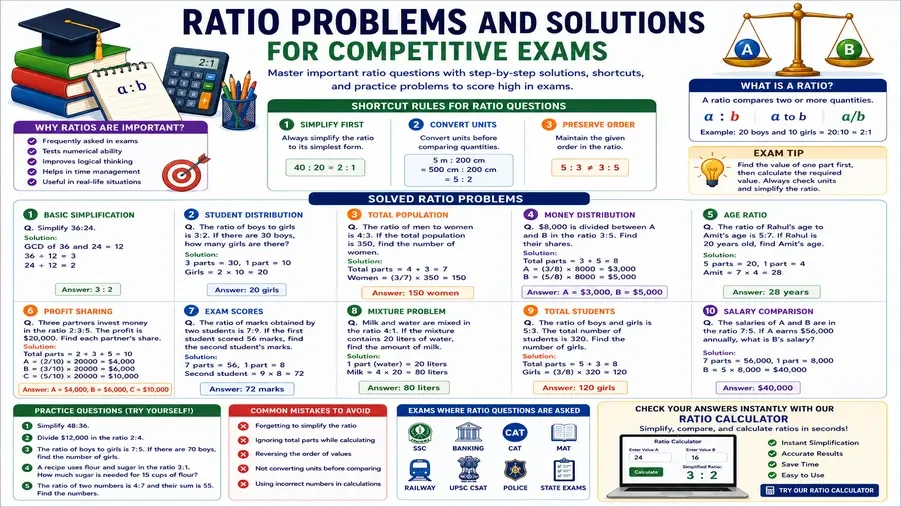
Ratios are one of the most frequently tested topics in competitive exams. Whether you're preparing for SSC, Banking, CAT, GMAT, UPSC, Railway, Police, or other aptitude-based examinations, mastering ratio problems can significantly improve your score.
Most ratio questions test your ability to compare quantities, simplify relationships, and apply logical reasoning under time constraints.
In this guide, you'll learn common ratio question types, shortcut methods, solved examples, and exam-focused strategies to solve ratio problems quickly and accurately.
If you'd like to verify your answers instantly, you can use our ratio calculator to simplify and compare ratios in seconds.
What Is a Ratio?
A ratio compares two or more quantities.
It is commonly written as:
a:b
a to b
a/b
Example:
20 boys and 10 girls
Ratio:
20:10
Simplified:
2:1
This means there are 2 boys for every 1 girl.
Why Are Ratios Important in Competitive Exams?
Ratio questions help examiners assess:
Numerical ability
Logical thinking
Problem-solving skills
Data interpretation skills
Speed and accuracy
Ratio-based questions frequently appear in:
SSC CGL
SSC CHSL
Banking Exams
CAT
MAT
Railway Exams
UPSC CSAT
State Government Exams
Shortcut Rules for Solving Ratio Questions
Rule 1: Always Simplify First
Example:
40:20
Simplified:
2:1
Working with smaller numbers makes calculations easier.
Rule 2: Convert Units Before Comparing
Incorrect:
5 meters : 200 centimeters
Correct:
500 cm : 200 cm
Ratio:
5:2
Rule 3: Preserve Ratio Order
5:3 is different from 3:5.
Always maintain the specified order.
Ratio Problem 1: Basic Simplification
Question
Simplify:
36:24
Solution
Find GCD:
12
Divide both numbers:
36 ÷ 12 = 3
24 ÷ 12 = 2
Answer:
3:2
Ratio Problem 2: Student Distribution
Question
The ratio of boys to girls in a classroom is 3:2.
If there are 30 boys, how many girls are there?
Solution
Ratio:
3:2
30 boys represent 3 parts.
1 part = 30 ÷ 3 = 10
Girls:
2 × 10 = 20
Answer:
20 girls
Ratio Problem 3: Total Population
Question
The ratio of men to women is 4:3.
If the total population is 350, find the number of women.
Solution
Total parts:
4 + 3 = 7
Women's share:
(3 ÷ 7) × 350
= 150
Answer:
150 women
Ratio Problem 4: Money Distribution
Question
A sum of $8,000 is divided between A and B in the ratio 3:5.
Find their shares.
Solution
Total parts:
3 + 5 = 8
A's Share:
(3 ÷ 8) × 8,000
= $3,000
B's Share:
(5 ÷ 8) × 8,000
= $5,000
Answer:
A = $3,000
B = $5,000
Ratio Problem 5: Age Ratio
Question
The ratio of Rahul's age to Amit's age is 5:7.
If Rahul is 20 years old, find Amit's age.
Solution
5 parts = 20
1 part = 4
Amit:
7 × 4 = 28
Answer:
28 years
Ratio Problem 6: Profit Sharing
Question
Three partners invest money in the ratio 2:3:5.
The profit is $20,000.
Find each partner's share.
Solution
Total parts:
2 + 3 + 5 = 10
Partner A:
(2 ÷ 10) × 20,000
= $4,000
Partner B:
(3 ÷ 10) × 20,000
= $6,000
Partner C:
(5 ÷ 10) × 20,000
= $10,000
Answer:
A = $4,000
B = $6,000
C = $10,000
Ratio Problem 7: Exam Scores
Question
The ratio of marks obtained by two students is 7:9.
If the first student scored 56 marks, find the second student's marks.
Solution
7 parts = 56
1 part = 8
Second student:
9 × 8 = 72
Answer:
72 marks
Ratio Problem 8: Mixture Problem
Question
Milk and water are mixed in the ratio 4:1.
If the mixture contains 20 liters of water, find the amount of milk.
Solution
1 part = 20 liters
Milk:
4 × 20
= 80 liters
Answer:
80 liters
Ratio Problem 9: Competitive Exam Favorite
Question
The ratio of boys and girls is 5:3.
The total number of students is 320.
Find the number of girls.
Solution
Total parts:
5 + 3 = 8
Girls:
(3 ÷ 8) × 320
= 120
Answer:
120 girls
Ratio Problem 10: Salary Comparison
Question
The salaries of A and B are in the ratio 7:5.
If A earns $56,000 annually, what is B's salary?
Solution
7 parts = 56,000
1 part = 8,000
B:
5 × 8,000
= $40,000
Answer:
$40,000
Practice Questions
Try solving these yourself:
Simplify 48:36.
Divide $12,000 in the ratio 2:4.
The ratio of boys to girls is 7:5. If there are 70 boys, find the number of girls.
A recipe uses flour and sugar in the ratio 3:1. How much sugar is needed for 15 cups of flour?
The ratio of two numbers is 4:7 and their sum is 55. Find the numbers.
Common Ratio Mistakes in Exams
Forgetting to Simplify
Always reduce ratios to their lowest terms.
Ignoring Total Parts
Many students forget to add ratio parts before calculating shares.
Reversing Values
A:B is not the same as B:A.
Unit Conversion Errors
Always convert measurements before comparing.
Tips to Solve Ratio Questions Faster
Simplify ratios immediately.
Memorize common ratio patterns.
Practice percentage-to-ratio conversions.
Learn fraction-to-ratio shortcuts.
Check calculations using an online ratio calculator when practicing.
Frequently Asked Questions
Are ratio questions important for competitive exams?
Yes. Ratio questions frequently appear in aptitude, banking, SSC, CAT, and government examinations.
What is the fastest way to solve ratio problems?
Simplify the ratio first and calculate the value of one part.
Can ratios have more than two quantities?
Yes. Ratios can compare three or more values.
How do I verify ratio answers?
You can use a ratio calculator to simplify and verify your answers instantly.
How much should I practice ratio questions?
Aim for at least 20–30 ratio questions daily while preparing for competitive exams.
Conclusion
Ratio questions are among the easiest scoring topics in competitive exams when you understand the underlying concepts. Most problems follow a predictable pattern involving simplification, proportional distribution, and comparison of quantities.
By practicing regularly and learning shortcut techniques, you can solve ratio questions quickly and accurately under exam conditions.
For instant verification and simplification of ratios, try our ratio calculator and practice with confidence.
Disclaimer
The information provided in this article is for educational and informational purposes only. It should not be considered as professional financial, medical, or legal advice. Always consult with qualified professionals for specific guidance related to your situation.
Popular Calculators
Explore our most-used free calculators for finance, health, and everyday needs.