
What Is a kWh? A Complete Beginner's Guide to Understanding Electricity Usage
Learn what a kWh (kilowatt-hour) means, how it is calculated, and why it matters for electricity bills. Understand energy consumption with simple examples.
Calcifyai Team
Expert calculators & financial tools
If you've ever looked at your electricity bill, you've probably seen the term kWh. Utility companies use kWh to measure how much electricity your home consumes and determine how much you pay each month.
Understanding what a kilowatt-hour is can help you track energy usage, compare appliances, lower electricity costs, and make smarter energy decisions.
Whether you're trying to estimate appliance power consumption or use a KWH Calculator to calculate electricity usage, understanding kWh is the first step.
What Does kWh Mean?
kWh stands for kilowatt-hour.
A kilowatt-hour is a unit of energy that measures how much electricity is used over time.
It represents:
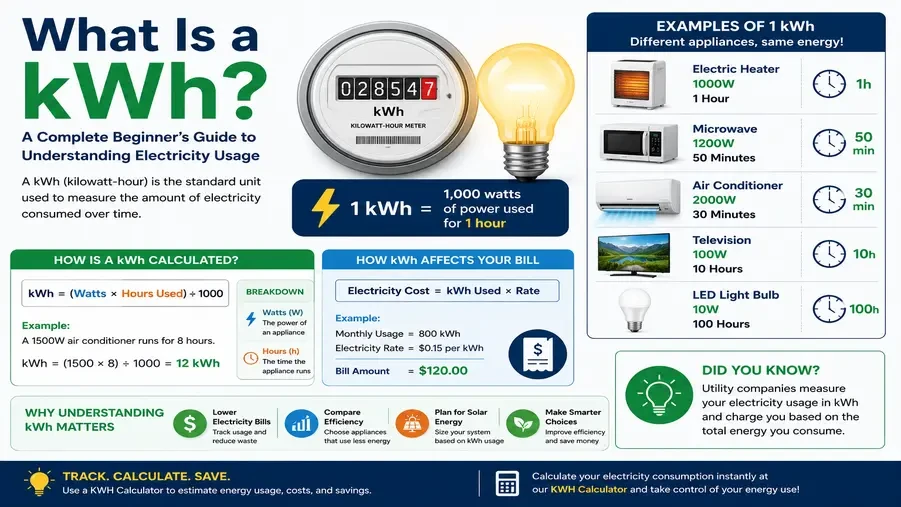
1,000 watts of power used for 1 hour
or
1 kilowatt of power used for 1 hour
A kWh does not measure speed or power alone. Instead, it measures the total amount of electricity consumed.
This is the same unit used by electricity providers when calculating your monthly bill.
Understanding Kilowatts and Hours
To understand a kWh, let's break it down into two parts:
Kilowatt (kW)
A kilowatt equals 1,000 watts.
Examples:
1000 watts = 1 kW
2000 watts = 2 kW
500 watts = 0.5 kW
Hour (h)
An hour is simply the amount of time an appliance runs.
When power and time are combined, you get energy consumption measured in kWh.
What Does 1 kWh Look Like?
Here are some real-world examples of appliances using approximately 1 kWh of electricity:
Appliance | Power Rating | Runtime for 1 kWh |
Electric Heater | 1000W | 1 Hour |
Microwave | 1200W | 50 Minutes |
Air Conditioner | 2000W | 30 Minutes |
Television | 100W | 10 Hours |
LED Light Bulb | 10W | 100 Hours |
These examples show how different appliances consume electricity at different rates.
For a complete breakdown, see our Appliance Energy Consumption Chart.
How Is a kWh Calculated?
The formula is:
kWh = (Watts × Hours Used) ÷ 1000
Example
A 1500W air conditioner runs for 8 hours.
kWh = (1500 × 8) ÷ 1000
kWh = 12
The air conditioner consumes 12 kWh of electricity.
If you're unsure how to perform these calculations, read our guide on How to Calculate Electricity Consumption.
Why Utility Companies Use kWh
Electricity companies need a standard way to measure energy usage.
Using kWh allows them to:
Track electricity consumption
Calculate utility bills
Compare energy usage
Monitor grid demand
Charge customers fairly
Every unit shown on your electricity bill is typically measured in kilowatt-hours.
How kWh Affects Your Electricity Bill
Your monthly electricity bill is calculated using a simple formula:
Electricity Cost = kWh Used × Electricity Rate
Example
Monthly Usage = 800 kWh
Electricity Rate = $0.15 per kWh
Bill Amount = 800 × $0.15
Total Cost = $120
This is why understanding kWh usage is important for managing household expenses.
For a detailed breakdown of energy costs, see our Electricity Cost Calculator Guide.
Average Household Electricity Usage
Electricity usage varies depending on:
Home size
Number of occupants
Climate
Appliances used
Heating and cooling systems
The average household in many countries uses hundreds of kWh each month.
To compare your home's consumption against typical usage patterns, read our guide on Average Household Electricity Usage.
Which Appliances Use the Most kWh?
Some appliances consume significantly more electricity than others.
The largest energy users are usually:
Air Conditioners
Cooling systems often account for the largest portion of summer electricity bills.
Read more in How Much Electricity Does an AC Use?
Refrigerators
Because refrigerators operate continuously, they contribute significantly to annual electricity usage.
Learn more in How Much Electricity Does a Refrigerator Use?
Other High-Energy Appliances
Electric water heaters
Clothes dryers
Space heaters
Electric ovens
Pool pumps
Monitoring these appliances can lead to substantial energy savings.
Why Understanding kWh Matters
Knowing your kWh usage helps you:
Lower Electricity Bills
You can identify energy-hungry appliances and reduce unnecessary consumption.
Compare Appliance Efficiency
Energy-efficient appliances use fewer kWh while providing similar performance.
Estimate Solar Requirements
Solar panel systems are typically sized based on monthly kWh usage.
Improve Energy Awareness
Understanding electricity consumption helps households make smarter decisions.
Use a KWH Calculator to Estimate Energy Usage
Manually calculating electricity consumption can be time-consuming, especially when evaluating multiple appliances.
A KWH Calculator helps you instantly calculate:
Appliance electricity usage
Daily energy consumption
Monthly power usage
Annual electricity costs
Utility bill estimates
Instead of manually applying formulas, simply enter wattage, usage hours, and electricity rates to get instant results.
Common Misconceptions About kWh
kWh Is Not the Same as kW
Many people confuse kilowatts and kilowatt-hours.
kW measures power.
kWh measures energy consumed over time.
Higher Wattage Doesn't Always Mean Higher Monthly Usage
An appliance with high wattage may consume less energy if used for shorter periods.
Usage habits often matter more than wattage alone.
Electricity Bills Are Based on kWh, Not Watts
Utility providers charge customers based on energy consumed, measured in kilowatt-hours.
Frequently Asked Questions
What does kWh stand for?
kWh stands for kilowatt-hour, a unit used to measure electricity consumption.
Is 1 kWh a lot of electricity?
It depends on the appliance.
A 1000W appliance uses 1 kWh in one hour, while a 100W appliance requires 10 hours to use the same amount.
How much does 1 kWh cost?
The cost depends on your electricity provider and location.
Rates vary by country, state, and utility company.
How can I calculate my kWh usage?
Use the formula:
kWh = (Watts × Hours Used) ÷ 1000
Or use a KWH Calculator for instant results.
Why is kWh important?
It determines your electricity bill, helps track energy consumption, and allows you to compare appliance efficiency.
Final Thoughts
A kilowatt-hour (kWh) is the standard unit used to measure electricity consumption. Understanding how kWh works makes it easier to estimate utility costs, compare appliance energy usage, reduce electricity bills, and improve overall energy efficiency.
Whether you're calculating household energy consumption, comparing appliances, or planning a solar installation, understanding kWh is essential. To save time and get accurate results, use our KWH Calculator to instantly estimate electricity usage and energy costs.
Disclaimer
The information provided in this article is for educational and informational purposes only. It should not be considered as professional financial, medical, or legal advice. Always consult with qualified professionals for specific guidance related to your situation.
Popular Calculators
Explore our most-used free calculators for finance, health, and everyday needs.