
10 Common Ratio Mistakes and How to Avoid Them
Discover the most common ratio mistakes students and professionals make. Learn how to avoid ratio calculation errors with practical examples and expert tips.
Calcifyai Team
Expert calculators & financial tools
Ratios are one of the most widely used mathematical concepts in education, finance, business, construction, cooking, and everyday life. While the concept of ratios is relatively simple, many students and professionals make mistakes that lead to incorrect calculations and conclusions.
Even a small error in ratio calculations can affect exam results, financial analysis, business reports, and practical decision-making.
In this guide, we'll explore the most common ratio mistakes, explain why they happen, and show you how to avoid them with simple examples.
If you want to double-check your answers and avoid manual errors, you can use our ratio calculator to calculate and simplify ratios instantly.
Why Ratio Mistakes Happen
Most ratio errors occur because people:
Rush through calculations
Forget to simplify
Compare different units
Reverse the order of values
Misinterpret the meaning of ratios
Fortunately, these mistakes are easy to avoid once you understand the underlying concepts.
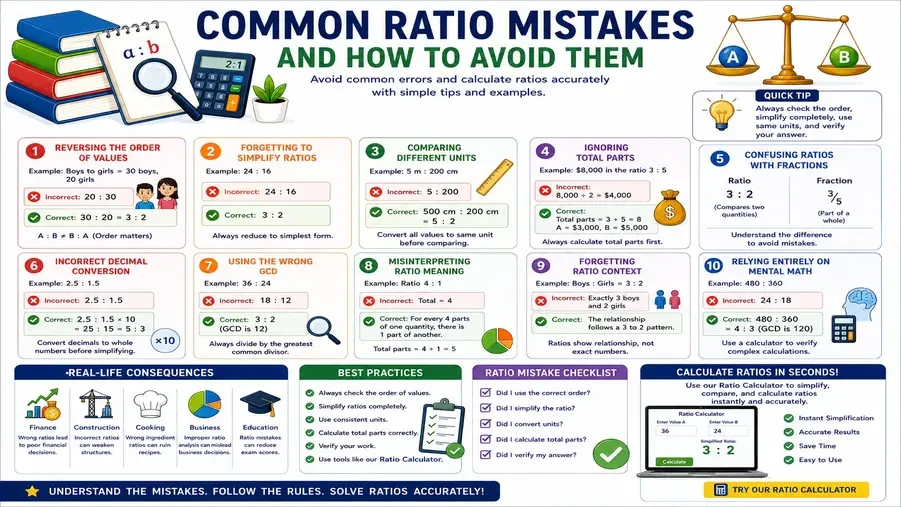
Mistake #1: Reversing the Order of Values
One of the most common ratio mistakes is writing the values in the wrong order.
Example
A classroom contains:
30 boys
20 girls
Question:
Find the ratio of boys to girls.
Incorrect Answer
20:30
Correct Answer
30:20
Simplified:
3:2
Always pay close attention to the order specified in the question.
Quick Tip
Remember:
A:B ≠ B:A
The order matters.
Mistake #2: Forgetting to Simplify Ratios
Many students stop after writing the ratio without reducing it to its simplest form.
Example
Ratio:
24:16
Incorrect Answer
24:16
Correct Answer
3:2
GCD = 8
24 ÷ 8 = 3
16 ÷ 8 = 2
Simplified ratios are easier to understand and compare.
You can use an online ratio calculator to simplify ratios automatically.
Mistake #3: Comparing Different Units
Ratios should only compare quantities measured in the same units.
Example
Compare:
5 meters : 200 centimeters
Incorrect Answer
5:200
Correct Answer
Convert meters into centimeters:
5 meters = 500 centimeters
Ratio:
500:200
Simplified:
5:2
Always convert units before calculating ratios.
Mistake #4: Ignoring Total Parts
This mistake often appears in word problems involving distribution.
Example
A sum of $8,000 is divided in the ratio 3:5.
Incorrect Method
Assume each person gets:
$8,000 ÷ 2
Correct Method
Total parts:
3 + 5 = 8
First person:
(3 ÷ 8) × 8,000
= $3,000
Second person:
(5 ÷ 8) × 8,000
= $5,000
Always calculate total parts first.
Mistake #5: Confusing Ratios with Fractions
Ratios and fractions may look similar, but they are not always the same.
Ratio Example
3:2
Compares two quantities.
Fraction Example
3/5
Represents part of a whole.
Understanding the difference prevents interpretation errors.
Mistake #6: Incorrect Decimal Conversion
Ratios containing decimals should be converted into whole numbers before simplification.
Example
2.5 : 1.5
Incorrect Answer
Leave as 2.5 : 1.5
Correct Method
Multiply both values by 10:
25 : 15
Simplify:
5 : 3
Final Ratio:
5:3
Mistake #7: Using the Wrong Greatest Common Divisor
Choosing the wrong divisor results in partially simplified ratios.
Example
36:24
Incorrect Simplification
18:12
Correct Simplification
3:2
The greatest common divisor is 12.
Always divide by the largest common factor.
Mistake #8: Misinterpreting Ratio Meaning
Many people misunderstand what a ratio actually represents.
Example
Ratio:
4:1
Incorrect Interpretation
Total = 4
Correct Interpretation
For every 4 units of one quantity, there is 1 unit of another.
Total parts:
4 + 1 = 5
Understanding this distinction is critical for solving ratio word problems.
Mistake #9: Forgetting Ratio Context
Ratios should always be interpreted within their context.
Example
Student Ratio
Boys:Girls
3:2
This does not mean there are exactly 3 boys and 2 girls.
It means the relationship between boys and girls follows a 3-to-2 pattern.
Mistake #10: Relying Entirely on Mental Math
Mental calculations can introduce unnecessary errors.
Example
Large Ratio
480:360
Many people simplify incorrectly.
Correct:
GCD = 120
480 ÷ 120 = 4
360 ÷ 120 = 3
Final Ratio:
4:3
Using a ratio calculator can help verify complex calculations instantly.
Real-Life Consequences of Ratio Mistakes
Finance
Incorrect financial ratios can lead to poor investment decisions.
Construction
Wrong material ratios can weaken structures.
Cooking
Incorrect ingredient ratios can ruin recipes.
Business
Improper ratio analysis can misrepresent performance.
Education
Ratio mistakes can reduce exam scores.
Best Practices for Accurate Ratio Calculations
Follow these simple rules:
Always Check the Order
Confirm which quantity comes first.
Simplify Completely
Reduce ratios to their lowest terms.
Use Consistent Units
Convert measurements before comparing.
Verify Your Work
Double-check calculations.
Use Technology Wisely
A ratio calculator can help confirm your answers quickly.
Ratio Mistakes Checklist
Before submitting your answer, ask yourself:
✅ Did I use the correct order?
✅ Did I simplify the ratio?
✅ Did I convert units?
✅ Did I calculate total parts correctly?
✅ Did I verify my answer?
Following this checklist eliminates most ratio-related errors.
Frequently Asked Questions
What is the most common ratio mistake?
Reversing the order of values is one of the most frequent errors.
Should ratios always be simplified?
In most cases, yes. Simplified ratios are easier to understand and compare.
Can ratios compare different units?
No. Convert quantities into the same unit first.
How do I verify ratio calculations?
You can use a ratio calculator to check your results instantly.
Why do students struggle with ratios?
Most ratio mistakes come from misunderstanding order, simplification, and proportional relationships.
Conclusion
Ratio calculations are simple once you understand the basic rules. Most mistakes occur because of incorrect order, failure to simplify, unit conversion errors, or misunderstanding the relationship between quantities.
By recognizing these common pitfalls and following best practices, you can improve accuracy and confidence in solving ratio problems.
If you'd like to verify your calculations instantly and avoid manual errors, try our ratio calculator to simplify, compare, and calculate ratios in seconds.
Disclaimer
The information provided in this article is for educational and informational purposes only. It should not be considered as professional financial, medical, or legal advice. Always consult with qualified professionals for specific guidance related to your situation.
Popular Calculators
Explore our most-used free calculators for finance, health, and everyday needs.