
Log Base 2 vs Log Base 10: What's the Difference?
Learn the difference between log base 2 and log base 10 with simple examples, real-world applications, comparison table, and tips on when to use each.
Calcifyai Team
Expert calculators & financial tools
Logarithms are used in mathematics, computer science, engineering, physics, and data analysis to simplify calculations involving exponential growth and large numbers. Among the different logarithmic bases, log base 2 (binary logarithm) and log base 10 (common logarithm) are the most widely used.
Although both measure the exponent needed to produce a number, they are designed for different purposes. Understanding when to use each one can make solving mathematical and real-world problems much easier. If you'd like to solve logarithms with different bases quickly, our Logarithm Calculator makes these calculations simple and accurate.
What Is Log Base 2?
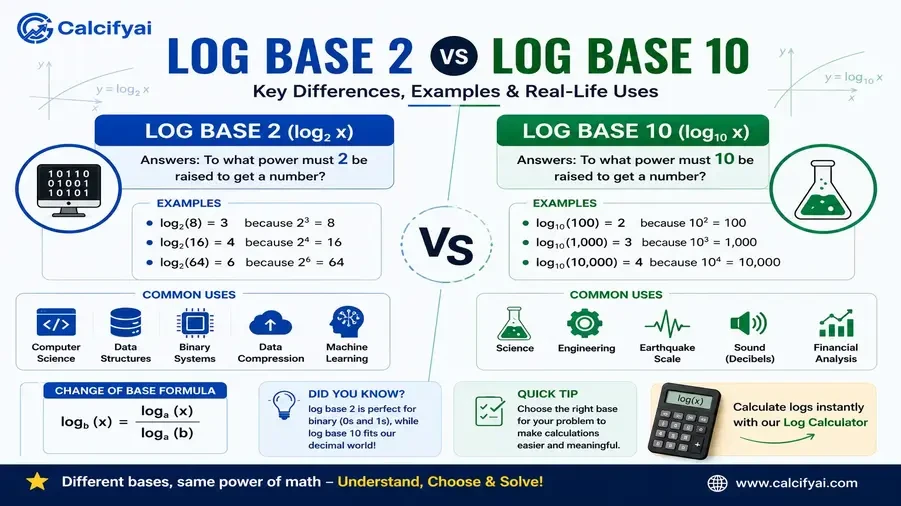
Log base 2, written as log₂(x), answers this question:
"To what power must 2 be raised to equal a given number?"
Examples
log₂(8) = 3 because 2³ = 8
log₂(16) = 4 because 2⁴ = 16
log₂(64) = 6 because 2⁶ = 64
Since computers process information using binary digits (0s and 1s), log base 2 plays a vital role in computer science, programming, and algorithm analysis.
What Is Log Base 10?
Log base 10, written as log₁₀(x) or simply log(x), answers this question:
"To what power must 10 be raised to equal a given number?"
Examples
log₁₀(100) = 2 because 10² = 100
log₁₀(1,000) = 3 because 10³ = 1,000
log₁₀(10,000) = 4 because 10⁴ = 10,000
Because our decimal number system is based on powers of ten, common logarithms are frequently used in science, engineering, and many everyday calculations.
Log Base 2 vs Log Base 10
Feature | Log Base 2 | Log Base 10 |
Symbol | log₂(x) | log(x) or log₁₀(x) |
Base | 2 | 10 |
Common Name | Binary Logarithm | Common Logarithm |
Main Use | Computer Science | Science & Engineering |
Example | log₂(32) = 5 | log₁₀(1000) = 3 |
Key Differences
Base Number
The primary difference is the base used in the logarithm.
Log base 2 uses 2.
Log base 10 uses 10.
Although the calculation method is similar, changing the base changes the result.
Common Applications
Log Base 2
Binary logarithms are commonly used in:
Computer algorithms
Binary search
Information theory
Data compression
Memory calculations
Artificial intelligence
Log Base 10
Common logarithms are commonly used in:
Scientific calculations
Engineering
Chemistry
Earthquake measurements
Sound intensity
Financial analysis
Worked Examples
Example 1
Find:
log₂(32)
Since:
2⁵ = 32
Answer = 5
Example 2
Find:
log₁₀(1000)
Since:
10³ = 1000
Answer = 3
Example 3
Compare both logarithms for the number 64.
log₂(64) = 6
log₁₀(64) ≈ 1.806
Although both expressions describe the same number, the answers are different because they use different logarithm bases. You can verify both values instantly using our Log Calculator.
When Should You Use Log Base 2?
Use log base 2 when working with:
Computers
Binary systems
Search algorithms
Machine learning
Data structures
Digital storage
When Should You Use Log Base 10?
Use log base 10 when working with:
Engineering
Physics
Chemistry
Scientific research
Population growth
Financial calculations
Can You Convert Between Log Bases?
Yes. Different logarithm bases can be converted using the Change of Base Formula.
Formula:
log₂(x) = log₁₀(x) ÷ log₁₀(2)
This allows you to calculate log base 2 using a standard scientific calculator that supports base-10 logarithms.
Real-Life Applications
Computer Science
Binary search algorithms and memory calculations rely on log base 2 because computers use binary numbers.
Engineering
Engineers frequently use common logarithms to simplify calculations involving large values.
Finance
Logarithms help model investment growth, compound interest, and financial forecasting.
Scientific Research
Scientists use logarithmic scales to measure values that span a wide range. Large numbers are often written in scientific notation, making our Scientific Notation Calculator a helpful companion when working with logarithms.
Common Mistakes
Avoid these common errors.
Confusing log₂ with log₁₀.
Forgetting to identify the logarithm base.
Assuming every calculator uses the same default logarithm.
Applying the wrong logarithm in formulas.
Quick Tips
Log₂ is mainly used in computing.
Log₁₀ is widely used in science.
Different bases produce different answers.
Always check which logarithm base is required before solving.
Conclusion
Both log base 2 and log base 10 are valuable mathematical tools, but they serve different purposes. Binary logarithms are ideal for computer science and digital systems, while common logarithms are widely used in engineering and scientific calculations. Understanding the differences will help you choose the correct logarithm and solve problems more confidently.
If you frequently solve logarithmic problems, try our Log Calculator for quick calculations. To deepen your understanding of logarithmic concepts, read our Logarithm Rules Explained guide, where you'll learn the key properties and identities used to simplify logarithmic expressions.
Disclaimer
The information provided in this article is for educational and informational purposes only. It should not be considered as professional financial, medical, or legal advice. Always consult with qualified professionals for specific guidance related to your situation.
Popular Calculators
Explore our most-used free calculators for finance, health, and everyday needs.