
Logarithm Rules Explained: The Complete Beginner's Guide
Learn the essential logarithm rules with easy formulas, examples, and a cheat sheet. Master product, quotient, power, and change of base rules.
Calcifyai Team
Expert calculators & financial tools
Logarithms can seem confusing at first, but once you understand the basic rules, solving exponential equations and simplifying complex calculations becomes much easier. Whether you're studying algebra, calculus, finance, or computer science, learning logarithm rules is an essential math skill.
If you want to solve logarithmic problems instantly while learning the concepts, try our Log Calculator to verify your answers and understand each step more confidently.
What Is a Logarithm?
A logarithm answers one simple question:
"To what power must a base be raised to produce a given number?"
For example:
(2^3 = 8)
Therefore,
log₂(8) = 3
This means the logarithm tells us the exponent.
The general logarithm formula is:
logₐ(b) = c
where:
a = base
b = number
c = exponent
If you're new to exponents, you may also find our Scientific Notation Explained guide helpful, as it covers powers of numbers that are closely related to logarithmic concepts.
Why Are Logarithm Rules Important?
Without logarithm rules, solving exponential equations would be much more difficult.
These rules help you:
Simplify complicated expressions
Solve exponential equations
Work with scientific notation
Perform engineering calculations
Analyze financial growth
Calculate earthquake magnitude (Richter Scale)
Measure sound intensity (Decibel Scale)
For calculations involving extremely large or very small numbers, you can also use our Scientific Notation Calculator to convert and simplify values before applying logarithm rules.
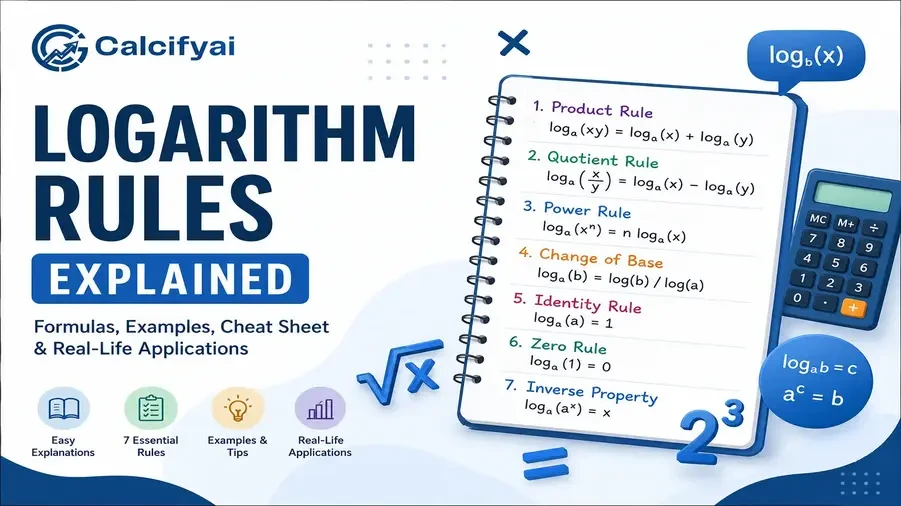
The 7 Essential Logarithm Rules
1. Product Rule
When multiplying numbers inside a logarithm, add their logarithms.
Formula
logₐ(xy) = logₐ(x) + logₐ(y)
Example
log₂(8 × 4)
= log₂(8) + log₂(4)
= 3 + 2
= 5
2. Quotient Rule
When dividing numbers, subtract the logarithms.
Formula
logₐ(x/y) = logₐ(x) − logₐ(y)
Example
log₁₀(1000 ÷ 10)
= log₁₀(1000) − log₁₀(10)
= 3 − 1
= 2
3. Power Rule
Move the exponent to the front.
Formula
logₐ(xⁿ) = n × logₐ(x)
Example
log₂(8²)
= 2 log₂(8)
= 2 × 3
= 6
This is one of the most frequently used logarithm identities.
4. Change of Base Formula
Convert any logarithm into another base.
Formula
logₐ(b) = log(b) / log(a)
or
logₐ(b) = ln(b) / ln(a)
Example
log₂(32)
= log(32) / log(2)
= 5
Most scientific calculators use this rule internally.
5. Identity Rule
The logarithm of the base equals 1.
Formula
logₐ(a) = 1
Example
log₅(5) = 1
Because:
5¹ = 5
6. Zero Rule
The logarithm of 1 is always zero.
Formula
logₐ(1) = 0
Example
log₁₀(1) = 0
Because:
10⁰ = 1
7. Inverse Property
Logarithms and exponents cancel each other.
Formula
logₐ(aˣ) = x
and
a^(logₐ(x)) = x
Example
log₃(3⁵)
= 5
Logarithm Rules Cheat Sheet
Rule | Formula |
Product Rule | log(xy) = log(x) + log(y) |
Quotient Rule | log(x/y) = log(x) − log(y) |
Power Rule | log(xⁿ) = n log(x) |
Change of Base | logₐ(x)=log(x)/log(a) |
Identity Rule | logₐ(a)=1 |
Zero Rule | logₐ(1)=0 |
Inverse Rule | logₐ(aˣ)=x |
Common Logarithm Mistakes
Many students make these mistakes:
❌ log(a + b) = log(a) + log(b)
This is incorrect.
Only multiplication can be separated.
✔ Correct:
log(ab) = log(a) + log(b)
❌ log(a − b)
There is no subtraction rule for logarithms.
❌ Forgetting the Base
Always check whether you're using:
Base 10 (common log)
Base e (natural log)
Base 2 (binary logarithm)
Real-Life Applications of Logarithms
Logarithms are used in many industries.
Science
Earthquake measurements
Radioactivity
Population growth
Finance
Compound interest
Investment growth
Loan calculations
Computer Science
Algorithm complexity
Binary search
Data compression
Engineering
Signal processing
Electrical circuits
Sound measurements
Tips for Remembering Logarithm Rules
A simple way to remember them is:
Multiply → Add
Divide → Subtract
Power → Bring the exponent in front
Base equals itself → 1
Log of 1 → 0
Practice these rules regularly and check your answers with our Log Calculator to build confidence and improve your speed.
Frequently Asked Questions
What is the easiest logarithm rule?
The Product Rule is often the easiest to learn:
log(ab) = log(a) + log(b)
Can logarithms have negative values?
Yes. If the number inside the logarithm is between 0 and 1, the result is negative.
Example:
log₁₀(0.1) = -1
Why can't we split log(a + b)?
Because logarithms only have multiplication and division properties. Addition and subtraction do not follow similar rules.
Which logarithm rule is used the most?
The Power Rule and Product Rule are the most frequently used in algebra, calculus, engineering, and physics.
Final Thoughts
Understanding logarithm rules makes it much easier to solve exponential equations, simplify mathematical expressions, and work with scientific calculations. Once you've mastered the Product Rule, Quotient Rule, Power Rule, Change of Base Formula, Identity Rule, Zero Rule, and Inverse Property, you'll be able to tackle a wide range of math problems with confidence.
Disclaimer
The information provided in this article is for educational and informational purposes only. It should not be considered as professional financial, medical, or legal advice. Always consult with qualified professionals for specific guidance related to your situation.
Popular Calculators
Explore our most-used free calculators for finance, health, and everyday needs.