
Understanding Large Numbers: A Simple Guide to Millions, Billions, Trillions & Beyond
Learn how to read and compare large numbers, understand millions, billions, trillions, place values, and scientific notation with easy examples and practical tips.
Calcifyai Team
Expert calculators & financial tools
Large numbers appear everywhere, from world populations and government budgets to business revenues, scientific discoveries, and computer storage. Yet many people struggle to understand just how big these numbers really are.
If you've ever wondered about the difference between a million and a billion, or how scientists write extremely large values, this guide will help you understand large numbers in a simple and practical way.
Along the way, you'll also discover useful tools and resources that make working with large numbers much easier.
What Are Large Numbers?
Large numbers are values that contain many digits and represent quantities much bigger than those we use in everyday counting.
Examples include:
Number | Name |
1,000 | One Thousand |
10,000 | Ten Thousand |
100,000 | One Hundred Thousand |
1,000,000 | One Million |
1,000,000,000 | One Billion |
1,000,000,000,000 | One Trillion |
As numbers become larger, reading and writing them accurately becomes more challenging.
Why Understanding Large Numbers Matters
Knowing how to interpret large numbers is useful in many real-life situations.
You may encounter them while:
Reading financial reports
Understanding national budgets
Comparing company valuations
Learning astronomy
Working with computer storage
Studying mathematics
Reading scientific research
Understanding population statistics
Without a clear understanding of place values, it's easy to misread these figures.
Place Value in Large Numbers
Every digit in a number has a specific place value.
Place | Value |
Ones | 1 |
Tens | 10 |
Hundreds | 100 |
Thousands | 1,000 |
Ten Thousands | 10,000 |
Hundred Thousands | 100,000 |
Millions | 1,000,000 |
Billions | 1,000,000,000 |
Trillions | 1,000,000,000,000 |
Understanding place values makes it easier to read large numbers correctly.
Million vs Billion vs Trillion
Many people confuse these terms because each one is dramatically larger than the previous.
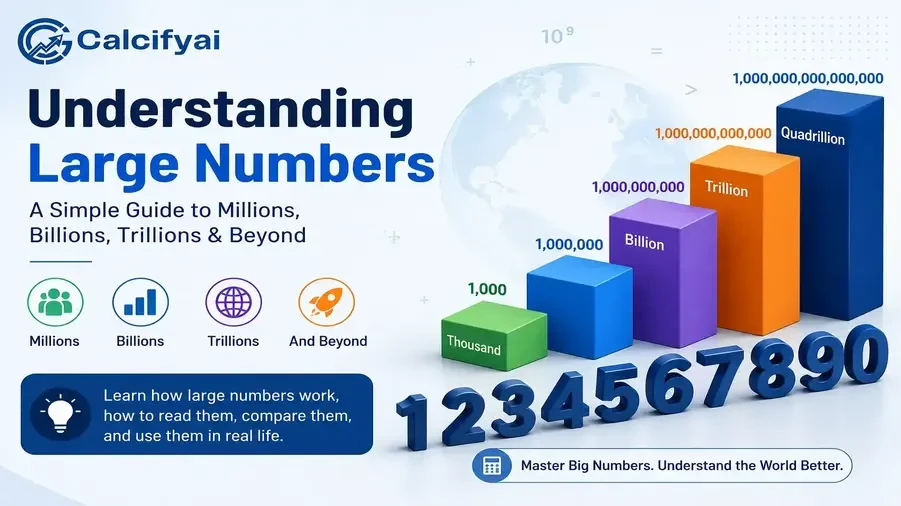
Name | Number |
Million | 1,000,000 |
Billion | 1,000,000,000 |
Trillion | 1,000,000,000,000 |
Quadrillion | 1,000,000,000,000,000 |
Each new level is 1,000 times larger than the previous one.
For example:
1 Billion = 1,000 Million
1 Trillion = 1,000 Billion
Scientific Notation Makes Large Numbers Easier
Scientists often use scientific notation to write extremely large values.
Examples:
1,000 = 1 × 10³
1,000,000 = 1 × 10⁶
1,000,000,000 = 1 × 10⁹
5,200,000 = 5.2 × 10⁶
Scientific notation reduces lengthy numbers into a compact and easy-to-read format.
If you frequently work with massive values, our Big Number Calculator can help you perform calculations with very large numbers quickly and accurately.
Real-World Examples of Large Numbers
Large numbers are used every day across different industries.
Finance
Company market capitalization
Government spending
National debt
GDP
Science
Distance between planets
Number of atoms
Speed of light calculations
Technology
Data storage
Internet users
Processor calculations
Population
World population
Country population
City population
Tips for Reading Large Numbers
Here are some easy tricks:
Read from Left to Right
Break numbers into groups of three digits.
Example:
12,345,678
Read as:
12 Million
345 Thousand
678
Use Commas
Commas separate groups of three digits, making numbers much easier to understand.
Instead of:
1234567890
Write:
1,234,567,890
Learn Common Place Values
Once you're comfortable with millions, billions, and trillions, reading larger values becomes much easier.
To gain a deeper understanding of exponents and powers of ten, don't miss our guide on Logarithm Rules Explained, which explains how logarithms relate to scientific notation and simplify complex calculations.
Common Mistakes When Working with Large Numbers
People often:
Misplace commas
Confuse million and billion
Count zeros incorrectly
Ignore place values
Misread scientific notation
Double-checking the number of zeros helps avoid costly mistakes.
How to Compare Large Numbers
Compare numbers by:
Counting the total number of digits.
Comparing the highest place value.
Comparing digits from left to right until you find a difference.
For example:
987,654,321 is larger than 876,543,210 because its first differing digit has a greater value.
Large Numbers in Mathematics
Mathematicians frequently use extremely large numbers for:
Probability
Statistics
Cryptography
Number theory
Astronomy
Physics
Computer science
Many advanced mathematical concepts rely on efficiently representing large values, which is why scientific notation is widely used in higher mathematics and engineering.
Everyday Situations Where Large Numbers Matter
You may encounter them while:
Calculating investments
Reading mortgage information
Understanding taxes
Following stock markets
Measuring internet storage
Comparing social media statistics
Planning business growth
Understanding these numbers helps you make better financial and analytical decisions.
Frequently Asked Questions
What is considered a large number?
Generally, any number with six or more digits is considered large, although the definition depends on the context.
How many zeros are in one billion?
One billion contains 9 zeros:
1,000,000,000
Is one trillion equal to 1,000 billion?
Yes. One trillion equals 1,000 billion.
Why is scientific notation important?
Scientific notation makes very large and very small numbers easier to write, compare, and calculate while reducing the chance of errors.
What's the easiest way to read large numbers?
Separate the number into groups of three digits using commas and read each group according to its place value.
Conclusion
Large numbers may seem overwhelming at first, but understanding place values, commas, and scientific notation makes them much easier to read and compare. Whether you're studying mathematics, analyzing financial reports, or exploring scientific concepts, mastering large numbers is a valuable skill.
For even faster calculations use the Scientific Notation Calculator to simplify exponential numbers.
Disclaimer
The information provided in this article is for educational and informational purposes only. It should not be considered as professional financial, medical, or legal advice. Always consult with qualified professionals for specific guidance related to your situation.
Popular Calculators
Explore our most-used free calculators for finance, health, and everyday needs.