
Natural Log vs Common Log: What's the Difference?
Learn the difference between natural log (ln) and common log (log). Compare formulas, bases, examples, uses, and applications with easy explanations.
Calcifyai Team
Expert calculators & financial tools
If you've recently started learning logarithms, you've probably encountered two terms that seem almost identical: natural log (ln) and common log (log). Although both are logarithmic functions, they use different bases and are applied in different areas of mathematics, science, engineering, and finance.
Understanding the difference between natural and common logarithms will help you solve equations more confidently and choose the correct function when using a scientific calculator.
If you'd like to calculate logarithms instantly while following this guide, try our Log Calculator to evaluate both natural logs and common logs accurately.
What Is a Logarithm?
A logarithm answers one important question:
"To what exponent must a base be raised to obtain a given number?"
For example,
10² = 100
Therefore,
log₁₀(100) = 2
Similarly,
e³ ≈ 20.085
Therefore,
ln(20.085) = 3
The only difference between these examples is the base being used.
If you're unfamiliar with logarithm properties, we recommend reading our Logarithm Rules Explained guide before continuing. It covers the Product Rule, Quotient Rule, Power Rule, and Change of Base Formula in detail.
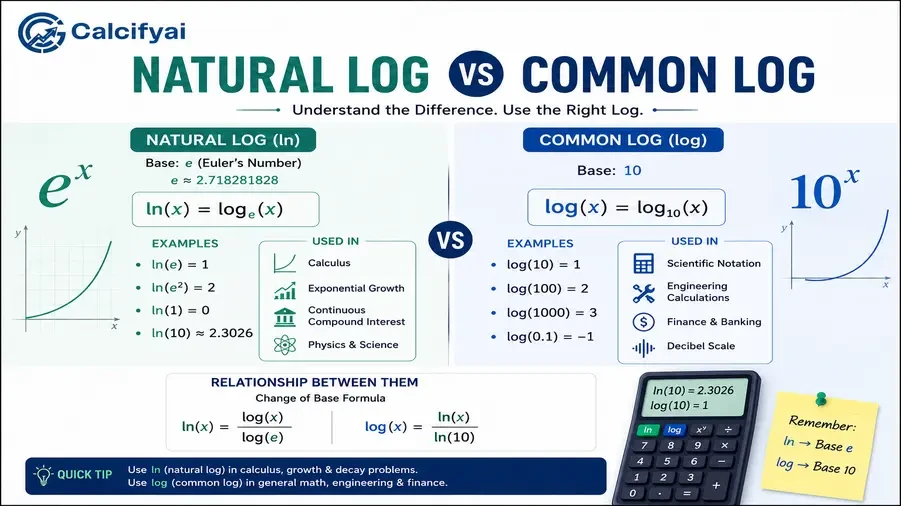
Natural Log vs Common Log: Quick Comparison
Feature | Natural Log (ln) | Common Log (log) |
Base | e (2.71828...) | 10 |
Symbol | ln(x) | log(x) |
Calculator Button | ln | log |
Common Applications | Calculus, Physics, Growth Models | Algebra, Engineering, Finance |
Exponential Form | eˣ | 10ˣ |
What Is a Common Log?
A common logarithm uses base 10.
Formula
log(x) = log₁₀(x)
Example
log(10) = 1
log(100) = 2
log(1000) = 3
Where Is Common Log Used?
Common logarithms are widely used in:
Engineering
Scientific notation
Financial calculations
Data analysis
Earthquake magnitude
Sound intensity (Decibel Scale)
If you're working with powers of ten or very large and very small numbers, our Scientific Notation Converter can simplify numbers before applying logarithmic calculations.
What Is a Natural Log?
A natural logarithm uses Euler's Number (e) as its base.
The value of e is approximately:
2.718281828
Formula
ln(x) = logₑ(x)
Example
ln(e) = 1
ln(e²) = 2
ln(1) = 0
Where Is Natural Log Used?
Natural logarithms are commonly used in:
Calculus
Differential equations
Compound interest
Population growth
Radioactive decay
Machine learning
Artificial intelligence
Key Differences Between Natural Log and Common Log
Different Bases
The primary difference is the logarithm base.
Common Log
Base = 10
Natural Log
Base = e
Although both follow the same logarithm rules, changing the base changes the answer.
Different Applications
Common Log Applications
Common logarithms are useful when working with:
Powers of 10
Scientific notation
Engineering calculations
Financial reports
Natural Log Applications
Natural logarithms are preferred for:
Continuous growth
Continuous decay
Exponential equations
Higher mathematics
Economics
Calculator Buttons
Most scientific calculators include both:
log
ln
Always choose the button that matches the logarithm base given in the problem.
Relationship Between ln and log
Natural logs and common logs can easily be converted using the Change of Base Formula.
Formula
logₐ(b) = log(b) ÷ log(a)
or
logₐ(b) = ln(b) ÷ ln(a)
Example
ln(100)
= log(100) ÷ log(e)
≈ 4.605
This formula is especially useful if your calculator supports only one logarithm function.
Worked Example
Suppose:
x = 100
Common Log
log(100)
= 2
Natural Log
ln(100)
≈ 4.605
Although the number is the same, the answers differ because the logarithm bases are different.
When Should You Use Each Logarithm?
Use Common Log When You Need To
Solve algebra problems
Work with scientific notation
Analyze engineering data
Read logarithmic charts
Use Natural Log When You Need To
Solve exponential equations
Study calculus
Calculate continuous compound interest
Model population growth
Solve physics equations
Real-Life Examples
Science
Natural logarithms describe:
Radioactive decay
Bacterial growth
Chemical reactions
Finance
Natural logs help calculate:
Continuous compound interest
Investment growth
Engineering
Common logarithms appear in:
Decibel calculations
Signal processing
Electrical engineering
Computer Science
Natural logarithms are used in:
Machine learning
Algorithm analysis
Probability models
Common Mistakes to Avoid
Using log Instead of ln
Always verify the required base before calculating.
Assuming log Means Base e
In most textbooks:
log = base 10
ln = base e
Pressing the Wrong Calculator Button
Choosing log instead of ln will produce a different answer.
Tips for Remembering the Difference
A simple memory trick:
log → Base 10
ln → Natural Number e
Practice with different examples until selecting the correct logarithm becomes automatic.
Frequently Asked Questions
Is ln the same as log?
No.
ln uses base e.
log uses base 10.
Which logarithm is used in calculus?
Natural logarithms (ln) are used extensively in calculus because they simplify differentiation and integration.
Why do calculators have both log and ln?
They represent two different logarithm bases, each used for different mathematical applications.
Can I convert one into another?
Yes. You can always convert between them using the Change of Base Formula.
Final Thoughts
Natural logarithms and common logarithms are closely related, but understanding when and why each is used is essential for solving mathematical problems accurately. Common logs (base 10) are ideal for everyday calculations, scientific notation, and engineering, while natural logs (base e) are fundamental in calculus, exponential growth, finance, and scientific modeling.
Disclaimer
The information provided in this article is for educational and informational purposes only. It should not be considered as professional financial, medical, or legal advice. Always consult with qualified professionals for specific guidance related to your situation.
Popular Calculators
Explore our most-used free calculators for finance, health, and everyday needs.