
Weighted Average Explained: Formula, Examples & Real-Life Uses
Learn what a weighted average is, how to calculate it using the formula, and when to use it. Explore simple examples, real-life applications, and common mistakes.
Calcifyai Team
Expert calculators & financial tools
A weighted average is a type of average where each value contributes according to its importance, or weight. Unlike a simple average, where every value counts equally, a weighted average gives more influence to values with higher weights.
Weighted averages are widely used in education, finance, business, investing, economics, and statistics. Whether you're calculating your GPA, determining a product's average price, or evaluating investment returns, understanding weighted averages can help you make more accurate decisions. If you need to perform these calculations quickly, our Average Calculator can help you find averages accurately in just a few seconds.
In this guide, you'll learn:
What a weighted average is
The weighted average formula
How to calculate it step by step
Real-world examples
Common mistakes to avoid
When to use a weighted average instead of a simple average
What Is a Weighted Average?
A weighted average is an average that assigns different levels of importance (weights) to each value before calculating the final result.
Instead of treating every value equally, larger weights have a greater impact on the final average.
Simple Example
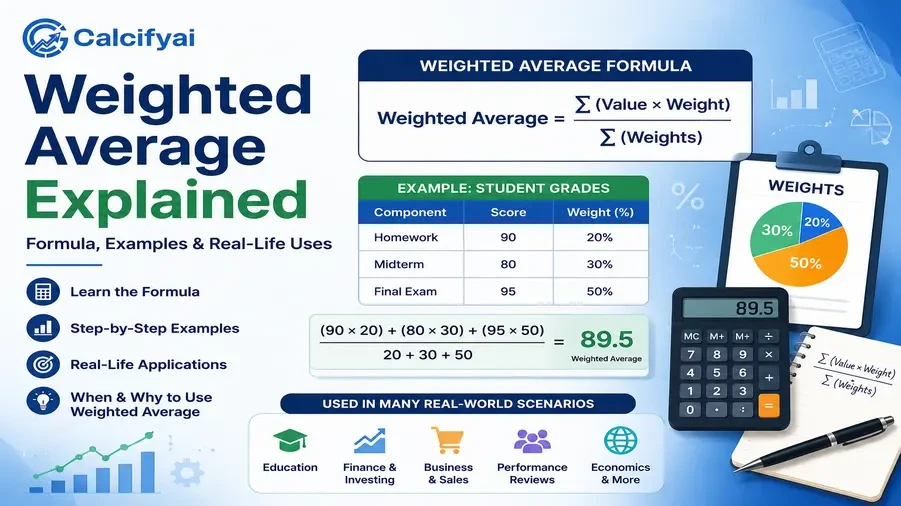
Imagine your course grade is made up of:
Homework = 20%
Midterm = 30%
Final Exam = 50%
Suppose you scored:
Homework: 90
Midterm: 80
Final Exam: 95
Since the final exam is worth more than the homework, it has a greater influence on your overall grade.
This is exactly how a weighted average works.
Weighted Average Formula
The weighted average is calculated using the following formula:
Weighted Average = Σ(Value × Weight) ÷ Σ(Weights)
Where:
Σ means "sum of"
Value is the individual data point
Weight is the importance assigned to that value
This formula ensures that each value contributes proportionally to its assigned weight. If you're looking to calculate weighted or simple averages instantly, try our Average Calculator for quick and accurate results.
How to Calculate a Weighted Average
Follow these simple steps:
Step 1: List all values
Score | Weight |
90 | 20 |
80 | 30 |
95 | 50 |
Step 2: Multiply each value by its weight
Score | Weight | Score × Weight |
90 | 20 | 1800 |
80 | 30 | 2400 |
95 | 50 | 4750 |
Step 3: Add the weighted values
1800 + 2400 + 4750 = 8950
Step 4: Add the weights
20 + 30 + 50 = 100
Step 5: Divide
8950 ÷ 100 = 89.5
Weighted Average = 89.5
Weighted Average vs Simple Average
Many people confuse a weighted average with a simple average.
Simple Average | Weighted Average |
Every value is equally important | Values have different importance |
Easy to calculate | Requires weights |
Best when all observations are equal | Best when some observations matter more |
Example
Scores:
80, 90
Simple Average
(80 + 90) ÷ 2 = 85
Suppose the second score counts twice as much.
Weighted Average
(80 × 1 + 90 × 2) ÷ 3
= 86.67
Notice how the weighted average shifts toward the value with the greater weight. To better understand how averages differ from other statistical measures, read our guide on Mean vs Median vs Mode: What's the Difference?
Real-Life Examples of Weighted Averages
Student Grades
Schools often assign different percentages to homework, quizzes, projects, and final exams.
A weighted average provides a fair representation of the final grade.
Stock Portfolio Returns
Investors use weighted averages to determine the average purchase price or return of a portfolio.
Larger investments have more impact than smaller ones.
Business Sales
A company selling products in different quantities calculates the weighted average selling price instead of using a simple average.
Employee Performance Reviews
Organizations often assign different weights to:
Productivity
Attendance
Teamwork
Communication
This produces a balanced overall evaluation.
Economics
Weighted averages are commonly used when calculating:
Consumer Price Index (CPI)
Inflation
GDP components
Market indexes
Financial analysts often use multiple statistical measures together. Our Statistics Calculator makes it easy to calculate averages, variance, standard deviation, and other statistical values from a single dataset.
Advantages of Weighted Averages
Using a weighted average offers several benefits:
Produces more accurate results
Reflects real-world importance
Reduces misleading averages
Useful in finance and statistics
Easy to apply once weights are known
Common Mistakes
Avoid these common errors:
Forgetting to multiply by the weight
Always multiply each value before adding.
Using percentages incorrectly
If weights are percentages, ensure they total 100%.
Ignoring weight totals
If weights don't add up to 100, divide by the sum of the weights, not by the number of values.
Confusing weighted average with simple average
Remember that weighted averages account for importance, while simple averages treat every value equally.
When Should You Use a Weighted Average?
Use a weighted average when:
Some values matter more than others
Grades have different percentages
Investments have different amounts
Sales volumes vary
Survey responses have different significance
Financial calculations require proportional influence
If every value has equal importance, a simple average is usually sufficient.
Frequently Asked Questions
What is the difference between a weighted average and a regular average?
A regular average gives every value equal importance, while a weighted average assigns greater influence to values with higher weights.
Can weights be percentages?
Yes. Percentages are one of the most common types of weights, provided they add up to 100%.
Can a weighted average be higher than the simple average?
Yes. If larger weights are assigned to higher values, the weighted average will exceed the simple average.
Where are weighted averages used?
Weighted averages are used in education, finance, investing, economics, business reporting, and statistical analysis.
Why is a weighted average more accurate?
Because it reflects the actual importance of each value instead of treating every observation equally.
Conclusion
A weighted average is one of the most useful statistical tools because it accounts for the importance of each value rather than treating all observations equally. Whether you're calculating grades, investment performance, sales data, or business metrics, using a weighted average provides a more realistic result than a simple average.
Disclaimer
The information provided in this article is for educational and informational purposes only. It should not be considered as professional financial, medical, or legal advice. Always consult with qualified professionals for specific guidance related to your situation.
Popular Calculators
Explore our most-used free calculators for finance, health, and everyday needs.