
Scientific Notation vs Standard Numbers: What's the Difference?
Learn the difference between scientific notation and standard numbers, when to use each, how to convert between them, and see practical examples with easy explanations.
Calcifyai Team
Expert calculators & financial tools
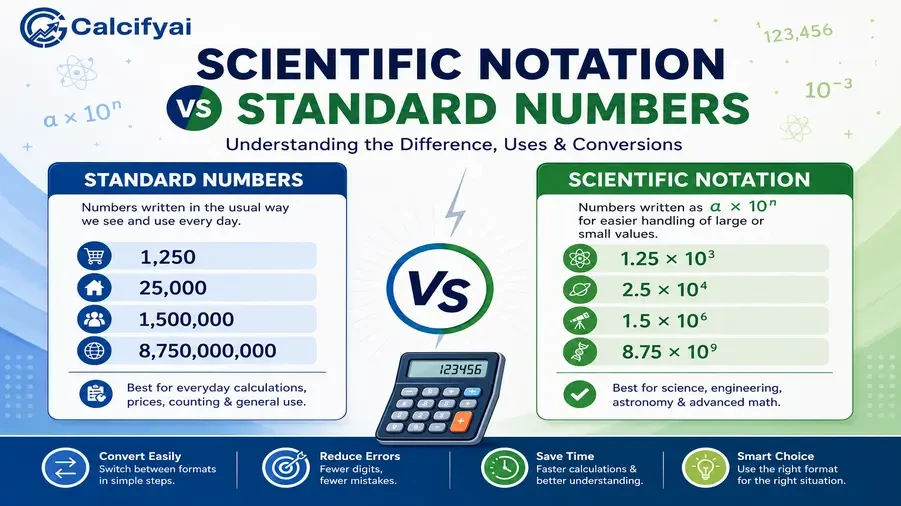
Scientific notation and standard numbers are two common ways of writing numerical values. While standard numbers are used in everyday life, scientific notation is designed to simplify extremely large or very small numbers.
Whether you're a student, teacher, engineer, scientist, or simply brushing up on math skills, understanding when and how to use each format can make calculations easier and reduce mistakes.
In this guide, we'll compare scientific notation and standard numbers, explain their advantages, and show you how to convert between them.
What Are Standard Numbers?
Standard numbers (also called decimal notation) are the numbers we use in everyday life.
Examples include:
Standard Number | Meaning |
25 | Twenty-five |
450 | Four hundred fifty |
8,750 | Eight thousand seven hundred fifty |
1,250,000 | One million two hundred fifty thousand |
Standard numbers are easy to read when values are relatively small, but they can become difficult to manage as numbers grow larger. If you're unfamiliar with reading numbers that contain many digits, our Understanding Large Numbers guide explains millions, billions, trillions, and beyond in a simple, beginner-friendly way.
What Is Scientific Notation?
Scientific notation is a mathematical method of expressing numbers as a value multiplied by a power of ten.
The general formula is:
a × 10ⁿ
Where:
a is a number between 1 and 10.
n is an integer exponent.
Examples:
Standard Number | Scientific Notation |
1,000 | 1 × 10³ |
45,000 | 4.5 × 10⁴ |
5,200,000 | 5.2 × 10⁶ |
0.005 | 5 × 10⁻³ |
0.000001 | 1 × 10⁻⁶ |
Scientific Notation vs Standard Numbers
Feature | Standard Numbers | Scientific Notation |
Readability | Best for everyday values | Best for extremely large or small values |
Number of Digits | Can be very long | Compact and concise |
Common Uses | Shopping, banking, education | Science, engineering, astronomy |
Calculations | Less efficient for huge numbers | Easier multiplication and division |
Error Risk | Higher with many zeros | Lower because of simplified format |
Why Scientific Notation Is Useful
Scientific notation offers several advantages:
Simplifies very large numbers
Makes tiny decimal values easier to read
Reduces counting errors
Speeds up calculations
Widely accepted in science and engineering
Makes comparing numbers much easier
For example, writing 6,700,000,000 as 6.7 × 10⁹ is much easier to understand and work with. When dealing with values much larger than billions or trillions, you can also use our Big Number Calculator to perform calculations accurately without manually counting long strings of digits.
How to Convert Standard Numbers to Scientific Notation
Follow these simple steps:
Step 1: Find the Decimal Point
Locate the decimal point in the original number.
Step 2: Move the Decimal
Move it until only one non-zero digit remains on the left.
Step 3: Count the Moves
The number of places moved becomes the exponent.
Step 4: Add the Power of Ten
Write the result in the form:
a × 10ⁿ
Example
7,250,000
↓
7.25 × 10⁶
Instead of converting numbers manually every time, you can use our Scientific Notation Calculator to instantly convert standard numbers into scientific notation and vice versa, helping you save time and avoid calculation errors.
How to Convert Scientific Notation to Standard Numbers
Converting back is equally simple.
Positive Exponent
Move the decimal point to the right.
Example:
3.8 × 10⁴
↓
38,000
Negative Exponent
Move the decimal point to the left.
Example:
7.2 × 10⁻⁵
↓
0.000072
Real-Life Examples
Scientific notation appears in many fields.
Science
Speed of light
Distance between planets
Number of atoms
Medicine
Cell sizes
Virus measurements
Blood analysis
Technology
Data processing
Semiconductor manufacturing
Computer engineering
Finance
Although standard numbers are commonly used in finance, scientific notation is helpful when working with massive economic datasets and research involving extremely large values.
When Should You Use Standard Numbers?
Standard numbers are best for:
Shopping
Banking
Budgets
Daily calculations
School assignments
Reading prices
Personal finance
They are familiar and easy for most people to understand.
When Should You Use Scientific Notation?
Scientific notation is ideal for:
Physics
Chemistry
Astronomy
Engineering
Statistics
Data science
Scientific research
It helps simplify calculations involving extremely large or extremely small numbers.
Common Mistakes to Avoid
Many learners make these mistakes:
Counting decimal places incorrectly
Using the wrong exponent sign
Forgetting the coefficient must be between 1 and 10
Confusing positive and negative exponents
Omitting the multiplication symbol (×)
Practicing conversions regularly helps eliminate these mistakes.
Scientific Notation vs Standard Form
Some countries use the term standard form to describe scientific notation, while others use it to mean ordinary decimal notation.
Always check the terminology used in your textbook, examination board, or curriculum.
Frequently Asked Questions
Which is easier to understand?
Standard numbers are easier for everyday use, while scientific notation is better for expressing extremely large or very small values.
Can scientific notation represent small numbers?
Yes. Negative exponents allow scientific notation to represent tiny decimal values.
Why do scientists prefer scientific notation?
Because it simplifies calculations, reduces writing, and minimizes errors.
Is scientific notation used outside science?
Absolutely. It is also widely used in engineering, computing, economics, finance, and statistics.
Can calculators convert scientific notation?
Yes. Many scientific calculators support this feature, and online calculators make conversions even faster.
Conclusion
Both scientific notation and standard numbers have important roles in mathematics and everyday life. Standard numbers are ideal for daily activities, while scientific notation makes working with extremely large or tiny values much simpler.
Disclaimer
The information provided in this article is for educational and informational purposes only. It should not be considered as professional financial, medical, or legal advice. Always consult with qualified professionals for specific guidance related to your situation.
Popular Calculators
Explore our most-used free calculators for finance, health, and everyday needs.