
Prime Factorization Method for GCF: Step-by-Step Guide with Examples
Learn the Prime Factorization Method for GCF with simple steps, solved examples, practice questions, and tips to find the greatest common factor easily.
Calcifyai Team
Expert calculators & financial tools
What Is the Prime Factorization Method for GCF?
Finding the Greatest Common Factor (GCF) is an essential math skill used in simplifying fractions, solving equations, and working with ratios. One of the most reliable ways to calculate the GCF is the Prime Factorization Method.
Instead of listing every factor of each number, this method breaks each number into its prime factors and identifies the common ones. It's accurate, systematic, and works well even for large numbers. If you'd like to find the factors of a number before starting, our Factor Calculator makes the process quick and easy.
What Is Prime Factorization?
Prime factorization means expressing a number as the product of its prime numbers.
A prime number has exactly two factors: 1 and itself.
For example:
12 = 2 × 2 × 3
18 = 2 × 3 × 3
30 = 2 × 3 × 5
These prime factors form the basis for finding the Greatest Common Factor.
What Is the Greatest Common Factor (GCF)?
The Greatest Common Factor (GCF) is the largest number that divides two or more numbers exactly without leaving a remainder.
Knowing the GCF is useful when simplifying fractions, factoring algebraic expressions, and solving many everyday math problems. If you want an instant answer, you can also use our GCF Calculator to calculate the greatest common factor in seconds.
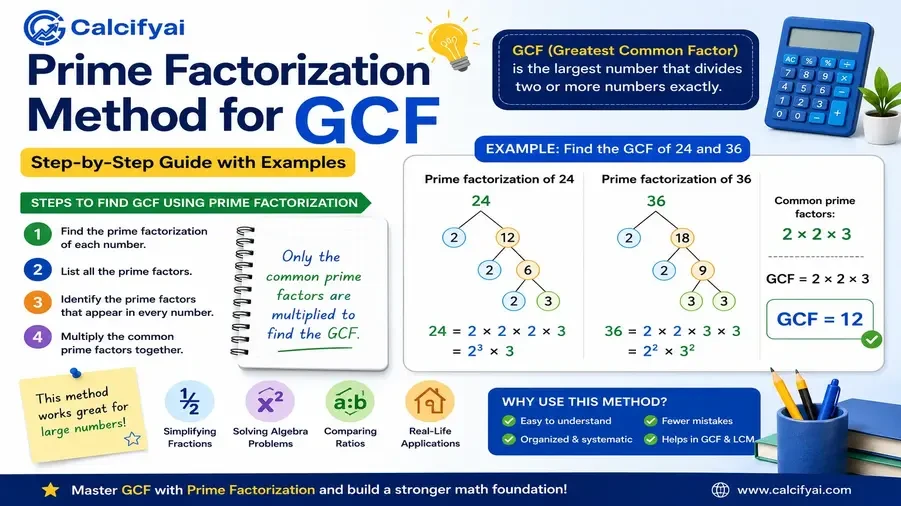
Steps to Find the GCF Using Prime Factorization
Follow these simple steps.
Step 1
Find the prime factorization of each number.
Step 2
List all the prime factors.
Step 3
Identify the prime factors that appear in every number.
Step 4
Multiply the common prime factors together.
The result is the Greatest Common Factor (GCF).
Example 1: Find the GCF of 24 and 36
Prime factorization of 24:
24 = 2 × 2 × 2 × 3
Prime factorization of 36:
36 = 2 × 2 × 3 × 3
Common prime factors:
2 × 2 × 3
Multiply them:
2 × 2 × 3 = 12
GCF = 12
Example 2: Find the GCF of 18 and 30
Prime factorization of 18:
18 = 2 × 3 × 3
Prime factorization of 30:
30 = 2 × 3 × 5
Common prime factors:
2 × 3
Multiply them:
2 × 3 = 6
GCF = 6
Example 3: Find the GCF of 45 and 60
Prime factorization of 45:
45 = 3 × 3 × 5
Prime factorization of 60:
60 = 2 × 2 × 3 × 5
Common prime factors:
3 × 5
Multiply them:
3 × 5 = 15
GCF = 15
Why Use Prime Factorization?
The prime factorization method offers several advantages.
Works well for large numbers.
Reduces calculation mistakes.
Makes common factors easier to identify.
Builds a stronger understanding of number relationships.
Helps when calculating both the GCF and LCM.
When Is This Method Useful?
The prime factorization method is commonly used in many situations.
Simplifying Fractions
Divide the numerator and denominator by their GCF to write fractions in their simplest form.
Solving Algebra Problems
Factoring expressions often begins by finding the greatest common factor.
Comparing Ratios
Reducing ratios becomes easier after calculating the GCF.
Number Theory
Prime factorization is one of the most important concepts in elementary and advanced mathematics.
Prime Factorization vs Listing Factors
Prime Factorization | Listing Factors |
Breaks numbers into prime factors | Lists every factor |
Better for larger numbers | Better for smaller numbers |
Systematic and organized | Can take longer |
Helps find both GCF and LCM | Mainly used for finding the GCF |
Common Mistakes to Avoid
Students often make these errors:
Missing repeated prime factors.
Forgetting to use only the common prime factors.
Including prime factors that appear in only one number.
Multiplying all prime factors instead of only the common ones.
Stopping before completing the prime factorization.
Always verify that every composite number has been broken down into prime numbers before finding the GCF.
Quick Tips
Every composite number has one unique prime factorization.
Only multiply the common prime factors.
The GCF can never be greater than the smallest number.
Prime factorization is useful for both GCF and LCM calculations.
Practice Questions
1. Find the GCF of 16 and 24.
Answer:
16 = 2⁴
24 = 2³ × 3
Common prime factors:
2³
GCF = 8
2. Find the GCF of 28 and 42.
Answer:
28 = 2² × 7
42 = 2 × 3 × 7
Common prime factors:
2 × 7
GCF = 14
3. Find the GCF of 32 and 48.
Answer:
32 = 2⁵
48 = 2⁴ × 3
Common prime factors:
2⁴
GCF = 16
Conclusion
The Prime Factorization Method is one of the most effective ways to find the Greatest Common Factor. By breaking numbers into their prime factors and multiplying only the common ones, you can solve GCF problems accurately and understand how numbers are related. This method is especially useful for simplifying fractions, solving algebra problems, and improving overall number sense.
To strengthen your understanding of prime numbers and factorization, read our guide on Factor Tree Method Explained with Examples. You can also use our Factor Calculator and GCF Calculator whenever you need quick and accurate answers.
Frequently Asked Questions
What is the prime factorization method?
It is a method of finding the GCF by breaking each number into its prime factors and multiplying the common prime factors.
Why is prime factorization useful for finding the GCF?
It makes it easy to identify the common prime factors, especially when working with larger numbers.
Can I use this method for more than two numbers?
Yes. Simply find the prime factorization of each number and multiply the prime factors that appear in every number.
Is the prime factorization method better than listing factors?
For larger numbers, yes. It is generally faster, more organized, and less likely to lead to mistakes.
What is the fastest way to calculate the GCF?
You can either use the prime factorization method manually or calculate it instantly with an online GCF Calculator.
Disclaimer
The information provided in this article is for educational and informational purposes only. It should not be considered as professional financial, medical, or legal advice. Always consult with qualified professionals for specific guidance related to your situation.
Popular Calculators
Explore our most-used free calculators for finance, health, and everyday needs.