
Factor Tree Method Explained with Examples
Learn the Factor Tree Method with easy steps, worked examples, diagrams, and practice questions. Master prime factorization and improve your math skills quickly.
Calcifyai Team
Expert calculators & financial tools
What Is the Factor Tree Method?
Finding the prime factors of a number is one of the first skills students learn in mathematics, and the Factor Tree Method is one of the easiest ways to do it. Instead of guessing the prime factors directly, a factor tree breaks a number into smaller factors step by step until only prime numbers remain.
This visual approach makes prime factorization simple to understand and helps build a strong foundation for topics like the Greatest Common Factor (GCF), Least Common Multiple (LCM), fractions, and algebra. If you'd like to find the factors of any number instantly before building a factor tree, try our factorising calculator.
What Is a Factor Tree?
A factor tree is a diagram that shows how a composite number can be broken down into smaller factors. You continue splitting each composite factor until every branch ends with a prime number.
The final prime numbers at the ends of the branches are called the prime factors of the original number.
Example
To factor 24:
24 = 4 × 6
4 = 2 × 2
6 = 2 × 3
Prime factors:
2 × 2 × 2 × 3
So, the prime factorization of 24 is:
2³ × 3
What Are Prime Factors?
Prime factors are numbers that have only two factors: 1 and themselves.
Common prime numbers include:
2, 3, 5, 7, 11, 13, 17, 19...
When creating a factor tree, every branch should end with one of these prime numbers.
How to Use the Factor Tree Method
Follow these simple steps.
Step 1
Write the number at the top of the tree.
Step 2
Split it into any two factors.
Step 3
Check each factor.
If it is prime, stop.
If it is composite, split it again.
Step 4
Continue until every branch ends with prime numbers.
Step 5
Multiply all the prime factors together.
Factor Tree Examples
Example 1: Factor Tree of 18
18
↓
2 × 9
↓
2 × 3 × 3
Prime factorization:
2 × 3²
Example 2: Factor Tree of 36
36
↓
6 × 6
↓
2 × 3 × 2 × 3
Prime factorization:
2² × 3²
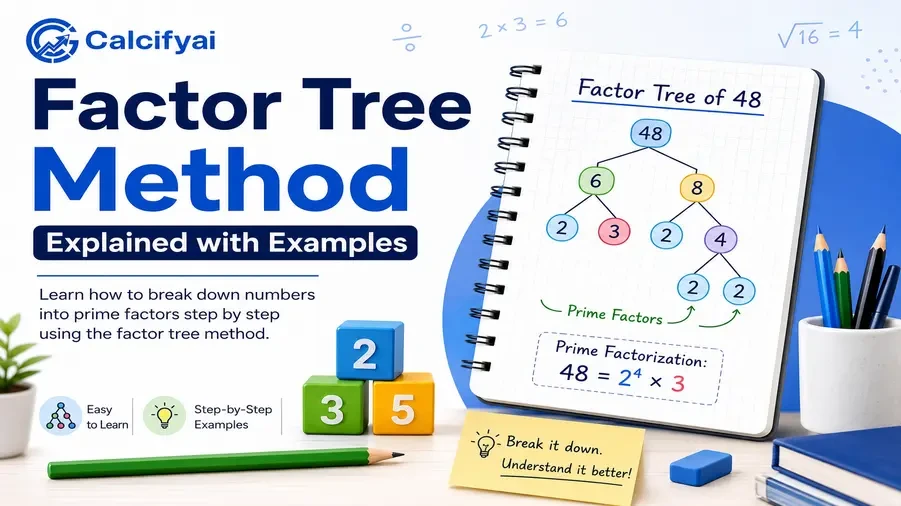
Example 3: Factor Tree of 48
48
↓
6 × 8
↓
2 × 3 × 2 × 4
↓
2 × 3 × 2 × 2 × 2
Prime factorization:
2⁴ × 3
Example 4: Factor Tree of 72
72
↓
8 × 9
↓
2 × 2 × 2 × 3 × 3
Prime factorization:
2³ × 3²
Why Does the Factor Tree Method Work?
Every composite number can be written as a unique product of prime numbers. This principle is known as the Fundamental Theorem of Arithmetic.
Even if you begin your factor tree with different pairs of factors, you'll always end up with the same set of prime factors.
For example:
24
24 = 4 × 6
24 = 3 × 8
24 = 2 × 12
Although the trees look different, they all produce:
2³ × 3
Benefits of Using the Factor Tree Method
The factor tree method offers several advantages.
Easy for beginners to learn.
Helps visualize factorization.
Makes prime factors easier to identify.
Useful for finding the GCF and LCM.
Improves problem-solving skills in mathematics.
Where Is the Factor Tree Method Used?
Factor trees are commonly used in many math topics.
Simplifying Fractions
Prime factors help reduce fractions to their simplest form.
Finding the Greatest Common Factor
Once the prime factors are known, finding the greatest common factor becomes much easier. You can also use our GCF Calculator to calculate it instantly.
Finding the Least Common Multiple
Prime factorization is one of the quickest ways to calculate the LCM.
Algebra
Factorization is frequently used when simplifying algebraic expressions and solving equations.
Common Mistakes to Avoid
When drawing a factor tree, students often make these mistakes:
Stopping before reaching prime numbers.
Treating composite numbers as prime.
Forgetting to include repeated prime factors.
Missing one of the branches.
Multiplying the final factors incorrectly.
Always check that every branch ends with a prime number.
Quick Tips
A factor tree can start with any pair of factors.
Different trees can produce the same prime factorization.
Every composite number has one unique prime factorization.
Prime numbers cannot be broken down further.
Practice Questions
1. Find the prime factorization of 20.
Answer:
20 = 2² × 5
2. Draw a factor tree for 45.
Answer:
45 = 5 × 9
9 = 3 × 3
Prime factorization:
5 × 3²
3. What is the prime factorization of 60?
Answer:
2² × 3 × 5
4. Is 29 a prime number?
Answer:
Yes. Since it has only two factors (1 and 29), it is a prime number.
Conclusion
The Factor Tree Method is one of the simplest ways to understand prime factorization. By breaking a number into smaller factors until only prime numbers remain, you can solve many mathematical problems with confidence. This technique is especially useful when simplifying fractions, finding the GCF, calculating the LCM, and learning algebra.
Frequently Asked Questions
What is the factor tree method?
The factor tree method is a technique used to break a composite number into its prime factors by repeatedly dividing it into smaller factors.
Can a factor tree start with any factors?
Yes. You can begin with any pair of factors, and the final prime factorization will always be the same.
Do prime numbers have factor trees?
No. Prime numbers cannot be divided into smaller factors other than 1 and themselves.
Why is the factor tree method important?
It helps students understand prime factorization, simplify fractions, calculate the GCF and LCM, and solve algebra problems.
What is the easiest way to find factors?
You can use the factor tree method manually or save time by using an online Factor Calculator.
Disclaimer
The information provided in this article is for educational and informational purposes only. It should not be considered as professional financial, medical, or legal advice. Always consult with qualified professionals for specific guidance related to your situation.
Popular Calculators
Explore our most-used free calculators for finance, health, and everyday needs.