
Multiples and Factors Explained: Learn the Difference with Examples
Learn the difference between multiples and factors with simple explanations, examples, comparison tables, and practice questions. Master the basics of math easily.
Calcifyai Team
Expert calculators & financial tools
What Are Multiples and Factors?
Every math problem starts with understanding how numbers relate to one another. Two of the most useful concepts for recognizing these relationships are multiples and factors. While they may sound similar, they serve different purposes and are used in everything from basic arithmetic to algebra, fractions, and real-life calculations.
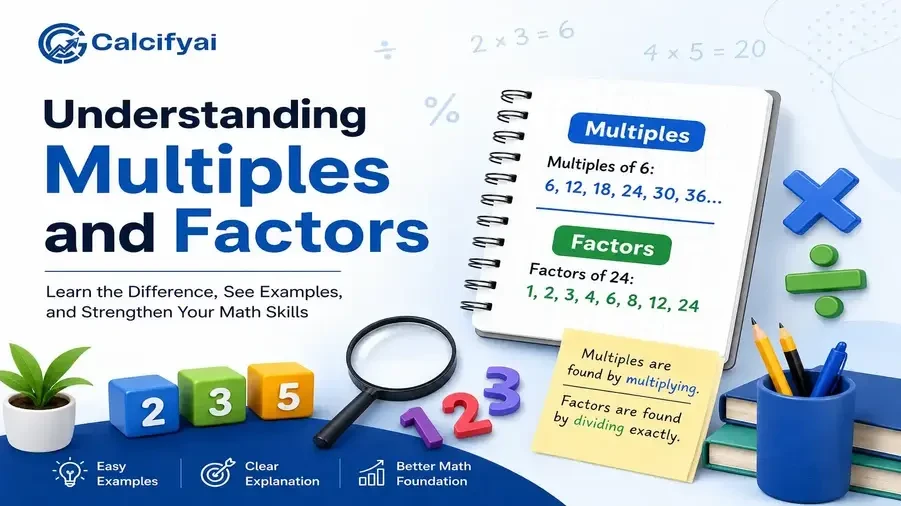
A multiple is the product you get when you multiply a number by a whole number. A factor is a number that divides another number evenly without leaving a remainder.
Knowing when to use multiples and factors can make solving math problems much easier. Whether you're finding common denominators, simplifying fractions, or checking divisibility, these concepts are essential. If you want to identify every factor of a number instantly, our Factor Calculator can help you get accurate results in seconds.
What Is a Multiple?
A multiple is formed by multiplying a number by 1, 2, 3, and other whole numbers.
Example
The first few multiples of 8 are:
8 × 1 = 8
8 × 2 = 16
8 × 3 = 24
8 × 4 = 32
8 × 5 = 40
Multiples of 8 are:
8, 16, 24, 32, 40, 48, 56...
Since there is no largest whole number, a number has infinitely many multiples.
What Is a Factor?
A factor is a number that divides another number exactly, producing no remainder.
Example
The factors of 36 are:
1
2
3
4
6
9
12
18
36
Each of these numbers divides 36 evenly.
Every number has a limited number of factors. When comparing the factors of two or more numbers, our GCF Calculator can quickly find the greatest common factor without manual calculations.
Multiples vs Factors
Multiples | Factors |
Found by multiplication | Found by division |
Can continue forever | Limited in number |
Equal to or greater than the original number | Equal to or smaller than the original number |
Used to find common multiples | Used to find common factors |
Examples of Multiples and Factors
Number | Factors | First Six Multiples |
3 | 1, 3 | 3, 6, 9, 12, 15, 18 |
6 | 1, 2, 3, 6 | 6, 12, 18, 24, 30, 36 |
9 | 1, 3, 9 | 9, 18, 27, 36, 45, 54 |
12 | 1, 2, 3, 4, 6, 12 | 12, 24, 36, 48, 60, 72 |
How to Find Multiples
Finding multiples only requires multiplication.
Step 1
Choose the number.
Step 2
Multiply it by consecutive whole numbers.
Example
Find the first five multiples of 7.
7 × 1 = 7
7 × 2 = 14
7 × 3 = 21
7 × 4 = 28
7 × 5 = 35
Answer: 7, 14, 21, 28, 35
How to Find Factors
To find the factors of any number:
Begin with 1.
Divide the number by whole numbers.
If the remainder is zero, the divisor is a factor.
Example
Find the factors of 28.
28 ÷ 1 = 28
28 ÷ 2 = 14
28 ÷ 4 = 7
Therefore, the factors are:
1, 2, 4, 7, 14, 28
Common Multiples
A common multiple is a number that appears in the multiplication tables of two or more numbers.
Example
Multiples of 5:
5, 10, 15, 20, 25, 30...
Multiples of 10:
10, 20, 30, 40...
Common multiples:
10, 20, 30...
The smallest common multiple is called the Least Common Multiple (LCM).
Common Factors
A common factor divides two or more numbers without leaving a remainder.
Example
Factors of 20:
1, 2, 4, 5, 10, 20
Factors of 30:
1, 2, 3, 5, 6, 10, 15, 30
Common factors:
1, 2, 5, 10
The largest one is known as the Greatest Common Factor (GCF).
Why Are Multiples and Factors Important?
These concepts appear in many practical situations.
In School
Students use them to solve fractions, algebra, and number theory problems.
In Everyday Life
They help divide items equally, organize schedules, and calculate repeated patterns.
In Construction
Builders use multiples and factors when measuring lengths and dividing materials.
In Finance
Payment schedules, installment plans, and budgeting often involve multiplication and divisibility.
Quick Tips to Remember
Multiples come from multiplication.
Factors come from division.
Every number has unlimited multiples.
Every number has a limited number of factors.
Every number is both a multiple and a factor of itself.
Practice Questions
What are the first six multiples of 9?
Answer: 9, 18, 27, 36, 45, 54
Find all the factors of 32.
Answer: 1, 2, 4, 8, 16, 32
What is the greatest common factor of 24 and 36?
Answer: 12
Which is the smallest common multiple of 4 and 6?
Answer: 12
Common Mistakes to Avoid
Thinking multiples and factors mean the same thing.
Forgetting that multiples continue forever.
Assuming factors can be larger than the original number.
Missing factor pairs when finding all factors.
Conclusion
Once you understand how multiples and factors work, many other math concepts become easier to learn. They are essential for solving fractions, identifying common divisors, working with algebra, and improving problem-solving skills.
Frequently Asked Questions
Are multiples and factors opposites?
In a way, yes. Multiples are produced through multiplication, while factors are identified through division.
Can a number have unlimited factors?
No. Every number has only a finite number of factors.
Does every number have infinite multiples?
Yes. Since multiplication never ends, every number has infinitely many multiples.
Why are common factors useful?
Common factors help simplify fractions, solve equations, and find the greatest common factor.
What's the fastest way to find factors?
You can divide the number by whole numbers or use an online Factor Calculator for instant results.
Disclaimer
The information provided in this article is for educational and informational purposes only. It should not be considered as professional financial, medical, or legal advice. Always consult with qualified professionals for specific guidance related to your situation.
Popular Calculators
Explore our most-used free calculators for finance, health, and everyday needs.