
Number Naming System Explained: Learn Large Numbers the Easy Way
Learn the number naming system with simple rules, Indian vs International place values, examples, and tips to read and write large numbers confidently.
Calcifyai Team
Expert calculators & financial tools
Have you ever wondered how numbers like 1,000,000 become one million or 10,00,000 becomes ten lakh? That's where the number naming system comes in. It provides a standardized way to read, write, and understand numbers of all sizes.
Whether you're a student, teacher, competitive exam aspirant, or simply brushing up on basic math, understanding the number naming system makes working with large numbers much easier.
In this guide, you'll learn how the number naming system works, the differences between the Indian and International systems, and practical tips for reading and writing numbers correctly.
If you're working with very large values, try our Large Number Calculator to perform calculations accurately without manual errors.
What Is the Number Naming System?
The number naming system is a method of assigning names to numbers based on their place values. Instead of reading each digit separately, numbers are grouped into place values and given names such as thousand, million, crore, or billion.
For example:
125 → One Hundred Twenty-Five
5,480 → Five Thousand Four Hundred Eighty
1,250,000 → One Million Two Hundred Fifty Thousand
10,00,000 → Ten Lakh (Indian System)
This system helps people read, write, and communicate numbers clearly.
Why Is the Number Naming System Important?
Understanding number names is useful in everyday life because numbers appear almost everywhere.
Examples include:
Banking and finance
Population statistics
Business reports
Scientific research
School mathematics
Government records
Learning number names also improves confidence when reading large figures.
Understanding Place Value
Every digit in a number has a value depending on its position.
For example:
Number | Place Value |
8 | Ones |
80 | Tens |
800 | Hundreds |
8,000 | Thousands |
80,000 | Ten Thousands |
800,000 | Hundred Thousands |
Place value forms the foundation of the number naming system.
If you'd like to understand place values in more detail, read our guide on Understanding Large Numbers.
Indian Number Naming System
The Indian numbering system uses Lakhs and Crores after thousands.
Number | Name |
1,000 | One Thousand |
10,000 | Ten Thousand |
1,00,000 | One Lakh |
10,00,000 | Ten Lakh |
1,00,00,000 | One Crore |
10,00,00,000 | Ten Crore |
The commas are placed differently after the first three digits.
Example:
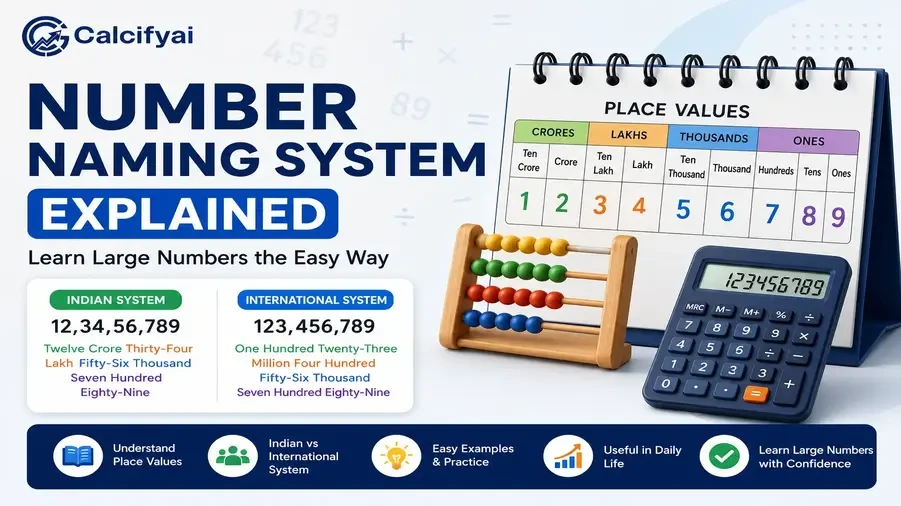
12,34,56,789
reads as
Twelve Crore Thirty-Four Lakh Fifty-Six Thousand Seven Hundred Eighty-Nine
International Number Naming System
The International system uses Thousands, Millions, Billions, and Trillions.
Number | Name |
1,000 | One Thousand |
1,000,000 | One Million |
1,000,000,000 | One Billion |
1,000,000,000,000 | One Trillion |
Example:
123,456,789
reads as
One Hundred Twenty-Three Million Four Hundred Fifty-Six Thousand Seven Hundred Eighty-Nine
Indian vs International Number Naming System
Indian System | International System |
Thousand | Thousand |
Lakh | Hundred Thousand |
Crore | Ten Million |
Arab | Billion |
Kharab | Hundred Billion |
The main difference lies in how digits are grouped and the names assigned to larger place values.
How to Read Large Numbers
Follow these simple steps:
Step 1
Identify the comma placement.
Step 2
Break the number into groups.
Step 3
Read each group from left to right.
Step 4
Add the correct place value name.
Example:
54,728,910
International System:
Fifty-Four Million Seven Hundred Twenty-Eight Thousand Nine Hundred Ten
Tips to Learn Number Names Faster
You can master the number naming system by:
Memorizing place values
Practicing daily with large numbers
Reading numbers aloud
Comparing Indian and International systems
Solving place value exercises
Using visual charts also makes learning easier.
Common Mistakes to Avoid
Many learners make these mistakes:
Confusing lakh with million
Incorrect comma placement
Skipping place values
Mixing Indian and International naming systems
Reading digits individually instead of grouping them
Regular practice helps eliminate these errors.
Real-Life Uses of the Number Naming System
You'll use number names in many situations, including:
Reading bank balances
Understanding budgets
Interpreting population data
Stock market reports
Scientific calculations
Business analytics
Large numbers become much easier to understand when you know the naming system.
Need to compare or simplify huge values? Our Scientific Notation Calculator can convert extremely large numbers into an easy-to-read scientific format.
Frequently Asked Questions
What is the number naming system?
It is a method of assigning names to numbers based on their place values so they can be read and written correctly.
What is the difference between the Indian and International number naming systems?
The Indian system uses terms like Lakh and Crore, while the International system uses Million, Billion, and Trillion.
Why is place value important?
Place value determines the value of each digit, making it possible to correctly read and write numbers.
Is one lakh equal to one million?
No. One lakh equals 100,000, while one million equals 1,000,000.
How can I learn number names quickly?
Practice reading large numbers, understand place values, and compare both numbering systems regularly.
Conclusion
The number naming system is an essential mathematical concept that helps us read, write, and communicate numbers accurately. By understanding place values and the differences between the Indian and International numbering systems, you'll find it much easier to work with everything from everyday figures to massive financial or scientific values.
Whether you're solving math problems, preparing for exams, or handling real-world data, mastering number names is a valuable skill that builds confidence with numbers.
Disclaimer
The information provided in this article is for educational and informational purposes only. It should not be considered as professional financial, medical, or legal advice. Always consult with qualified professionals for specific guidance related to your situation.
Popular Calculators
Explore our most-used free calculators for finance, health, and everyday needs.