
Ratio vs Fraction: What's the Difference?
Learn the difference between ratios and fractions with simple explanations, formulas, examples, and comparison tables. Understand when to use a ratio and when to use a fraction.
Calcifyai Team
Expert calculators & financial tools
Many students and even adults often confuse ratios and fractions because they look similar and both involve numbers being compared. While ratios and fractions share some similarities, they serve different purposes in mathematics and everyday life.
Understanding the difference between ratios and fractions can help you solve math problems more accurately, interpret data correctly, and improve your overall number sense.
In this guide, you'll learn exactly what ratios and fractions are, how they differ, when to use each one, and practical examples that make the concepts easy to understand.
What Is a Ratio?
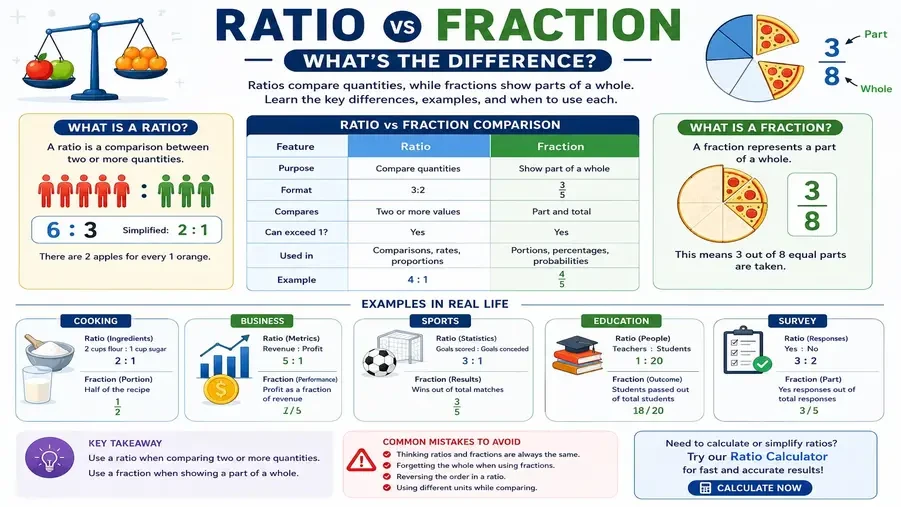
A ratio is a comparison between two or more quantities.
It shows the relationship between values and tells us how much of one quantity exists compared to another.
Ratio Examples
3:2
5:1
10 to 4
For example:
A basket contains:
6 apples
3 oranges
The ratio of apples to oranges is:
6:3
After simplification:
2:1
This means there are 2 apples for every 1 orange.
What Is a Fraction?
A fraction represents a part of a whole.
Fractions show how many parts are taken from a total number of equal parts.
Fraction Examples
1/2
3/4
5/8
For example:
A pizza is divided into 8 slices.
You eat 3 slices.
The fraction representing the portion eaten is:
3/8
This means 3 out of 8 equal parts were consumed.
Key Difference Between Ratio and Fraction
The simplest way to understand the difference is:
A ratio compares quantities.
A fraction represents part of a whole.
Example
Suppose a class contains:
12 boys
8 girls
Ratio
Ratio of boys to girls:
12:8
Simplified:
3:2
Fraction
Fraction of boys in the class:
12 / (12 + 8)
12/20
3/5
The ratio compares boys and girls.
The fraction shows what portion of the class is boys.
Ratio vs Fraction Comparison Table
Feature | Ratio | Fraction |
Purpose | Compare quantities | Show part of a whole |
Format | 3:2 | 3/5 |
Compares | Two or more values | Part and total |
Can exceed 1? | Yes | Yes |
Used in | Comparisons, rates, proportions | Portions, percentages, probabilities |
Example | 4:1 | 4/5 |
Similarities Between Ratios and Fractions
Ratios and fractions have several similarities.
Both Use Division
A ratio can be written as a fraction.
Example:
4:2
can also be written as
4/2
Both Can Be Simplified
Ratio:
12:8
Simplified:
3:2
Fraction:
12/8
Simplified:
3/2
Both Compare Numbers
Both concepts involve understanding relationships between quantities.
When Should You Use a Ratio?
Use ratios when comparing separate quantities.
Examples
Comparing Students
20 boys : 15 girls
Comparing Ingredients
2 cups flour : 1 cup sugar
Comparing Business Metrics
Revenue : Profit
Sports Statistics
Wins : Losses
Ratios are ideal when the goal is comparison.
When Should You Use a Fraction?
Use fractions when describing part of a whole.
Examples
Pizza
3 slices out of 8
3/8
Survey Results
45 people out of 100 selected an option
45/100
Classroom Attendance
18 students attended out of 20
18/20
Fractions are best when measuring portions.
Converting Ratios to Fractions
Sometimes a ratio can be converted into a fraction.
Example
Ratio:
3:2
Total parts:
3 + 2 = 5
Fraction of the first quantity:
3/5
Fraction of the second quantity:
2/5
This is commonly used when converting ratios into percentages.
Converting Fractions to Ratios
Fractions can also be expressed as ratios.
Example
Fraction:
4/7
Ratio:
4:7
However, the meaning changes slightly.
The fraction represents part of a whole.
The ratio compares quantities.
Real-Life Examples of Ratios and Fractions
Cooking
Ratio:
2 cups water : 1 cup rice
Fraction:
Half of the recipe
1/2
Business
Ratio:
Assets : Liabilities
Fraction:
Profit as a fraction of revenue
Sports
Ratio:
Goals scored : Goals conceded
Fraction:
Wins out of total matches played
Education
Ratio:
Teachers : Students
Fraction:
Students passing out of total students
Common Mistakes People Make
Assuming Ratios and Fractions Are Always the Same
Although ratios can be written as fractions, they often have different meanings.
Forgetting the Whole in Fractions
Fractions always involve a total quantity.
Reversing Ratio Order
5:2 is not the same as 2:5.
Order matters.
Comparing Different Units
Always use the same units before creating ratios or fractions.
Ratio vs Fraction in Competitive Exams
Many aptitude and reasoning tests include questions about ratios and fractions.
Common exam topics include:
Simplifying ratios
Ratio and proportion
Fraction conversion
Percentage conversion
Word problems
Understanding the difference helps students solve problems faster and more accurately.
Benefits of Understanding Ratios and Fractions
Improves mathematical skills
Helps with financial calculations
Makes data interpretation easier
Useful in business analysis
Supports exam preparation
Enhances problem-solving abilities
Frequently Asked Questions
Is a ratio the same as a fraction?
No. A ratio compares quantities, while a fraction represents part of a whole.
Can a ratio be written as a fraction?
Yes. Ratios can often be expressed as fractions, but the meaning may differ.
Which is easier to simplify?
Both use similar simplification methods by dividing by the greatest common factor.
Why are ratios important?
Ratios help compare values and understand relationships between quantities.
Why are fractions important?
Fractions help describe portions, percentages, probabilities, and measurements.
Conclusion
Ratios and fractions may look similar, but they serve different purposes. A ratio compares quantities, while a fraction describes part of a whole. Understanding when to use each concept is essential for solving math problems, interpreting data, managing finances, and handling everyday calculations.
Whenever you need to compare two quantities quickly, use a ratio. When you need to show a portion of a total, use a fraction.
To simplify, compare, and calculate ratios instantly, try our Ratio Calculator and get accurate results in seconds.
Disclaimer
The information provided in this article is for educational and informational purposes only. It should not be considered as professional financial, medical, or legal advice. Always consult with qualified professionals for specific guidance related to your situation.
Popular Calculators
Explore our most-used free calculators for finance, health, and everyday needs.