
Simplifying Ratios Explained with Examples | Easy Step-by-Step Guide
Learn how to simplify ratios step by step with easy examples, formulas, and practical applications. Understand the simplest form of ratios and avoid common mistakes.
Calcifyai Team
Expert calculators & financial tools
Ratios are used everywhere, from classroom math problems and cooking recipes to business reports and financial analysis. However, ratios are often easier to understand when they are written in their simplest form.
Simplifying ratios helps reduce larger numbers into smaller, equivalent values while maintaining the same relationship between quantities. This makes comparisons easier and calculations more efficient.
If you want to simplify ratios quickly without manual calculations, you can use our ratio calculator to get instant results and reduce ratios automatically.
In this guide, you'll learn exactly how to simplify ratios, why it's important, and how to solve common ratio problems step by step.
What Does It Mean to Simplify a Ratio?
Simplifying a ratio means reducing it to its smallest equivalent form.
The relationship between the numbers remains the same, but the ratio becomes easier to read and understand.
Example
Ratio:
20:10
Both numbers can be divided by 10.
20 ÷ 10 = 2
10 ÷ 10 = 1
Simplified Ratio:
2:1
Although the numbers changed, the relationship stayed exactly the same.
Why Is Simplifying Ratios Important?
Simplified ratios make comparisons easier and help avoid unnecessary complexity.
Benefits include:
Easier calculations
Better understanding of relationships
Faster problem-solving
Improved accuracy in exams
Simplified financial analysis
Clearer business and statistical reporting
For large numbers, using an online ratio calculator can save significant time and eliminate manual errors.
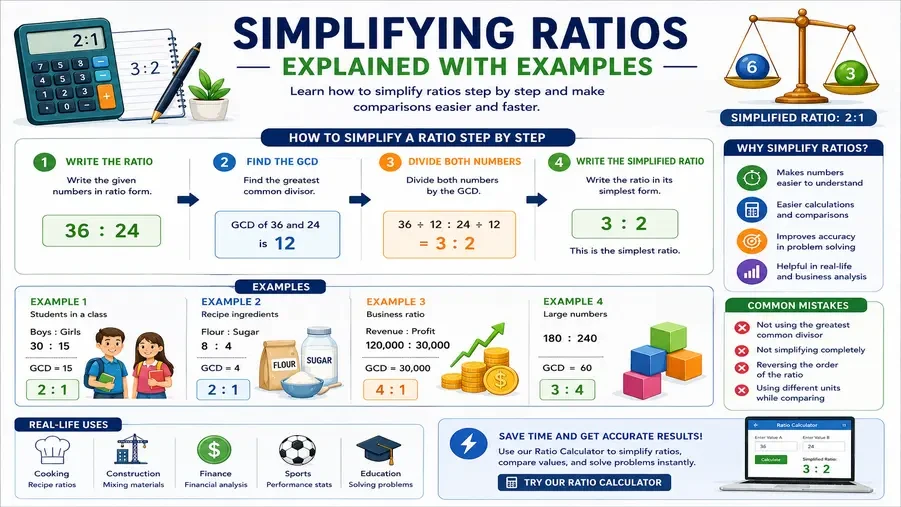
How to Simplify Ratios Step by Step
Step 1: Write the Ratio
Example:
36:24
Step 2: Find the Greatest Common Divisor (GCD)
Factors of 36:
1, 2, 3, 4, 6, 9, 12, 18, 36
Factors of 24:
1, 2, 3, 4, 6, 8, 12, 24
Largest common factor:
12
Step 3: Divide Both Numbers
36 ÷ 12 = 3
24 ÷ 12 = 2
Step 4: Write the Simplified Ratio
3:2
This is the simplest form.
Example 1: Simplifying a Student Ratio
A classroom has:
30 boys
15 girls
Ratio:
30:15
GCD:
15
Divide:
30 ÷ 15 = 2
15 ÷ 15 = 1
Final Ratio:
2:1
Interpretation:
For every 2 boys, there is 1 girl.
Example 2: Simplifying a Recipe Ratio
Recipe Ingredients:
8 cups flour
4 cups sugar
Ratio:
8:4
Divide by 4:
2:1
The recipe requires 2 parts flour for every 1 part sugar.
Example 3: Simplifying a Business Ratio
A company reports:
Revenue = $120,000
Profit = $30,000
Ratio:
120,000:30,000
Divide by 30,000:
4:1
This means the company earns $4 in revenue for every $1 in profit.
Simplifying Ratios with Large Numbers
Example:
180:240
GCD:
60
Divide:
180 ÷ 60 = 3
240 ÷ 60 = 4
Simplified Ratio:
3:4
Large numbers can often be simplified dramatically. A ratio simplifier calculator can help verify your results instantly.
Simplifying Ratios with Decimals
Example
2.5 : 1.5
Multiply both numbers by 10:
25 : 15
Find GCD:
5
Divide:
25 ÷ 5 = 5
15 ÷ 5 = 3
Final Ratio:
5:3
Simplifying Ratios with Fractions
Example
1/2 : 1/4
Convert to a common denominator:
2/4 : 1/4
Remove denominators:
2 : 1
Simplified Ratio:
2:1
Real-Life Uses of Simplified Ratios
Education
Students simplify ratios to solve math and aptitude questions.
Cooking
Recipes often use simplified ingredient ratios.
Construction
Builders use ratios for concrete mixing and scaling measurements.
Finance
Investors compare financial metrics using simplified ratios.
Sports
Analysts compare wins, losses, goals, and performance statistics.
Common Ratio Simplification Mistakes
Not Using the Greatest Common Divisor
Incorrect:
20:10 → 10:5
Correct:
20:10 → 2:1
Always simplify completely.
Mixing Different Units
Incorrect:
5 meters : 100 centimeters
Convert first:
500 cm : 100 cm
Simplified:
5:1
Reversing the Order
Ratio order matters.
3:2 is not the same as 2:3.
Forgetting Decimals
Always convert decimals into whole numbers before simplifying.
Simplified Ratio vs Unsimplified Ratio
Original Ratio | Simplified Ratio |
20:10 | 2:1 |
24:16 | 3:2 |
36:24 | 3:2 |
100:50 | 2:1 |
180:240 | 3:4 |
Both ratios are mathematically equivalent, but the simplified version is easier to understand.
When Should Ratios Be Simplified?
Ratios should usually be simplified when:
Solving math problems
Completing school assignments
Preparing reports
Comparing quantities
Taking competitive exams
However, some real-world situations may require keeping the original values for context.
Frequently Asked Questions
What is the easiest way to simplify a ratio?
Find the greatest common divisor and divide both numbers by it.
Can ratios with decimals be simplified?
Yes. Convert decimals into whole numbers first, then simplify.
Do simplified ratios change the meaning?
No. They represent the same relationship between quantities.
Why do we simplify ratios?
Simplified ratios make comparisons easier and improve clarity.
Can I simplify ratios automatically?
Yes. You can use our ratio calculator to simplify ratios instantly and avoid manual calculations.
Conclusion
Simplifying ratios is an essential math skill that helps make comparisons clearer and calculations easier. Whether you're working with school assignments, recipes, business metrics, or financial data, reducing ratios to their simplest form improves understanding and accuracy.
The process is simple:
Find the greatest common divisor.
Divide both numbers.
Write the simplified ratio.
If you want to save time and eliminate mistakes, try our ratio calculator to simplify ratios instantly and compare values with ease.
Disclaimer
The information provided in this article is for educational and informational purposes only. It should not be considered as professional financial, medical, or legal advice. Always consult with qualified professionals for specific guidance related to your situation.
Popular Calculators
Explore our most-used free calculators for finance, health, and everyday needs.