
BigInt Explained: How Computers Handle Very Large Integers
Learn what BigInt is, how computers handle very large integers, how BigInt differs from Number, and when to use it in JavaScript.
Calcifyai Team
Expert calculators & financial tools
A computer can store and calculate numbers far larger than the numbers we normally use every day. But there is an important catch: not every number type can represent every integer exactly.
Educational Resources
That matters when software works with huge IDs, cryptographic calculations, large counters, mathematical formulas, or other data where losing even one digit can cause a problem.
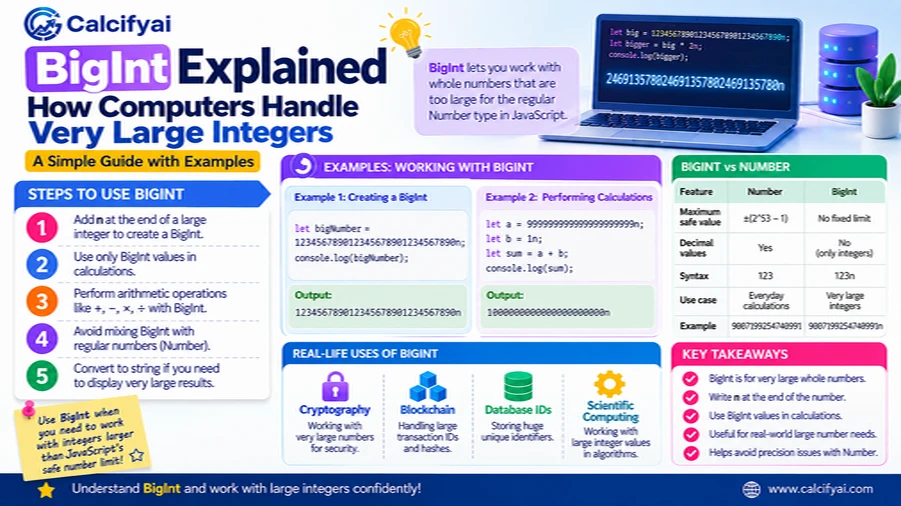
BigInt is a numeric data type designed for this situation. In JavaScript, BigInt can represent integers with arbitrary magnitude, allowing calculations beyond the safe integer range of the regular Number type.
In simple terms:
BigInt lets JavaScript work with very large whole numbers while preserving integer precision.
For example:
The n at the end tells JavaScript that this value is a BigInt.
What Is BigInt?
BigInt is a JavaScript primitive data type for representing integers that are too large or too small to be handled safely as ordinary JavaScript Number values.
JavaScript's regular Number type uses 64-bit IEEE 754 floating-point representation. Although it can represent numbers with very large magnitudes, its integer precision is limited.
The largest safe integer is:
2⁵³ − 1 = 9,007,199,254,740,991
The safe range for integers is therefore:
−9,007,199,254,740,991 to 9,007,199,254,740,991
Beyond this range, not every integer can be represented exactly as a Number.
BigInt provides another option when exact large-integer calculations are needed.
Why Do Computers Need BigInt?
To understand BigInt, it helps to understand the basic problem with fixed-precision numbers.
A computer stores numerical information using binary data. A numeric representation has a certain structure and precision.
For a fixed-width unsigned integer with n bits, the number of possible values is:
2ⁿ
For example, a 32-bit unsigned integer can represent:
0 to 2³² − 1
A 64-bit unsigned integer can represent:
0 to 2⁶⁴ − 1
Those are large ranges, but they still have limits.
Think of it like this:
Fixed-size integer: one box with a fixed capacity.
BigInt: a storage system that can use more space when the number requires more digits.
The exact internal implementation is handled by the JavaScript engine. Developers simply work with the BigInt value.
BigInt vs. Number
The difference becomes clearer with a simple example.
JavaScript provides:
Its value is:
Now consider two values just beyond that range:
Regular Number arithmetic cannot reliably distinguish every integer at this scale.
Mathematics
For example, JavaScript can produce:
with a result of:
That looks strange mathematically, but it is a consequence of the limited integer precision of the Number representation.
With BigInt:
The result is:
Both integers remain distinct.
How Does BigInt Work?
At a conceptual level, a BigInt can be thought of as an integer represented using an expandable sequence of binary data rather than being restricted to the precision available for a standard JavaScript Number.
For example:
A regular fixed-precision representation may not have enough precision to preserve every digit.
An arbitrary-precision integer representation can use additional storage to hold the larger value.
This is why BigInt is sometimes described as an arbitrary-precision integer type.
It does not mean that computers have infinite memory or that BigInt has literally unlimited size. The practical limit depends on the JavaScript engine, available memory, and other implementation constraints.
How to Create a BigInt
There are two common ways to create BigInt values.
Use the n Suffix
The easiest method is to add n after an integer:
Now number has the BigInt type.
You can check it with:
The result is:
BigInt literals can also be negative:
Use the BigInt() Function
You can also create one using:
Using a string is particularly useful when the original value is too large to safely pass through a regular Number.
Mathematics
BigInt Arithmetic
BigInt supports many familiar integer operations.
Addition
const result = a + b;
Result:
Subtraction
Result:
Multiplication
BigInt can preserve the exact integer result even when it is far beyond the regular safe-integer range.
Exponentiation
BigInt also supports powers:
This produces the exact integer:
How BigInt Division Works
BigInt represents whole numbers only, so division works differently from ordinary floating-point division.
Consider:
The result is:
not:
The fractional part is discarded.
In other words:
5 ÷ 2 = 2 remainder 1
BigInt keeps the integer result and does not create a decimal fraction. JavaScript's BigInt division truncates toward zero. MDN Web Docs
This is important when deciding whether BigInt is appropriate for a calculation.Educational Resources
BigInt Cannot Be Mixed Directly With Number
One of the most common BigInt mistakes is mixing it with a regular Number.
This does not work:
JavaScript throws a TypeError.
Instead, use the same type:
Or explicitly convert the value when appropriate:
JavaScript does not automatically mix the two types in arithmetic because doing so could hide precision problems.
BigInt Does Not Replace Number
BigInt is useful, but it is not a replacement for JavaScript's Number type.
The two types solve different problems.
Feature | Number | BigInt |
|---|---|---|
Whole numbers | Yes | Yes |
Decimal values | Yes | No |
Exact very large integers | Limited | Yes |
Floating-point calculations | Yes | No |
Fractional division | Yes | No |
| Yes | Not directly |
Mixed arithmetic | — | Requires matching types |
For everyday values such as:
Number is usually the natural choice.Mathematics
For very large exact integers, BigInt may be more appropriate.
When Should You Use BigInt?
BigInt is useful when integer precision matters and the value can exceed the safe Number range.
Large Integer IDs
Some applications work with very large identifiers.
If an identifier must remain exactly the same from one system to another, accidentally converting it into an imprecise Number can create problems.
Large Counters
Applications that count extremely large numbers of events may need integer values beyond the normal safe range.
Cryptographic Calculations
Many cryptographic operations involve large integers.
BigInt can therefore be useful for certain integer calculations, although it should not be treated as a complete cryptography solution. Security-sensitive applications should use established cryptographic APIs and libraries.
Mathematical Calculations
BigInt can also help with calculations involving rapidly growing integers, such as:
Large factorials
Large powers
Combinatorial calculations
Integer sequences
Number theory
Large counters
When Should You Not Use BigInt?
BigInt is not automatically better just because a number is large.
You may not need it if your values remain comfortably within the safe integer range.
It is also not designed for decimal fractions.
For example:
are not BigInt values.
If your application depends on decimal arithmetic, you need a different approach.
BigInt and Arbitrary Precision
BigInt is closely related to arbitrary-precision arithmetic, but the terms are not interchangeable.
BigInt specifically deals with integers.
Arbitrary-precision arithmetic is a broader idea that can include calculations requiring many digits of precision, including certain decimal calculations.Educational Resources
For example:
BigInt:
A broader arbitrary-precision system might also work with:
CalcifyAI's guide to arbitrary precision arithmetic explains this broader concept and how it differs from fixed-precision arithmetic.
This is the most closely related existing CalcifyAI article, so it provides a useful contextual link without duplicating the main BigInt topic.
BigInt vs. Scientific Notation
BigInt and scientific notation solve different problems.
Scientific notation is a way of writing numbers compactly.
For example:
can be written as:
BigInt, on the other hand, is a data type used to represent exact integers in JavaScript.
For example:
The difference is simple:
Scientific notation: changes how a number is written.
BigInt: changes how an integer is represented and calculated in JavaScript.
If you want to perform calculations with extremely large values, the Big Number Calculator can be useful for checking large-number operations.
A Practical BigInt Example
Suppose a program needs to calculate:
12,345,678,901,234,567,890 × 10
Using BigInt:
The result is:
Every digit of the integer is preserved.
That is the main reason to use BigInt when exact large-integer arithmetic is required.
BigInt and Memory
There is an important trade-off behind arbitrary-size integers.
A very large integer requires more information to store than a small integer.
For example:
is tiny compared with:
As a BigInt becomes larger, the computer may need more memory and more processing time to perform operations on it.
So BigInt is not a free upgrade in performance.
If your application only needs ordinary integer values, using a standard Number can be simpler and more efficient.Mathematics
Common BigInt Mistakes
Mistake 1: Forgetting the n
These are different:
and:
The second one is explicitly a BigInt.
Mistake 2: Mixing Number and BigInt
This is invalid:
Use:
instead.
Mistake 3: Expecting Decimal Results
This:
returns:
not:
Mistake 4: Converting a Huge BigInt to Number
Converting a very large BigInt to Number can cause precision loss.
For example:
Once a value is outside the safe integer range, you should be careful about converting it back to Number.Mathematics
Mistake 5: Assuming BigInt Works With Math
Built-in Math functions are designed for Number values and do not directly accept BigInt values. MDN Web Docs
BigInt in Real-World Programming
BigInt is useful when the exact integer matters more than keeping the value within a traditional numeric format.
Some examples include:
Database and API Data
A backend system may use a 64-bit or larger integer while a JavaScript application needs to preserve that value exactly.
Cryptography
Large integers are common in cryptographic mathematics.
Scientific and Mathematical Software
Some calculations produce integers that quickly become much larger than ordinary numeric types can safely handle.
Large Counters
Analytics systems, event counters, and other software can eventually deal with very large integer values.
Binary Data
BigInt can also be useful when JavaScript needs to work with wide integer values coming from binary data or other programming languages. MDN specifically notes interoperability with wide integer types such as 64-bit and 128-bit integers as one reason BigInt exists.
Frequently Asked Questions
What is BigInt in simple terms?
BigInt is a JavaScript data type that lets you store and calculate very large whole numbers without the same safe-integer limitation as regular Number values.
What is the maximum BigInt value?
BigInt does not have the same fixed maximum integer value as a standard 64-bit integer. Its practical size is limited by the JavaScript engine and available system resources.
What is the difference between BigInt and Number?
Number uses IEEE 754 double-precision floating-point representation and can exactly represent integers only within the safe range of ±(2⁵³ − 1). BigInt is designed for exact integer values beyond that range.Mathematics
Can BigInt contain decimals?
No. BigInt represents integers only.
For example:
is valid, while:
is not a valid BigInt literal.
Why does BigInt use ?
The n suffix tells JavaScript that an integer literal should be treated as a BigInt.
For example:
is a Number.
is a BigInt.
Can you add BigInt and Number?
Not directly in arithmetic.
This causes an error:
You need to use compatible types:
Is BigInt faster than Number?
Not necessarily. Number is often preferable for ordinary calculations. BigInt is useful when exact large-integer arithmetic is actually required.
Does BigInt have unlimited precision?
BigInt supports arbitrary-size integers within practical implementation and memory limits. It does not mean infinite memory or infinite computation.
Is BigInt supported by modern browsers?
Yes. BigInt is a widely available JavaScript feature and has been supported across major browsers since around 2020.
Final Takeaway
BigInt gives JavaScript a way to work with very large integers without relying on the limited integer precision of regular Number values.Mathematics
The key difference is easy to remember:
Number: convenient for everyday integers and decimal calculations.
BigInt: designed for exact integers that can exceed the safe Number range.
If you are working with a value larger than:
9,007,199,254,740,991
and need every integer digit to remain accurate, BigInt is worth considering.
Remember these important points:
Add
nto an integer literal to create a BigInt.BigInt supports very large whole numbers.
BigInt does not represent decimal fractions.
BigInt and Number cannot normally be mixed in arithmetic.
BigInt division removes the fractional part.
Converting a huge BigInt to Number can lose precision.
BigInt is useful for large IDs, counters, mathematical calculations, and some cryptographic operations.
BigInt is not automatically the best choice for every numerical calculation.
The bigger lesson is that choosing the right number representation is part of writing reliable software. A number may look correct on screen while its internal representation has already lost precision.
Disclaimer
The information provided in this article is for educational and informational purposes only. It should not be considered as professional financial, medical, or legal advice. Always consult with qualified professionals for specific guidance related to your situation.
Popular Calculators
Explore our most-used free calculators for finance, health, and everyday needs.