
Communication Compatibility in Relationships Explained
Learn what communication compatibility means, its signs, common problems, and how couples can improve communication and handle conflict.
Calcifyai Team
Expert calculators & financial tools
Two people can care deeply about each other and still communicate in very different ways. One person may want to discuss a problem immediately, while the other needs time to think. One may enjoy frequent texts throughout the day, while the other prefers fewer but more meaningful conversations.
These differences do not automatically mean a relationship is incompatible.
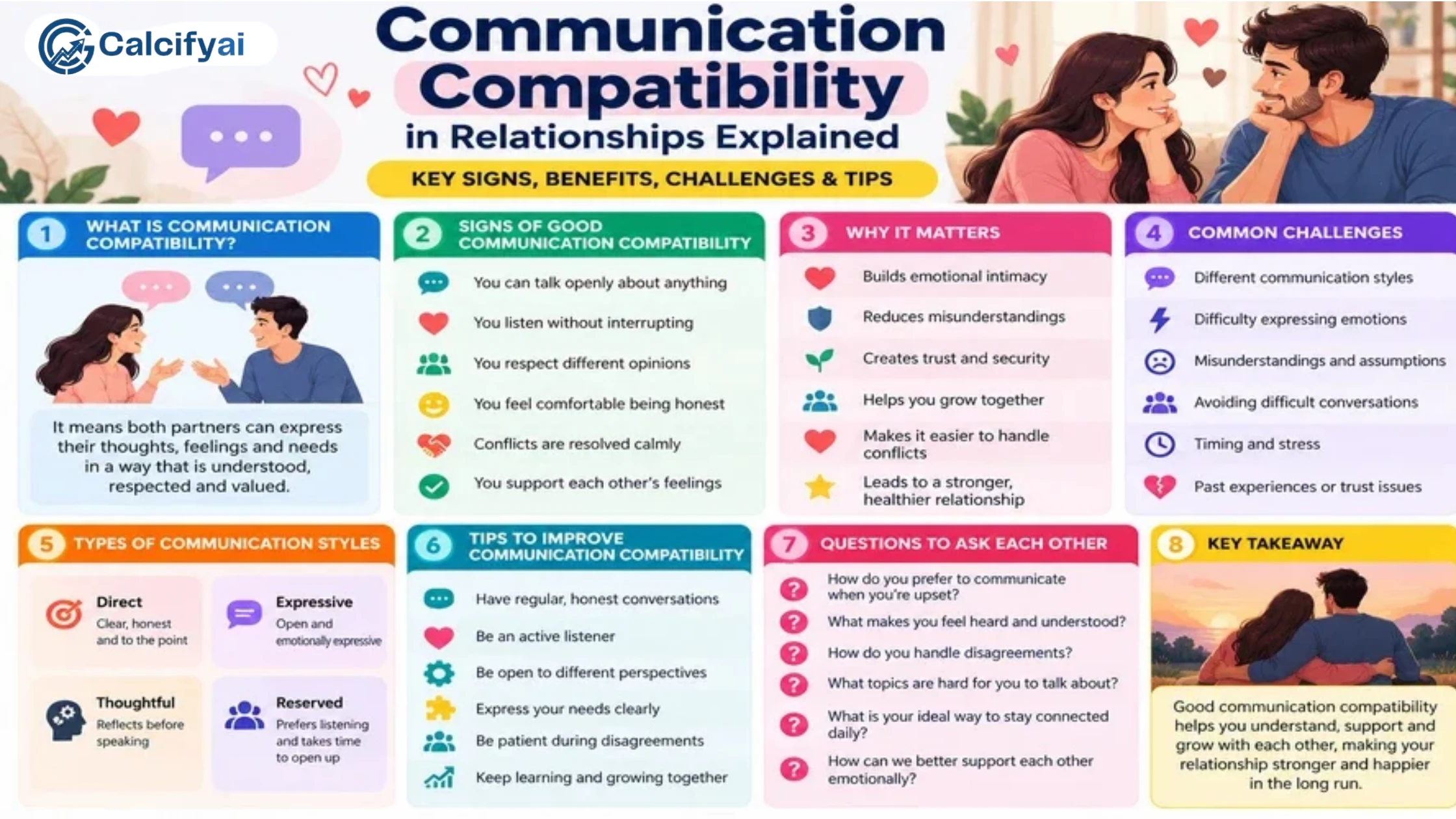
Communication compatibility is about how well two people's communication styles, needs, and expectations work together. It includes how they express feelings, listen, handle disagreements, ask for what they need, and respond when communication goes wrong.
You do not need identical communication styles to be compatible. What matters is whether both people can understand their differences and develop ways of communicating that feel respectful and workable for both.
What Is Communication Compatibility?
Communication compatibility is how well two people can exchange thoughts, feelings, needs, and concerns in ways that both can understand and respond to constructively.
It involves more than being talkative.
Communication compatibility can include:
How directly you express your needs
How carefully you listen
How comfortable you are discussing feelings
How you respond to disagreements
Whether you need time before difficult conversations
How often you like to communicate
How you communicate through text or calls
How you handle misunderstandings
Whether both people feel heard
For example, imagine one partner becomes upset after an argument and wants to talk immediately. The other needs 30 minutes alone before continuing the conversation.
Those styles are different, but they can still work together. The couple might agree to take a short break and return to the conversation at a specific time.
That adjustment is an example of communication compatibility in practice.
Why Is Communication Compatibility Important?
Good communication does not guarantee that two people will agree on everything. Instead, it gives them a healthier way to deal with their differences.
Compatible communication can make it easier to discuss everyday decisions, emotional needs, money, boundaries, family, intimacy, future plans, and conflict.
The NIH Social Wellness Toolkit recommends healthy relationship behaviors such as sharing feelings honestly, asking for what you need, listening without judgment or blame, disagreeing respectfully, and compromising.
It Reduces Misunderstandings
Many relationship disagreements begin with assumptions.
One person thinks:
"They should know why I'm upset."
The other person thinks:
"If something were wrong, they would tell me."
Clear communication reduces the need to guess.
Instead of expecting a partner to read your mind, you can explain what happened, how you feel, and what you need.
It Helps Both People Feel Heard
Being heard does not necessarily mean getting your way.
It means knowing that your partner has listened and tried to understand your perspective.
Two people can reach different conclusions and still communicate respectfully.
It Makes Difficult Conversations Easier
Relationships eventually involve uncomfortable subjects.
Couples may need to discuss:
Money
Family
Personal boundaries
Living arrangements
Work
Marriage
Children
Sex and intimacy
Personal space
Future plans
Communication compatibility can make these conversations more manageable because both people have ways to express themselves and listen to each other.
Signs of Communication Compatibility
There is no perfect communication style, but several behaviors can indicate that two people's styles work reasonably well together.
You Can Speak Honestly
You feel able to express concerns without constantly worrying that the conversation will become hostile or dismissive.
Honesty does not mean saying everything without considering the other person's feelings. Healthy honesty can still be thoughtful and respectful.
You Listen to Understand
Listening is more than waiting for your turn to speak.
You try to understand what your partner means before preparing a response.
For example, you might say:
"So you're saying you felt left out when I made the decision without asking you?"
This gives the other person a chance to clarify what they meant.
You Can Ask for What You Need
A partner cannot always know what you need unless you communicate it.
Instead of:
"You never care about me."
A more specific statement might be:
"I've had a difficult week, and I'd like some time together tonight."
Specific requests are usually easier to understand than broad accusations.
You Respect Different Communication Styles
One partner may process thoughts by talking.
The other may need quiet time before explaining how they feel.
Neither approach is automatically wrong.
Compatibility comes from finding a way for both styles to exist without one person always having to communicate according to the other's preference.
You Can Repair Misunderstandings
Even compatible couples misunderstand each other.
What happens afterward matters.
A healthy repair might involve:
Clarifying what you meant
Acknowledging hurt
Apologizing when appropriate
Listening again
Correcting an assumption
Agreeing on a better approach next time
The goal is not perfect communication. It is being able to recover when communication fails.
Communication Compatibility vs. Communication Style
These terms are related, but they are not identical.
A communication style describes how an individual tends to communicate.
Communication compatibility describes how two people's communication patterns work together.
For example:
Person A may be direct and expressive.
Person B may be quiet and reflective.
Their communication styles are different.
However, they may still be compatible if Person A gives Person B enough time to process and Person B communicates when they are ready to return to the discussion.
Different styles do not automatically equal poor compatibility.
Verbal Communication Compatibility
Verbal compatibility involves how comfortably two people communicate through conversation.
It can include:
How much each person likes to talk
How directly they speak
Whether they ask questions
How they discuss emotions
Whether interruptions are common
How they express disagreement
How comfortable they are with silence
A highly talkative person and a quieter person can still communicate well.
Problems are more likely when one person's style consistently prevents the other from participating.
For example, if one person dominates every serious conversation, the quieter partner may eventually feel unheard.
Emotional Communication Compatibility
Emotional communication focuses on expressing and responding to feelings.
Some people can quickly say:
"I'm disappointed."
Others need time to identify what they are feeling before they can explain it.
A useful question is not simply:
"Do we express emotions the same way?"
Instead, ask:
"Can we understand and respect how each other communicates emotions?"
A partner who needs time to process feelings should still communicate rather than disappearing from difficult conversations indefinitely.
Likewise, a partner who wants immediate discussion may need to respect a reasonable request for space.
Communication Compatibility During Conflict
Conflict is one of the clearest situations in which communication differences become visible.
Suppose one person wants to solve a disagreement immediately while the other becomes overwhelmed and needs a break.
If neither understands the other's style, the first person may interpret the break as avoidance. The second may experience continued discussion as pressure.
A workable compromise could be:
"Let's take 30 minutes and continue this conversation at 8:00."
The person needing space gets time to calm down, while the other person knows the issue will not simply be ignored.
Healthy Conflict Communication
During disagreements, try to:
Focus on the specific problem.
Let both people speak.
Listen before responding.
Avoid insults and personal attacks.
Ask questions when something is unclear.
Take a break when necessary.
Return to unresolved conversations.
Look for a solution rather than a winner.
Disagreement itself is not proof of poor communication compatibility.
The more useful question is whether both people can disagree while maintaining basic respect.
Texting and Digital Communication Compatibility
Communication compatibility also applies to texting, messaging, and phone calls.
One partner may enjoy texting throughout the day. Another may rarely check their phone while working.
Without discussing expectations, these differences can create unnecessary tension.
For example, someone may interpret a slow reply as a lack of interest even though their partner simply prefers not to use their phone during work.
Questions Worth Discussing
Couples can talk about:
How often they like to text
Whether quick replies are expected
When phone calls are preferred
Whether serious disagreements should happen over text
What happens when someone is busy
How much communication feels comfortable during the day
There is no universal correct number of texts or calls.
What matters is whether expectations are clear and reasonable for both people.
Direct vs. Indirect Communication
Some people communicate very directly.
They may say:
"I don't want to go out tonight. I'm tired."
Others communicate more indirectly:
"It's been a really long day."
The second person may expect their partner to understand that they would rather stay home.
Neither style is automatically better in every situation. However, major differences can lead to misunderstandings.
If your partner communicates indirectly, asking a clarifying question can help:
"Would you rather stay home tonight?"
If you tend to communicate indirectly, being more specific about important needs can reduce confusion.
How to Improve Communication Compatibility
Communication compatibility can develop over time.
You can learn how your partner communicates while also becoming clearer about your own needs.
1. Understand Your Own Communication Style
Start by noticing your habits.
Ask yourself:
Do I communicate directly?
Do I avoid difficult conversations?
Do I interrupt?
Do I need time to process emotions?
Do I expect people to know what I need?
Do I become defensive when criticized?
Do I communicate differently through text?
Self-awareness makes it easier to explain your needs and change unhelpful habits.
2. Learn Your Partner's Preferences
Do not assume your partner communicates the same way you do.
Ask simple questions such as:
"When you're upset, do you prefer to talk immediately or have some time first?"
The answer can prevent future misunderstandings.
3. Be Specific
Vague criticism can make communication difficult.
Instead of:
"You never listen."
Try:
"When I was explaining what happened at work and you looked at your phone, I felt like you weren't listening."
Specific examples make the problem easier to understand and address.
4. Use Questions Instead of Assumptions
If you are unsure what your partner means, ask.
For example:
"Are you asking for advice, or would you rather I just listen?"
One question can prevent an entire conversation from going in the wrong direction.
5. Choose the Right Time
A difficult conversation may go poorly if one person is exhausted, rushing to work, or already overwhelmed.
You can say:
"There's something important I'd like to discuss. Is now a good time?"
Choosing a better time does not mean avoiding the issue.
6. Create a Plan for Conflict
Couples can decide in advance how to handle difficult conversations.
For example:
Either person can request a short break.
The conversation must be resumed later.
Personal insults are off-limits.
Both people get time to speak.
Important disagreements are not handled only through text.
Simple agreements can make future conflicts easier to navigate.
Can Different Communication Styles Work in a Relationship?
Yes.
Communication compatibility does not require two people to communicate identically.
A direct communicator and an indirect communicator can learn to clarify meaning. A talkative person and a quiet person can create space for both styles. Someone who wants immediate conflict resolution can learn to give a partner reasonable processing time.
The key is adaptability without forcing one person to abandon their needs completely.
Both people should be making an effort.
If only one person continually adjusts while the other's preferences always take priority, the communication pattern may feel unbalanced.
Communication Compatibility vs. Overall Relationship Compatibility
Communication is one part of relationship compatibility, not the entire picture.
Two people may communicate extremely well but disagree about major life goals.
Likewise, two people may share similar values but struggle because they cannot discuss disagreements constructively.
Overall compatibility can involve:
Communication
Emotional needs
Values
Trust
Lifestyle
Finances
Family expectations
Personal boundaries
Future goals
For a broader view of these areas, read the CalcifyAI guide to what makes two people compatible in a relationship.
Can a Love Calculator Measure Communication Compatibility?
No online love calculator can scientifically measure how well two people communicate in everyday life.
Real communication compatibility involves behaviors that a name-based score cannot observe, such as listening, handling disagreements, expressing needs, respecting boundaries, and repairing misunderstandings.
If you want a fun relationship result, you can try CalcifyAI's Love Calculator, but its percentage should be treated as entertainment rather than a scientific assessment of communication compatibility.
Common Communication Compatibility Mistakes
Expecting Your Partner to Read Your Mind
Even a caring partner cannot reliably know what you need without communication.
Explain important needs rather than testing whether your partner can guess them.
Assuming Different Means Incompatible
A person who communicates differently from you is not automatically a poor match.
Focus on whether you can adapt and understand each other.
Trying to Win Every Argument
Relationship communication is not a debate competition.
Winning an argument while leaving your partner feeling ignored may not solve the underlying problem.
Bringing Up Every Past Problem
When possible, focus on the current issue.
Repeatedly adding unrelated past conflicts can make the original problem harder to solve.
Avoiding Difficult Topics
Avoiding conflict can feel peaceful in the short term.
But important disagreements about boundaries, finances, commitment, or future plans usually do not disappear because they are ignored.
Using Text for Every Serious Conversation
Texting is convenient, but tone can be difficult to interpret.
Some sensitive conversations may be clearer by phone, video, or face-to-face, depending on the situation and relationship.
A Simple Communication Compatibility Checklist
Ask yourself:
Expression: Can we explain what we think and feel?
Listening: Do we both get a chance to speak and feel heard?
Needs: Can we ask directly for what we need?
Conflict: Can we disagree without repeatedly attacking each other?
Timing: Can we respect when someone needs reasonable time to process?
Digital communication: Are our expectations about texting and calling manageable?
Clarification: Do we ask questions instead of automatically assuming the worst?
Repair: Can we apologize, clarify, and reconnect after misunderstandings?
Adaptability: Are both people willing to adjust their communication habits?
You do not need perfect answers to every question.
The checklist is more useful for identifying where communication works well and where the relationship may need clearer expectations.
Frequently Asked Questions
What is communication compatibility?
Communication compatibility is how well two people's communication styles, needs, and expectations work together. It includes speaking, listening, expressing feelings, resolving misunderstandings, and managing disagreements.
Why is communication compatibility important in relationships?
It helps partners understand each other's needs, reduce unnecessary misunderstandings, discuss difficult subjects, and handle disagreements more constructively.
Do couples need the same communication style?
No. Different communication styles can work well together when both partners understand the differences and are willing to adapt.
What are signs of good communication compatibility?
Common signs include honest conversations, active listening, respectful disagreements, clear requests, comfortable boundaries, and the ability to repair misunderstandings.
Can an introvert and an extrovert be communication compatible?
Yes. Personality differences do not automatically determine communication compatibility. What matters more is whether both people can communicate their needs and respect each other's preferred ways of interacting.
What if one partner needs space during an argument?
Taking reasonable time to calm down or process thoughts can be helpful. It is usually clearer to communicate the need for a break and agree on when to return to the conversation rather than simply disappearing.
Can communication compatibility improve?
Yes. People can improve communication by becoming more self-aware, listening carefully, making specific requests, clarifying assumptions, and developing agreed ways to handle conflict.
Does good communication mean never arguing?
No. Couples can communicate well and still disagree. The way disagreements are handled is more informative than whether they happen at all.
Can a compatibility test measure communication compatibility?
A simple online score cannot reliably evaluate real-life communication. Communication compatibility is better understood through actual conversations, disagreements, decisions, and everyday interactions.
Final Takeaway
Communication compatibility is not about finding someone who communicates exactly like you. It is about whether two people can understand each other's communication needs and create a style that works for both.
Healthy communication includes more than talking. Listening, asking questions, expressing needs clearly, respecting boundaries, managing conflict, and repairing misunderstandings all matter.
Different communication styles can work together when both people are willing to listen and adapt. Instead of asking, "Do we communicate the same way?", a more useful question is:
"Can we communicate in a way that allows both of us to feel heard, understood, and respected?"
Disclaimer
The information provided in this article is for educational and informational purposes only. It should not be considered as professional financial, medical, or legal advice. Always consult with qualified professionals for specific guidance related to your situation.
Popular Calculators
Explore our most-used free calculators for finance, health, and everyday needs.