
Equivalent Ratios Explained: How to Find and Check Them
Learn how to find and check equivalent ratios with simple rules, formulas, examples, cross multiplication, and common mistakes.
Calcifyai Team
Expert calculators & financial tools
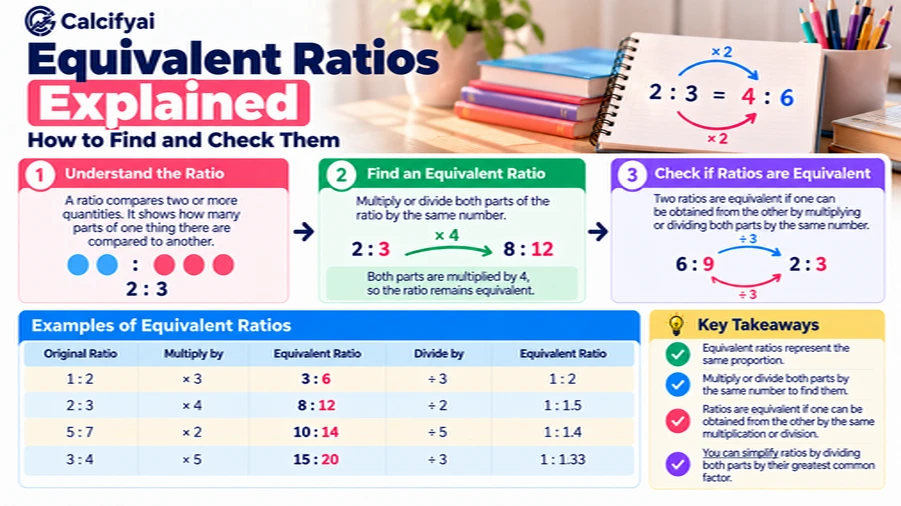
Equivalent ratios are ratios that describe the same relationship between quantities, even though their numbers may look different.
For example:
2:3 and 4:6 are equivalent ratios because both describe the same relationship. If you multiply both parts of 2:3 by 2, you get 4:6.
The key rule is simple:
To create an equivalent ratio, multiply or divide both parts of the ratio by the same nonzero number.
Understanding equivalent ratios makes it easier to solve proportions, compare quantities, work with recipes, scale measurements, and solve everyday math problems.
What Are Equivalent Ratios?
Two ratios are equivalent when they represent the same relationship between two quantities.
For example:
2:5
4:10
6:15
All three ratios are equivalent.
Why?
Starting with 2:5:
2 × 2 = 4
5 × 2 = 10
So:
2:5 = 4:10
Starting with 2:5 again:
2 × 3 = 6
5 × 3 = 15
So:
2:5 = 6:15
The numbers change, but the relationship stays the same.
How Do Equivalent Ratios Work?
The most important rule is to perform the same operation on both parts of the ratio.
For example:
3:4
Multiply both numbers by 2:
3 × 2 = 6
4 × 2 = 8
So:
3:4 = 6:8
You can also divide both numbers by the same number.
For example:
12:18
Divide both numbers by 6:
12 ÷ 6 = 2
18 ÷ 6 = 3
So:
12:18 = 2:3
The Basic Rule
If a ratio is:
a:b
then multiplying both parts by the same nonzero number gives an equivalent ratio:
a × n : b × n
Similarly, dividing both parts by the same nonzero number also produces an equivalent ratio when the division is valid.
How to Find Equivalent Ratios Step by Step
Finding an equivalent ratio is usually straightforward.
Step 1: Write the Original Ratio
Suppose the ratio is:
4:7
Step 2: Choose a Multiplier
Choose a number such as 2.
Step 3: Multiply Both Parts
4 × 2 = 8
7 × 2 = 14
Step 4: Write the New Ratio
8:14
Therefore:
4:7 = 8:14
Both ratios represent the same relationship.
Example 1: Finding an Equivalent Ratio
Suppose a recipe uses flour and sugar in the ratio:
3:2
You want an equivalent ratio with a first value of 12.
Ask:
How does 3 become 12?
3 × 4 = 12
Now multiply the second number by 4:
2 × 4 = 8
Therefore:
3:2 = 12:8
The equivalent ratio is 12:8.
Example 2: Finding an Equivalent Ratio by Division
Suppose you have:
20:30
Both numbers can be divided by 10.
20 ÷ 10 = 2
30 ÷ 10 = 3
Therefore:
20:30 = 2:3
This is also called simplifying the ratio.
You can learn more about simplifying ratios when you want to reduce a ratio to its simplest form.
How to Check if Two Ratios Are Equivalent
There are several ways to check whether two ratios are equivalent.
The easiest methods are:
Simplify both ratios.
Multiply both parts by the same number.
Convert the ratios to fractions and compare them.
Use cross multiplication.
Method 1: Simplify Both Ratios
Suppose you want to check:
6:9 and 10:15
Simplify the first ratio:
6 ÷ 3 = 2
9 ÷ 3 = 3
So:
6:9 = 2:3
Now simplify the second:
10 ÷ 5 = 2
15 ÷ 5 = 3
So:
10:15 = 2:3
Because both simplify to 2:3, the ratios are equivalent.
Method 2: Use Cross Multiplication
Suppose you want to check:
4:6 and 10:15
Cross multiply:
4 × 15 = 60
6 × 10 = 60
The cross products are equal.
Therefore:
4:6 = 10:15
This is a useful way to check equivalent ratios quickly.
Equivalent Ratios and Fractions
A ratio can also be written as a fraction.
For example:
3:5 = 3/5
If you multiply both parts by 2:
6:10 = 6/10
As fractions:
3/5 = 6/10
Both fractions have the same value, so the ratios are equivalent.
This connection between ratios and fractions is useful when comparing relationships or solving proportions.
How to Find a Missing Number Using Equivalent Ratios
Equivalent ratios can also help you find an unknown value.
Suppose:
3:4 = x:20
Ask how 4 becomes 20.
4 × 5 = 20
Now multiply 3 by 5:
3 × 5 = 15
Therefore:
x = 15
So:
3:4 = 15:20
This method can be faster than cross multiplication when the multiplier is easy to see.
Equivalent Ratios With Larger Numbers
Equivalent ratios can contain very large numbers.
For example:
25:40
Multiply both numbers by 100:
25 × 100 = 2,500
40 × 100 = 4,000
So:
25:40 = 2,500:4,000
The numbers are much larger, but the relationship has not changed.
If you work with large ratios frequently, a ratio calculator can simplify ratios and find equivalent ratios without doing every calculation manually. The CalcifyAI Ratio Calculator can simplify ratios and show equivalent ratios.
Equivalent Ratios With Decimals
Ratios can contain decimal values.
For example:
1.5:2
Multiply both values by 2:
1.5 × 2 = 3
2 × 2 = 4
Therefore:
1.5:2 = 3:4
You can also convert decimal ratios into whole-number ratios when that makes the comparison easier.
Equivalent Ratios With Fractions
Fractions can also be used in ratios.
For example:
1/2 : 3/4
Multiply both parts by 4:
1/2 × 4 = 2
3/4 × 4 = 3
So:
1/2 : 3/4 = 2:3
This makes the relationship easier to work with.
Real-Life Examples of Equivalent Ratios
Equivalent ratios are used in many everyday situations.
Recipes
Suppose a recipe uses:
2 cups of flour : 1 cup of sugar
If you want to double the recipe:
4 cups of flour : 2 cups of sugar
The ratios are equivalent:
2:1 = 4:2
Maps and Scale Drawings
A map may use a fixed ratio between map distance and actual distance.
Changing both measurements by the same factor keeps the relationship consistent.
Shopping and Prices
Suppose 3 notebooks cost $6.
The ratio is:
3:6
If 6 notebooks cost $12:
6:12
These ratios are equivalent because both represent $2 per notebook.
Mixing Solutions
Suppose a mixture uses:
1 part concentrate : 4 parts water
A larger batch could use:
2 parts concentrate : 8 parts water
The relationship remains:
1:4 = 2:8
Equivalent Ratios vs Equal Ratios
The terms can sometimes cause confusion.
Equivalent ratios are different numerical representations of the same relationship.
For example:
2:3 and 8:12
They look different, but they represent the same relationship.
An equation such as:
2 + 3 = 5
is an equality between numerical values, while:
2:3 = 8:12
states that two ratios represent the same relationship.
Equivalent Ratios vs Proportions
A ratio compares quantities.
For example:
3:4
A proportion states that two ratios are equal.
For example:
3:4 = 6:8
The second statement is a proportion because it says that the two ratios are equivalent.
This is why equivalent ratios are an important part of understanding proportions.
Common Mistakes When Working With Equivalent Ratios
Multiplying Only One Part
Incorrect:
3:5
3 × 2 = 6
5 stays 5
6:5 is not equivalent to 3:5.
Both parts must be multiplied by the same number.
Dividing by Different Numbers
Suppose:
12:18
Dividing 12 by 2 and 18 by 3 gives:
6:6
This is not equivalent to 12:18.
The same divisor must be used for both parts.
Reversing the Ratio
A ratio of:
2:5
is not the same as:
5:2
The order matters.
Mixing Units
Suppose you compare:
2 meters : 50 centimeters
You should convert the measurements to the same unit before comparing them.
2 meters = 200 centimeters
So the ratio becomes:
200:50
which simplifies to:
4:1
Assuming Similar-Looking Ratios Are Equivalent
Consider:
2:3 and 4:7
They look similar, but they are not equivalent.
Check them:
2 × 7 = 14
3 × 4 = 12
The cross products are not equal, so the ratios are not equivalent.
A Quick Way to Remember Equivalent Ratios
Remember this simple rule:
Multiply or divide both parts by the same nonzero number.
For example:
2:7
Multiply by 3:
6:21
Multiply by 5:
10:35
Multiply by 10:
20:70
All of these ratios are equivalent.
Frequently Asked Questions
What are equivalent ratios?
Equivalent ratios are two or more ratios that represent the same relationship between quantities.
How do you find an equivalent ratio?
Multiply or divide both parts of the original ratio by the same nonzero number.
How do you know if two ratios are equivalent?
You can simplify both ratios, compare them as fractions, or use cross multiplication. If the cross products are equal, the ratios are equivalent.
Is 2:3 equivalent to 4:6?
Yes. Multiply both parts of 2:3 by 2:
2 × 2 = 4
3 × 2 = 6
Therefore:
2:3 = 4:6
Is 3:5 equivalent to 6:10?
Yes. Both parts of 3:5 are multiplied by 2:
3 × 2 = 6
5 × 2 = 10
So:
3:5 = 6:10
Is 4:6 equivalent to 6:9?
Yes. Both simplify to 2:3.
4:6 → 2:3
6:9 → 2:3
Therefore, they are equivalent.
Can equivalent ratios have different numbers?
Yes. In fact, equivalent ratios often have different numbers while representing the same relationship.
Can equivalent ratios contain decimals?
Yes. Ratios can contain decimals as long as both parts are changed by the same factor when creating an equivalent ratio.
Can equivalent ratios contain fractions?
Yes. Fractions can be used in ratios, and the same multiplication or division rule applies.
What is the fastest way to check equivalent ratios?
Cross multiplication is often a quick method. Multiply the first number of one ratio by the second number of the other ratio, then compare it with the other cross product.
Final Takeaway
Equivalent ratios represent the same relationship using different numbers.
For a formal explanation of ratios and proportions, you can also review the OpenStax ratios and proportions material.
The main rule is simple:
Multiply or divide both parts of a ratio by the same nonzero number.
For example:
2:3 = 4:6 = 6:9 = 10:15
You can check whether two ratios are equivalent by simplifying them, comparing their fractional values, or using cross multiplication.
Once you understand this idea, ratios and proportions become much easier to work with. Equivalent ratios are useful in school math, recipes, measurements, maps, prices, scaling, and many other real-world situations.
Disclaimer
The information provided in this article is for educational and informational purposes only. It should not be considered as professional financial, medical, or legal advice. Always consult with qualified professionals for specific guidance related to your situation.
Popular Calculators
Explore our most-used free calculators for finance, health, and everyday needs.