
GCF & LCM Explained: What's the Difference and When to Use Each?
Learn the difference between GCF and LCM with simple explanations, formulas, examples, and practical uses to solve math problems confidently.
Calcifyai Team
Expert calculators & financial tools
Many students learn about the Greatest Common Factor (GCF) and Least Common Multiple (LCM) at the same time, making it easy to confuse the two. While both involve finding relationships between numbers, they serve different purposes and are used to solve different types of math problems.
In this guide, you'll learn what GCF and LCM are, how to calculate them, their key differences, practical examples, and when to use each. If you're just getting started, you can also read our What Is the Greatest Common Factor? guide for a deeper understanding of GCF before comparing it with LCM.
What Is GCF?
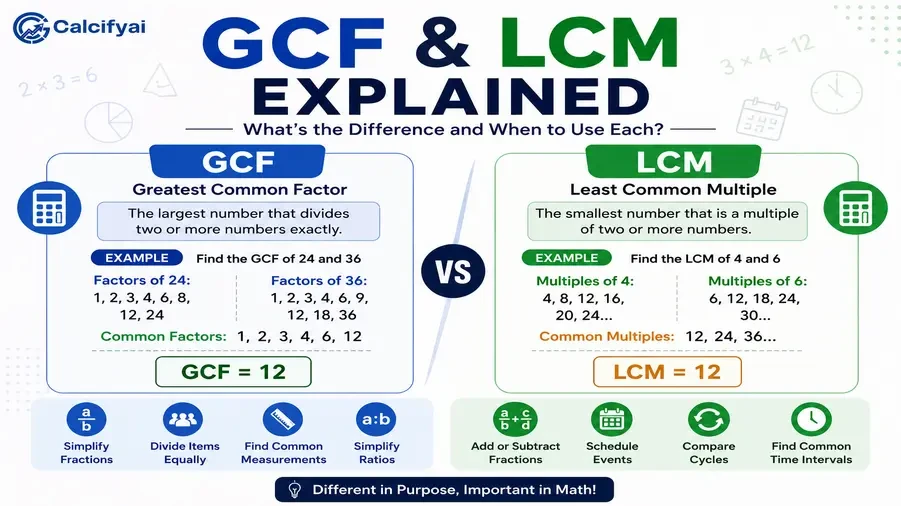
The Greatest Common Factor (GCF) is the largest positive number that divides two or more numbers exactly without leaving a remainder.
It is also called:
Greatest Common Divisor (GCD)
Highest Common Factor (HCF)
Example
Find the GCF of 24 and 36.
Factors of 24:
1, 2, 3, 4, 6, 8, 12, 24
Factors of 36:
1, 2, 3, 4, 6, 9, 12, 18, 36
Common factors:
1, 2, 3, 4, 6, 12
Greatest Common Factor = 12
If you want to solve similar problems instantly, try our Greatest Common Factor Calculator, which finds the GCF in seconds.
What Is LCM?
The Least Common Multiple (LCM) is the smallest positive number that is a multiple of two or more numbers.
Example
Find the LCM of 4 and 6.
Multiples of 4:
4, 8, 12, 16, 20, 24...
Multiples of 6:
6, 12, 18, 24...
The first common multiple is:
LCM = 12
You can also use our LCM Calculator to calculate the least common multiple quickly, especially for larger numbers.
GCF vs LCM: Key Differences
Greatest Common Factor (GCF) | Least Common Multiple (LCM) |
Largest common factor | Smallest common multiple |
Obtained from common factors | Obtained from common multiples |
Used to simplify fractions | Used to add or subtract fractions |
Always less than or equal to the smallest number | Always greater than or equal to the largest number |
Helps divide items equally | Helps combine repeating events |
How to Find the GCF
There are three common methods.
1. Listing Factors
Write all factors of each number and choose the largest common one.
Example:
GCF of 18 and 30
Factors of 18:
1, 2, 3, 6, 9, 18
Factors of 30:
1, 2, 3, 5, 6, 10, 15, 30
Largest common factor:
6
2. Prime Factorization
Example:
24 = 2 × 2 × 2 × 3
36 = 2 × 2 × 3 × 3
Common prime factors:
2 × 2 × 3
GCF = 12
3. Euclidean Algorithm
This method is ideal for large numbers.
Example:
Find GCF of 48 and 18.
48 ÷ 18 = remainder 12
18 ÷ 12 = remainder 6
12 ÷ 6 = remainder 0
GCF = 6
How to Find the LCM
1. Listing Multiples
Example:
Find the LCM of 5 and 8.
Multiples of 5:
5, 10, 15, 20, 25, 30, 35, 40
Multiples of 8:
8, 16, 24, 32, 40
LCM = 40
2. Prime Factorization
Example:
12 = 2² × 3
18 = 2 × 3²
Take the highest power of each prime:
2² × 3²
LCM = 36
3. Using the GCF Formula
For any two numbers:
LCM × GCF = Number 1 × Number 2
Example:
Numbers:
12 and 18
GCF = 6
LCM = (12 × 18) ÷ 6
LCM = 36
When Should You Use GCF?
Use the Greatest Common Factor when you need to:
Simplify fractions
Divide objects into equal groups
Find the largest common measurement
Simplify algebraic expressions
Reduce ratios
Example
Simplify:
24/36
GCF = 12
24 ÷ 12 = 2
36 ÷ 12 = 3
Answer:
2/3
When Should You Use LCM?
Use the Least Common Multiple when you need to:
Add or subtract fractions
Find common denominators
Solve scheduling problems
Compare repeating cycles
Solve time interval problems
Example
A bus arrives every 15 minutes.
Another bus arrives every 20 minutes.
When will they arrive together?
LCM(15,20)=60
They will meet every 60 minutes.
Real-Life Applications
GCF Applications
Sharing candies equally
Packaging products
Simplifying recipes
Construction measurements
Simplifying mathematical expressions
LCM Applications
Event scheduling
School timetables
Manufacturing cycles
Traffic light synchronization
Machine maintenance schedules
Common Mistakes
Avoid these mistakes:
Confusing factors with multiples
Using GCF instead of LCM
Forgetting common prime factors
Stopping too early when listing multiples
Choosing the first common factor instead of the greatest one
Quick Comparison Table
Question | Use GCF | Use LCM |
Simplify fractions | ✅ | ❌ |
Find common denominator | ❌ | ✅ |
Divide objects equally | ✅ | ❌ |
Schedule repeating events | ❌ | ✅ |
Simplify ratios | ✅ | ❌ |
Compare recurring cycles | ❌ | ✅ |
Frequently Asked Questions
Is GCF the same as LCM?
No. The GCF is the largest common factor, while the LCM is the smallest common multiple.
Can GCF and LCM be the same?
Yes. If the numbers are identical (for example, 8 and 8), both the GCF and LCM are 8.
Which is easier to calculate?
For small numbers, listing factors or multiples works well. For larger numbers, prime factorization or the Euclidean Algorithm is more efficient.
Why do students confuse GCF and LCM?
Because both involve comparing numbers. Remember this simple rule:
GCF = Largest factor
LCM = Smallest multiple
Is there a relationship between GCF and LCM?
Yes. For any two numbers:
GCF × LCM = First Number × Second Number
This formula is often used to calculate one value if the other is already known.
Conclusion
Although GCF and LCM are closely related, they solve different types of problems. The Greatest Common Factor helps simplify fractions, ratios, and algebraic expressions, while the Least Common Multiple is useful for finding common denominators, solving schedules, and working with repeating events. Understanding when to use each concept will improve your problem-solving skills and make many math calculations easier.
Disclaimer
The information provided in this article is for educational and informational purposes only. It should not be considered as professional financial, medical, or legal advice. Always consult with qualified professionals for specific guidance related to your situation.
Popular Calculators
Explore our most-used free calculators for finance, health, and everyday needs.