
What Is the Greatest Common Factor? A Beginner's Guide to GCF
Learn what the Greatest Common Factor (GCF) is, how to find it using simple methods, real examples, and practical applications in this beginner-friendly guide.
Calcifyai Team
Expert calculators & financial tools
The Greatest Common Factor (GCF) is one of the most important concepts in mathematics. Whether you're simplifying fractions, solving algebra problems, or dividing objects into equal groups, understanding the GCF makes calculations much easier.
If you're new to factors, we recommend reading our What Is a Factor in Math? A Beginner's Guide before diving into GCF, as it explains the basics you'll use throughout this guide.
In this guide, you'll learn what the Greatest Common Factor is, why it matters, different methods to find it, practical examples, and common mistakes to avoid.
What Is the Greatest Common Factor?
The Greatest Common Factor (GCF) is the largest positive number that divides two or more numbers exactly without leaving a remainder. It is also commonly known as:
Greatest Common Divisor (GCD)
Highest Common Factor (HCF)
For example:
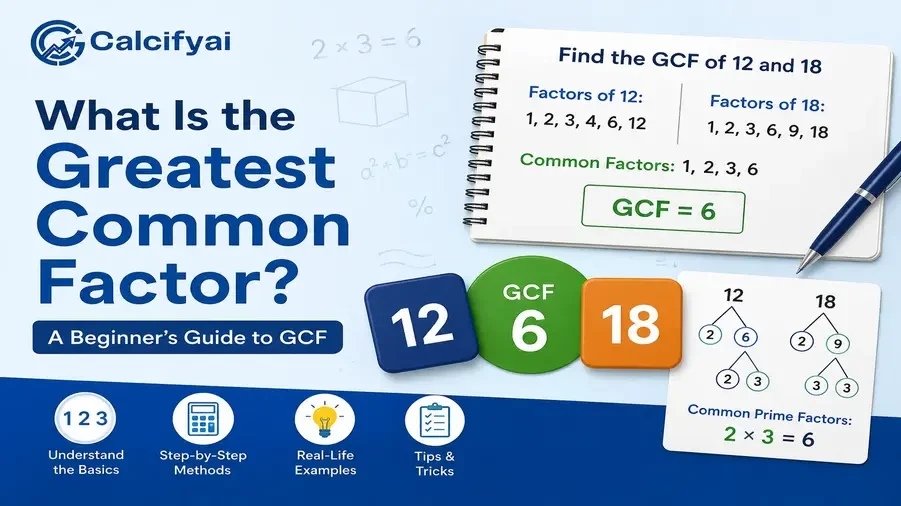
Factors of 12 = 1, 2, 3, 4, 6, 12
Factors of 18 = 1, 2, 3, 6, 9, 18
The common factors are:
1, 2, 3, 6
The largest common factor is:
GCF = 6
What Is a Factor?
Before learning the GCF, it's important to understand what a factor is.
A factor is a number that divides another number evenly.
If you'd like to quickly identify all the factors of a number, try our Factor Calculator, which instantly lists every factor and makes learning easier.
Examples:
Number | Factors |
10 | 1, 2, 5, 10 |
16 | 1, 2, 4, 8, 16 |
24 | 1, 2, 3, 4, 6, 8, 12, 24 |
If a number divides another number without leaving a remainder, it is considered a factor.
Why Is the Greatest Common Factor Important?
Learning the GCF helps in many areas of mathematics and everyday problem-solving.
Some common uses include:
Simplifying fractions
Solving algebraic expressions
Dividing objects into equal groups
Finding common measurements
Organizing materials efficiently
Understanding number relationships
Students encounter GCF frequently from elementary school through higher-level mathematics.
How to Find the Greatest Common Factor
There are several methods to determine the GCF.
If you want to verify your answer instantly, you can also use our GCF Calculator to calculate the GCF of two or more numbers in seconds.
Method 1: Listing Factors
This method works best for smaller numbers.
Example: Find the GCF of 24 and 36.
Factors of 24:
1, 2, 3, 4, 6, 8, 12, 24
Factors of 36:
1, 2, 3, 4, 6, 9, 12, 18, 36
Common factors:
1, 2, 3, 4, 6, 12
Greatest Common Factor = 12
Method 2: Prime Factorization
Break each number into its prime factors.
Example:
24 = 2 × 2 × 2 × 3
36 = 2 × 2 × 3 × 3
Common prime factors:
2 × 2 × 3
GCF = 12
This method becomes useful for larger numbers.
Method 3: Euclidean Algorithm
For very large numbers, mathematicians often use the Euclidean Algorithm.
Example:
Find GCF of 48 and 18.
48 ÷ 18 = remainder 12
18 ÷ 12 = remainder 6
12 ÷ 6 = remainder 0
Therefore:
GCF = 6
This is the fastest method for large values.
Worked Examples
Example 1
Find the GCF of 20 and 30.
Factors of 20:
1, 2, 4, 5, 10, 20
Factors of 30:
1, 2, 3, 5, 6, 10, 15, 30
Largest common factor:
10
Example 2
Find the GCF of 42 and 56.
Prime factorization:
42 = 2 × 3 × 7
56 = 2 × 2 × 2 × 7
Common factors:
2 × 7
GCF = 14
Example 3
Find the GCF of 15 and 28.
Common factors:
Only 1
Therefore:
GCF = 1
These numbers are called coprime (or relatively prime).
Greatest Common Factor vs Least Common Multiple
Many students confuse the GCF with the Least Common Multiple (LCM).
Greatest Common Factor (GCF) | Least Common Multiple (LCM) |
Largest common factor | Smallest common multiple |
Used to simplify fractions | Used to add or subtract fractions |
Always less than or equal to the smaller number | Always greater than or equal to the larger number |
Understanding the difference helps you choose the correct method for solving problems.
Real-Life Applications of GCF
Although it is taught in school, the Greatest Common Factor has many practical uses.
Sharing Items Equally
If you have 24 apples and 36 oranges, the GCF tells you the largest number of identical baskets you can create without leftovers.
Simplifying Fractions
Example:
24/36
GCF = 12
24 ÷ 12 = 2
36 ÷ 12 = 3
Answer:
2/3
Construction Projects
Builders often use common measurements when cutting wood, tiles, or pipes into equal lengths.
Manufacturing
Factories use GCF to package products into identical groups with no waste.
Common Mistakes When Finding the GCF
Avoid these common errors:
Choosing the largest factor instead of the largest common factor.
Forgetting that 1 is always a common factor.
Confusing GCF with LCM.
Missing factors when listing them manually.
Incorrect prime factorization.
Double-checking your work helps prevent mistakes.
Tips to Find the GCF Faster
Start with the smaller number.
Use prime factorization for larger values.
Memorize multiplication tables.
Use the Euclidean Algorithm for very large numbers.
Verify your answer divides every number evenly.
Frequently Asked Questions
Is GCF the same as HCF?
Yes. Greatest Common Factor (GCF), Greatest Common Divisor (GCD), and Highest Common Factor (HCF) all refer to the same mathematical concept.
Can the GCF be 1?
Yes. If two numbers share no common factors other than 1, their GCF is 1.
Can the GCF be larger than the smallest number?
No. The GCF can never be greater than the smallest number in the set.
Why do we use GCF to simplify fractions?
Dividing the numerator and denominator by their Greatest Common Factor reduces the fraction to its simplest form.
Which method is best?
Listing factors for small numbers
Prime factorization for medium-sized numbers
Euclidean Algorithm for large numbers
Conclusion
The Greatest Common Factor is a fundamental math concept that makes many calculations easier. By finding the largest number that divides two or more numbers evenly, you can simplify fractions, solve algebra problems, and tackle real-world situations more efficiently.
Disclaimer
The information provided in this article is for educational and informational purposes only. It should not be considered as professional financial, medical, or legal advice. Always consult with qualified professionals for specific guidance related to your situation.
Popular Calculators
Explore our most-used free calculators for finance, health, and everyday needs.