
How Fast Do Factorials Grow? A Beginner's Guide
Learn how fast factorials grow, compare factorials with exponential functions, explore examples, and understand why large factorials matter.
Calcifyai Team
Expert calculators & financial tools
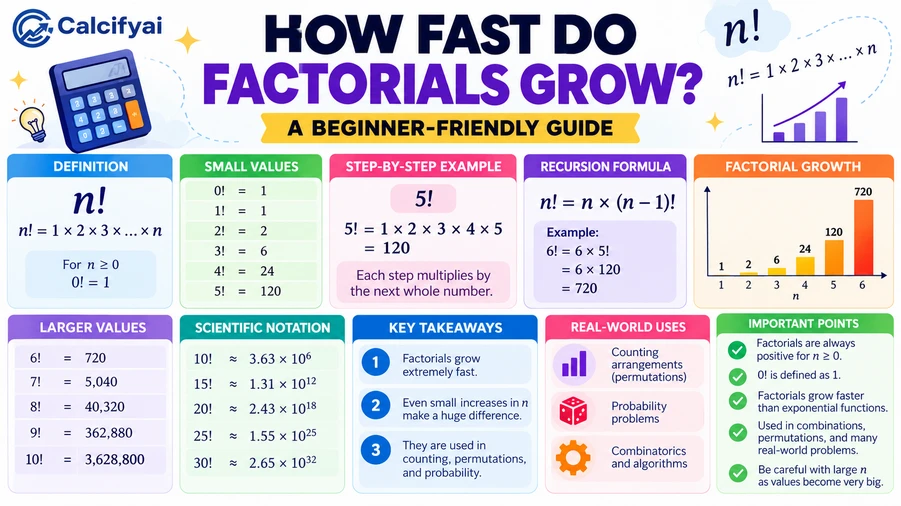
Factorials grow extremely quickly. When you increase a number by 1, its factorial is multiplied by that new number. This makes factorial growth much faster than ordinary addition and, eventually, faster than exponential growth with any fixed base.
For example:
3! = 3 × 2 × 1 = 6
5! = 5 × 4 × 3 × 2 × 1 = 120
10! = 3,628,800
20! = 2,432,902,008,176,640,000
The main reason factorials grow so quickly is that each new factorial multiplies the previous result by an increasingly large number.
Understanding factorial growth helps explain counting problems, probability, permutations, algorithms, and why some computer calculations become expensive as their inputs increase.
What Is a Factorial?
A factorial is the product of all positive integers from a number down to 1. It is written using an exclamation mark (!).
For example:
5! = 5 × 4 × 3 × 2 × 1 = 120
The factorial of zero is defined as:
0! = 1
This definition is important in mathematics, combinations, and probability.
A Simple Factorial Example
Suppose you want to calculate 6!.
Multiply the integers from 6 down to 1:
6! = 6 × 5 × 4 × 3 × 2 × 1 = 720
Now calculate 7!:
7! = 7 × 6! = 7 × 720 = 5,040
Increasing the input from 6 to 7 makes the result seven times larger.
How Fast Do Factorials Grow?
The easiest way to understand factorial growth is to compare several values.
Number | Factorial | Number of Digits |
|---|---|---|
1 | 1 | 1 |
2 | 2 | 1 |
3 | 6 | 1 |
4 | 24 | 2 |
5 | 120 | 3 |
6 | 720 | 3 |
7 | 5,040 | 4 |
10 | 3,628,800 | 7 |
15 | 1,307,674,368,000 | 13 |
20 | 2,432,902,008,176,640,000 | 19 |
50 | Approximately 3.04 × 10⁶⁴ | 65 |
100 | Approximately 9.33 × 10¹⁵⁷ | 158 |
Notice how quickly the values increase. By the time you reach 20!, the result contains 19 digits. At 100!, it contains 158 digits.
This is why factorial growth becomes dramatic even when the input number is relatively small.
Why Do Factorials Grow So Quickly?
Factorials grow quickly because each new factorial multiplies the previous result by the next whole number.
The formula is:
Next Factorial = Current Factorial × Next Integer
For example:
5! = 120
6! = 6 × 120 = 720
7! = 7 × 720 = 5,040
8! = 8 × 5,040 = 40,320
Each step uses a larger multiplier. The increase is therefore not a fixed amount.
Compare this with adding 10 each time, where the increase is always 10. Factorials behave differently because their growth factor keeps getting larger.
Factorial Growth vs. Exponential Growth
Factorials are often compared with exponential functions because both can grow quickly. However, factorial growth eventually outpaces every exponential function with a fixed base.
Consider these examples:
Polynomial growth: n²
Exponential growth: 2ⁿ
Factorial growth: n!
Here is a comparison:
n | n² | 2ⁿ | n! |
|---|---|---|---|
3 | 9 | 8 | 6 |
5 | 25 | 32 | 120 |
10 | 100 | 1,024 | 3,628,800 |
20 | 400 | 1,048,576 | 2,432,902,008,176,640,000 |
At small values, a factorial is not always the largest. For example, 3! is smaller than 3².
But as n increases, factorials eventually overtake every fixed polynomial and every fixed-base exponential function.
This matters in mathematics and computer science because problems involving factorials can become extremely large.
How Many Digits Does a Factorial Have?
One way to understand factorial growth is to count the digits in the result.
For example:
5! = 120, which has 3 digits.
10! = 3,628,800, which has 7 digits.
20! has 19 digits.
100! has 158 digits.
For a positive integer n, the number of digits in n! can be calculated using this formula:
Digits in n! = floor(log₁₀(n!)) + 1
The floor function means to round down to the nearest integer.
You do not need to write out the entire factorial to calculate its number of digits. Logarithms allow you to work with very large factorials efficiently.
For more examples, see how many digits are in a factorial.
How to Estimate Large Factorials
For very large values of n, calculating every multiplication may be inconvenient. A mathematical approximation called Stirling's approximation provides a useful estimate.
The formula is:
n! ≈ √(2 × π × n) × (n ÷ e)ⁿ
Here:
n is the number whose factorial you want to estimate.
π is approximately 3.14159.
e is approximately 2.71828.
The symbol ≈ means “approximately equal to.”
This formula becomes increasingly useful as n grows.
It helps estimate factorial values without multiplying every integer individually. It is an approximation, not an exact replacement for the factorial.
For additional mathematical background, Wolfram MathWorld's factorial reference explains factorial notation, properties, and its role in counting arrangements.
Where Is Factorial Growth Used in Real Life?
Factorials are not just theoretical math. They appear in several practical fields.
1. Permutations and Arrangements
Factorials count the number of ways to arrange distinct objects.
For example, if you have four different books and want to arrange them on a shelf, the number of possible orders is:
4! = 4 × 3 × 2 × 1 = 24
With five books, there are:
5! = 120
Adding just one more book increases the number of possible arrangements from 24 to 120.
2. Probability and Statistics
Factorials are used in formulas for combinations, permutations, and probability problems.
For example, the number of ways to choose r objects from n distinct objects is:
Number of combinations = n! ÷ (r! × (n − r)!)
This formula is useful when the order of the selected objects does not matter.
3. Computer Science
Factorials help explain why some algorithms become impractical for large inputs.
Imagine an algorithm that checks every possible ordering of 10 items. There are:
10! = 3,628,800 possible arrangements
For 15 items, the number rises to:
15! = 1,307,674,368,000
An algorithm that examines every arrangement can become too slow as the input grows.
This is one reason computer scientists look for more efficient methods rather than checking every possible ordering.
4. Mathematics and Scientific Computing
Factorials appear in mathematical series, combinatorial identities, and formulas used in calculus and numerical methods.
Large factorials can also create storage and precision challenges in software, especially when the results contain hundreds or thousands of digits.
Why Can Factorials Be Difficult for Computers to Calculate?
Factorials are straightforward to define, but their results become very large.
For example, 100! contains 158 digits. Larger factorials can contain thousands or even millions of digits.
A computer program must use a suitable numeric representation to store these values.
Fixed-size integer types have limits. Once a result exceeds the supported range, a program may overflow or produce an incorrect value, depending on the language and implementation.
For very large exact factorials, arbitrary-precision integer arithmetic can be useful. You can use the Big Number Calculator to explore calculations involving large numbers.
Common Mistakes When Working With Factorials
Confusing Factorial With Multiplication by a Fixed Number
A factorial is not simply a number multiplied by 2 or 3. It is the product of every positive integer up to that number.
For example:
5! = 5 × 4 × 3 × 2 × 1 = 120
Forgetting That 0! Equals 1
By definition:
0! = 1
This convention keeps many mathematical formulas consistent.
Assuming Factorials Always Start Out Larger Than Exponentials
At small values, a fixed-base exponential can be larger than a factorial. Factorials eventually grow faster, but the comparison depends on the input size and exponential base.
Trying to Write Out Extremely Large Results
For large factorials, it is often more practical to use scientific notation, logarithms, or Stirling's approximation rather than writing every digit.
Ignoring the Difference Between Exact Values and Estimates
Stirling's approximation is useful for estimating factorials, but it does not give the exact value in general.
Frequently Asked Questions
How fast do factorials grow?
Factorials grow extremely quickly because each new value is the previous factorial multiplied by the next integer. Their growth eventually exceeds that of every fixed polynomial and every fixed-base exponential function.
Why does factorial growth become so large?
The multiplier increases with every step. Moving from 5! to 6! multiplies the result by 6, while moving from 20! to 21! multiplies it by 21.
Is factorial growth faster than exponential growth?
Yes, eventually. For any fixed base, factorial growth eventually exceeds exponential growth as n becomes sufficiently large.
How big is 10 factorial?
10! = 3,628,800, which has 7 digits.
How big is 20 factorial?
20! = 2,432,902,008,176,640,000, which has 19 digits.
What is 0 factorial?
0! = 1 by mathematical definition. This convention makes many formulas in counting and probability work consistently.
What is Stirling's approximation?
Stirling's approximation estimates large factorials using:
n! ≈ √(2 × π × n) × (n ÷ e)ⁿ
It is especially useful when calculating the exact factorial would be inconvenient.
Why are factorials important in computer science?
Factorials describe the number of possible arrangements of distinct items. Algorithms that examine every arrangement can require enormous amounts of time as the number of items increases.
Conclusion
Factorial growth starts simply but becomes enormous very quickly. The reason is that each new factorial multiplies the previous result by a larger integer.
This makes factorials useful for counting arrangements, solving probability problems, and understanding algorithm complexity. It also creates challenges when computers must store or calculate very large values.
The most important rule to remember is:
n! = n × (n − 1)!
Once you understand this relationship, it becomes much easier to see why factorials grow so rapidly and why their values can become enormous even when the input number is relatively small.
Disclaimer
The information provided in this article is for educational and informational purposes only. It should not be considered as professional financial, medical, or legal advice. Always consult with qualified professionals for specific guidance related to your situation.
Popular Calculators
Explore our most-used free calculators for finance, health, and everyday needs.