
How to Compare Two Ratios: 3 Easy Methods With Examples
Learn how to compare ratios using simplification, decimals, and cross multiplication with simple examples and practical tips.
Calcifyai Team
Expert calculators & financial tools
Comparing ratios helps you decide which relationship is greater, smaller, or equal. It is useful in school math, recipes, sports statistics, business, finance, maps, and everyday decisions.
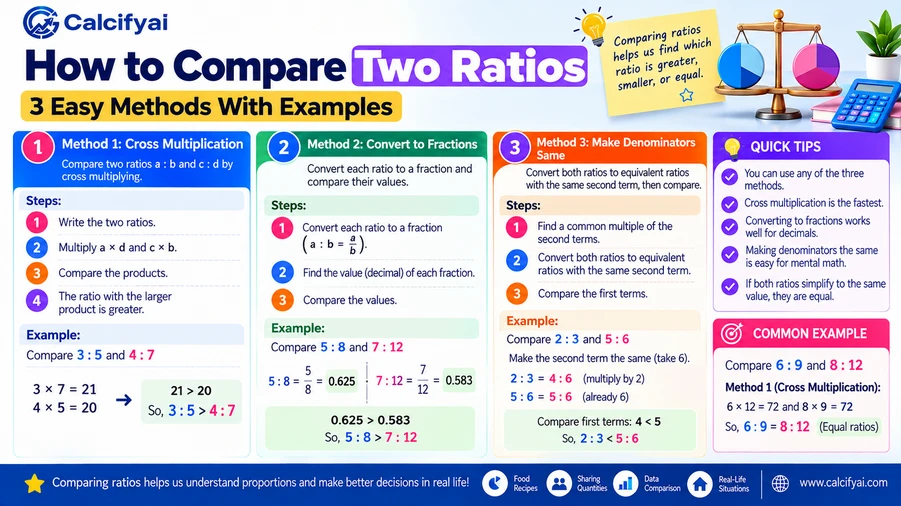
If you need to know how to compare ratios, there are three simple methods you can use:
Simplify both ratios
Convert the ratios to fractions or decimals
Use cross multiplication
For example, to compare 3:5 and 4:7, you can turn them into fractions:
3:5 = 3/5 = 0.60
4:7 ≈ 0.571
Since 0.60 is greater than 0.571:
3:5 > 4:7
The best method depends on the numbers and the type of problem.
What Does It Mean to Compare Ratios?
A ratio compares two quantities.
For example:
3:4
means there are 3 parts for every 4 parts of the other quantity.
When comparing two ratios, you are trying to determine whether:
The first ratio is greater
The second ratio is greater
Both ratios are equal
Suppose you want to compare:
2:3 and 4:6
At first glance, the numbers are different. But both ratios represent the same relationship:
2:3 = 4:6
Therefore, the ratios are equivalent.
Method 1: Compare Ratios by Simplifying Them
One of the easiest ways to compare ratios is to reduce both to their simplest form.
Step 1: Write the Two Ratios
Suppose you want to compare:
12:18 and 8:12
Step 2: Simplify the First Ratio
Find the greatest common divisor of 12 and 18.
The GCD is 6.
Divide both numbers by 6:
12 ÷ 6 = 2
18 ÷ 6 = 3
So:
12:18 = 2:3
Step 3: Simplify the Second Ratio
The GCD of 8 and 12 is 4.
Divide:
8 ÷ 4 = 2
12 ÷ 4 = 3
So:
8:12 = 2:3
Step 4: Compare
Both ratios simplify to:
2:3
Therefore:
12:18 = 8:12
They are equivalent ratios.
This method is especially convenient when the numbers have obvious common factors. CalcifyAI's guide to simplifying ratios covers the GCD method in more detail.
Example: Comparing Ratios by Simplifying
Compare:
15:25 and 18:30
First ratio:
15:25
Divide both numbers by 5:
3:5
Second ratio:
18:30
Divide both numbers by 6:
3:5
Therefore:
15:25 = 18:30
Both ratios represent the same relationship.
Method 2: Convert Ratios to Fractions or Decimals
Another simple method is to write each ratio as a fraction and then compare the values.
For example:
3:4 and 5:8
Write them as fractions:
3/4 = 0.75
5/8 = 0.625
Now compare the decimals:
0.75 > 0.625
Therefore:
3:4 > 5:8
This method works particularly well when the decimal values are easy to calculate.
Example With Different Ratios
Compare:
7:10 and 2:3
Convert each ratio to a decimal:
7 ÷ 10 = 0.70
2 ÷ 3 ≈ 0.667
Now compare:
0.70 > 0.667
Therefore:
7:10 > 2:3
When Should You Use This Method?
Converting ratios to decimals can be useful when:
The denominators are easy to divide.
You want to see the difference clearly.
The ratios contain decimals.
You are comparing rates or percentages.
However, repeating decimals can make this method less convenient. In those cases, cross multiplication is often easier.
Method 3: Compare Ratios Using Cross Multiplication
Cross multiplication is one of the fastest ways to compare two ratios.
Suppose you want to compare:
3:7 and 4:9
Write them as fractions:
3/7 and 4/9
Now multiply diagonally:
3 × 9 = 27
4 × 7 = 28
Compare the results:
27 < 28
Therefore:
3/7 < 4/9
So:
3:7 < 4:9
The idea behind this method is that two ratios are proportional when their cross products are equal. OpenStax explains the same cross-product rule for checking whether two ratios form a proportion. OpenStax
Why Does Cross Multiplication Work?
Suppose you have:
a:b and c:d
Write them as:
a/b and c/d
To compare them, calculate:
a × d
and:
c × b
Then:
If a × d > c × b, the first ratio is greater.
If a × d < c × b, the second ratio is greater.
If a × d = c × b, the ratios are equal.
This gives you a direct comparison without having to simplify or calculate decimal values.
Example: Cross Multiplication
Compare:
5:8 and 3:5
Write the ratios as fractions:
5/8 and 3/5
Cross multiply:
5 × 5 = 25
3 × 8 = 24
Since:
25 > 24
we know:
5/8 > 3/5
Therefore:
5:8 > 3:5
Which Method Should You Use?
All three methods can give you the same answer, but some are more convenient in certain situations.
Method | Best For |
|---|---|
Simplifying | Ratios with easy common factors |
Decimals | Ratios that divide easily |
Cross multiplication | Large or awkward numbers |
For an exam or quick calculation, cross multiplication is often convenient because you do not have to find the GCD or calculate decimal values.
For simple ratios such as 12:18 and 8:12, simplifying may be faster.
How to Compare Ratios With Different Denominators
Different denominators do not prevent you from comparing ratios.
For example:
5:6 and 7:9
Convert them into fractions:
5/6 and 7/9
Cross multiply:
5 × 9 = 45
7 × 6 = 42
Because:
45 > 42
we get:
5:6 > 7:9
You do not need to make the denominators the same before using cross multiplication.
How to Compare Ratios With Large Numbers
Large numbers can make simplification difficult.
For example:
125:200 and 144:225
You could simplify both ratios, but cross multiplication may be quicker.
First ratio × opposite denominator:
125 × 225 = 28,125
Second ratio × opposite denominator:
144 × 200 = 28,800
Since:
28,125 < 28,800
the result is:
125:200 < 144:225
For very large values, an online ratio tool can also reduce manual calculations. CalcifyAI's Ratio Calculator can simplify ratios and show their decimal or percentage representations.
How to Compare Ratios With Decimals
Ratios can contain decimal values.
For example:
2.5:4 and 3:5
You can convert them into fractions:
2.5/4 = 0.625
3/5 = 0.60
Since:
0.625 > 0.60
we get:
2.5:4 > 3:5
Another option is to remove the decimal by multiplying both parts of the first ratio by 10:
2.5:4 = 25:40
Then compare:
25:40 and 3:5
The important rule is to multiply both parts of a ratio by the same number.
How to Compare Ratios With Fractions
Ratios can also contain fractions.
Suppose you need to compare:
1/2 : 3/4
and:
2/3 : 1
First, simplify each ratio carefully.
For the first ratio:
1/2 : 3/4
Multiply both parts by 4:
2:3
For the second ratio:
2/3 : 1
Multiply both parts by 3:
2:3
Therefore:
1/2 : 3/4 = 2/3 : 1
Both ratios represent the same relationship.
How to Compare Ratios in Real-Life Situations
Ratios are not just a classroom math topic. You may need to compare them in everyday situations.
Comparing Prices
Suppose Store A sells 5 notebooks for $10.
Its price ratio is:
$10:5 = $2 per notebook
Store B sells 8 notebooks for $14.
Its price ratio is:
$14:8 = $1.75 per notebook
Now compare:
$2 > $1.75
So the cost per notebook is higher at Store A.
Comparing Sports Statistics
Suppose two players have these records:
Player A: 18 goals in 30 games
Player B: 20 goals in 40 games
Convert them to rates:
Player A:
18 ÷ 30 = 0.60
Player B:
20 ÷ 40 = 0.50
Therefore:
0.60 > 0.50
Player A has the higher goals-per-game ratio.
Comparing Recipe Ratios
Imagine two recipes use different amounts of flour and sugar.
Recipe A:
4 cups flour : 2 cups sugar
Recipe B:
6 cups flour : 4 cups sugar
Simplify Recipe A:
4:2 = 2:1
Simplify Recipe B:
6:4 = 3:2
Convert to decimals:
2/1 = 2
3/2 = 1.5
Therefore, Recipe A has the greater flour-to-sugar ratio.
How to Tell if Two Ratios Are Equivalent
Two ratios are equivalent when they describe the same relationship.
For example:
2:5 and 6:15
Simplify the second ratio:
6 ÷ 3 = 2
15 ÷ 3 = 5
So:
6:15 = 2:5
Therefore:
2:5 = 6:15
You can also use cross multiplication:
2 × 15 = 30
5 × 6 = 30
Because both products are equal, the ratios are equivalent.
Common Mistakes When Comparing Ratios
1. Comparing Only the First Numbers
Consider:
5:10 and 6:20
You cannot simply say that 6:20 is greater because 6 is greater than 5.
The second numbers also matter.
Compare the actual ratios:
5/10 = 0.50
6/20 = 0.30
Therefore:
5:10 > 6:20
2. Reversing the Ratio
Order matters.
2:3 is not the same as 3:2.
Always keep the quantities in the order given by the question.
3. Comparing Different Units
Before comparing ratios, make sure the units are compatible.
For example:
2 meters : 50 centimeters
You should first convert:
2 meters = 200 centimeters
Now the ratio is:
200:50 = 4:1
Comparing numbers without accounting for units can produce the wrong result.
4. Using Cross Multiplication Incorrectly
When comparing:
a/b and c/d
multiply diagonally:
a × d
and:
c × b
Do not multiply the numbers on the same side.
5. Rounding Too Early
Suppose two ratios produce decimal values that are very close.
If you round both too early, you might make them appear equal when they are not.
For close comparisons, cross multiplication is often a safer choice because it can avoid unnecessary rounding.
Quick Example: Compare Two Ratios in Three Ways
Let's compare:
4:7 and 5:9
Method 1: Simplify
Neither ratio can be simplified further.
So use another method.
Method 2: Convert to Decimals
4 ÷ 7 ≈ 0.571
5 ÷ 9 ≈ 0.556
Therefore:
4:7 > 5:9
Method 3: Cross Multiply
4 × 9 = 36
5 × 7 = 35
Since:
36 > 35
we again get:
4:7 > 5:9
All three methods give the same answer.
A Simple Step-by-Step Method for Any Ratio Comparison
When you are unsure which method to use, follow these steps:
Step 1: Write the Ratios Clearly
For example:
A:B and C:D
Step 2: Check the Order
Make sure the quantities are in the same order.
Step 3: Check the Units
Convert the quantities to compatible units if necessary.
Step 4: Choose a Comparison Method
You can:
Simplify both ratios.
Convert them to decimals.
Cross multiply.
Step 5: Compare the Results
Determine whether the first ratio is greater, smaller, or equal.
Step 6: Check Your Answer
If the result seems surprising, use another method to verify it.
Frequently Asked Questions
What is the easiest way to compare two ratios?
For many problems, cross multiplication is a quick method. You can also simplify both ratios when they have easy common factors.
How do you compare ratios with different denominators?
Write the ratios as fractions and cross multiply. For example, to compare a/b and c/d, compare a × d with c × b.
How do you know if two ratios are equal?
Two ratios are equal when they simplify to the same ratio or when their cross products are equal.
Can I compare ratios using decimals?
Yes. Divide the first part by the second part for each ratio and compare the resulting decimal values.
Which is better: simplifying or cross multiplication?
Neither method is always better. Simplifying is convenient when the numbers have obvious common factors. Cross multiplication is often useful when the numbers are larger or difficult to simplify.
Can ratios with decimals be compared?
Yes. You can convert them into fractions, remove decimals by multiplying both parts by the same power of 10, or convert the ratios to decimal values.
Can ratios with fractions be compared?
Yes. Simplify the ratios first or use equivalent fractions and cross multiplication.
Why does the order of a ratio matter?
The order tells you which quantity is being compared with which. For example, 2:5 and 5:2 describe opposite relationships.
Final Takeaway
Learning how to compare ratios becomes much easier when you know a few reliable methods.
The three main approaches are:
Simplify both ratios and compare their simplest forms.
Convert them to decimals and compare the values.
Cross multiply and compare the two products.
For example, to compare 3:7 and 4:9:
3 × 9 = 27
4 × 7 = 28
Since 27 < 28:
3:7 < 4:9
The most important thing is to keep the ratio order correct, use compatible units, and avoid rounding too early.
Once you understand these methods, you can compare ratios in math problems, recipes, prices, sports statistics, business data, and many other everyday situations.
Disclaimer
The information provided in this article is for educational and informational purposes only. It should not be considered as professional financial, medical, or legal advice. Always consult with qualified professionals for specific guidance related to your situation.
Popular Calculators
Explore our most-used free calculators for finance, health, and everyday needs.