
Ratio and Proportion Word Problems With Step-by-Step Solutions
Learn how to solve ratio and proportion word problems with step-by-step examples, formulas, common mistakes, and practical solutions.
Calcifyai Team
Expert calculators & financial tools
Ratio and proportion word problems appear in school math, shopping, recipes, maps, measurements, speed, and many everyday situations. They can look complicated because the information is written as a story, but the underlying math is often simple.
The key is to identify the quantities being compared, write the relationship in the correct order, and then solve it step by step.
This guide explains how to solve ratio and proportion problems using clear methods, formulas, worked examples, and practical tips.
What Are Ratio and Proportion Word Problems?
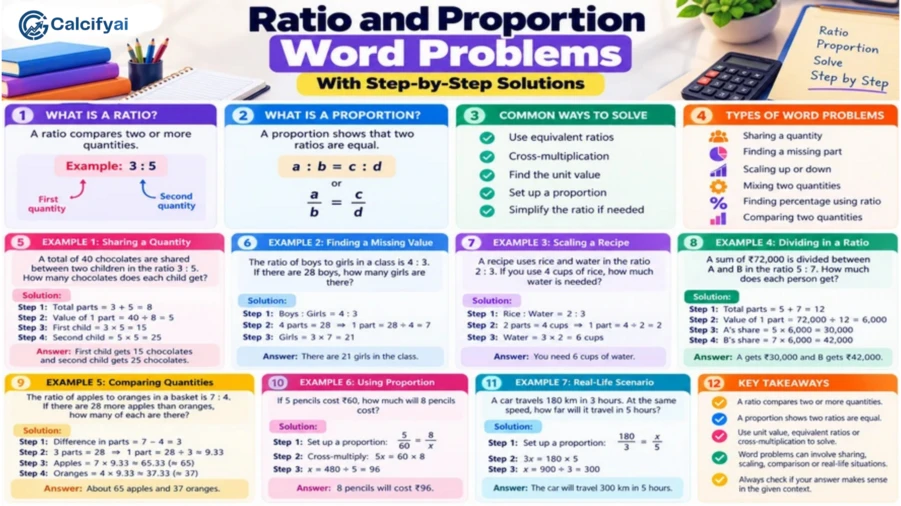
A ratio compares two or more quantities.
For example, if a basket has 8 apples and 12 oranges, the ratio of apples to oranges is:
8:12
Simplifying by 4 gives:
2:3
A proportion states that two ratios are equal.
For example:
2:3 = 8:12
Both ratios describe the same relationship.
In a word problem, you usually need to translate the information from the question into a ratio or proportion and then find the unknown value.
A standard proportion can be written as:
a:b = c:d
or:
a/b = c/d
For a proportion, the cross products are equal:
a × d = b × c
If you want to review the basic concepts before solving word problems, Math Is Fun's ratios and proportions guide provides explanations and examples covering ratios, ratio sharing, rates, and proportions.
How to Identify a Ratio and Proportion Problem
Before calculating anything, read the problem carefully.
Look for words such as:
ratio
for every
compared with
proportional
same rate
equivalent
per
scale
how many
how much
find the missing value
For example:
A recipe uses 3 cups of flour for every 2 cups of sugar. How much flour is needed for 8 cups of sugar?
The important relationship is:
3 cups flour : 2 cups sugar
The question gives a new sugar quantity, so you need to find the matching amount of flour.
A Simple 5-Step Method
Most ratio and proportion word problems can be solved using these five steps.
Step 1: Identify the quantities
Determine which values are being compared.
Step 2: Write the ratio
Keep the order exactly as stated in the problem.
Step 3: Set up a proportion
Match corresponding quantities.
Step 4: Solve for the unknown
Use cross multiplication or an equivalent-ratio method.
Step 5: Check the answer
Make sure the result makes sense in the original situation.
Example 1: Students in a Classroom
A classroom has 12 boys and 18 girls. If the same ratio is maintained in another group with 30 girls, how many boys are there?
Step 1: Identify the ratio
Boys to girls:
12:18
Simplify:
2:3
So the relationship is:
2 boys for every 3 girls
Step 2: Set up a proportion
Let x represent the number of boys.
2:3 = x:30
Or:
2/3 = x/30
Step 3: Cross multiply
2 × 30 = 3 × x
60 = 3x
Step 4: Solve
Divide by 3:
x = 20
Answer
There are 20 boys.
Check
20:30 simplifies to:
2:3
So the answer is correct.
Example 2: Recipe Scaling
A recipe requires 4 cups of flour to make 10 servings. How many cups of flour are needed to make 25 servings?
This is a proportional relationship because the amount of flour changes with the number of servings.
Step 1: Write the known ratio
4 cups flour : 10 servings
Step 2: Set up the proportion
Let x be the required amount of flour.
4:10 = x:25
Step 3: Cross multiply
4 × 25 = 10 × x
100 = 10x
Step 4: Solve
x = 10
Answer
You need 10 cups of flour for 25 servings.
Example 3: Finding a Missing Price
Five notebooks cost $15. How much would 8 notebooks cost at the same price per notebook?
Step 1: Identify the quantities
Notebooks: 5
Cost: $15
The unit relationship is:
5 notebooks : $15
Step 2: Create a proportion
Let x be the cost of 8 notebooks.
5:15 = 8:x
Step 3: Cross-multiply
5 × x = 15 × 8
5x = 120
Step 4: Solve
x = 24
Answer
Eight notebooks cost $24.
Another way to check
One notebook costs:
$15 ÷ 5 = $3
Therefore:
8 × $3 = $24
Both methods give the same result.
Example 4: Map Scale Problem
A map uses a scale of 1 inch for every 20 miles. Two cities are 3.5 inches apart on the map. What is the actual distance?
Step 1: Write the scale
1 inch : 20 miles
Step 2: Set up the proportion
Let x represent the actual distance.
1:20 = 3.5:x
Step 3: Cross multiply
1 × x = 20 × 3.5
x = 70
Answer
The actual distance is 70 miles.
Map scales are a common real-world application of proportions.
Example 5: Mixing Paint
A paint mixture uses 2 parts blue paint for every 5 parts white paint. If you use 15 parts white paint, how much blue paint do you need?
Step 1: Identify the ratio
Blue to white:
2:5
Step 2: Set up the proportion
Let x represent the blue paint.
2:5 = x:15
Step 3: Cross multiply
2 × 15 = 5 × x
30 = 5x
Step 4: Solve
x = 6
Answer
You need 6 parts blue paint.
Check
6:15 simplifies to:
2:5
The ratio is maintained.
Example 6: Distance and Time
A car travels 180 miles in 3 hours at a constant speed. How far will it travel in 5 hours?
Step 1: Identify the relationship
Distance changes proportionally with time when the speed remains constant.
Known relationship:
180 miles : 3 hours
Step 2: Set up the proportion
180:3 = x:5
Step 3: Cross multiply
180 × 5 = 3 × x
900 = 3x
Step 4: Solve
x = 300
Answer
The car will travel 300 miles in 5 hours.
Check using unit rate
Speed:
180 ÷ 3 = 60 miles per hour
For 5 hours:
60 × 5 = 300 miles
The answer checks out.
Example 7: Dividing a Total in a Ratio
Two friends divide $150 in the ratio 2:3. How much does each person receive?
This type of problem is slightly different because you are dividing one total amount into ratio parts.
Step 1: Add the ratio parts
2 + 3 = 5 parts
Step 2: Find the value of one part
$150 ÷ 5 = $30
Step 3: Find each person's share
First person:
2 × $30 = $60
Second person:
3 × $30 = $90
Answer
First person: $60
Second person: $90
Check:
$60 + $90 = $150
For a deeper explanation of this method, you can also read CalcifyAI's guide on how to divide a quantity in a given ratio.
Example 8: Finding a Missing Value
A school has 4 teachers for every 60 students. If there are 180 students, how many teachers are needed at the same ratio?
Step 1: Write the known ratio
4 teachers : 60 students
Step 2: Set up the proportion
4:60 = x:180
Step 3: Cross multiply
4 × 180 = 60 × x
720 = 60x
Step 4: Solve
x = 12
Answer
The school would need 12 teachers at the same ratio.
When a word problem gives a known ratio and asks for an unknown value, setting up the corresponding quantities in the same order is essential.
How to Know Which Numbers Go Together
One of the hardest parts of ratio word problems is deciding how to arrange the numbers.
Suppose a problem says:
A machine produces 240 items in 6 hours. How many items can it produce in 10 hours?
The corresponding quantities are:
Items ↔ items
Hours ↔ hours
So write:
240 items : 6 hours = x items : 10 hours
Do not write the second ratio backward.
A useful rule is:
Keep the same type of quantity in the same position.
For example:
items : hours = items : hours
or:
hours : items = hours : items
Both can work, but you must remain consistent.
Using a Ratio Calculator
For quick checking, you can use a Ratio Calculator to simplify ratios, solve proportions, and find missing values. The calculator supports proportions such as a:b = c:d and can also show equivalent ratios and conversions.
However, when learning ratio and proportion word problems, it is useful to understand the setup and calculation rather than relying only on a tool.
Common Mistakes in Ratio and Proportion Problems
1. Reversing the Ratio
If the question asks for the ratio of boys to girls, write:
Boys : Girls
not:
Girls : Boys
For example:
20 boys and 15 girls
Correct:
20:15 = 4:3
The reverse ratio, 3:4, represents a different relationship.
2. Mixing Units
Suppose a problem compares 2 meters with 50 centimeters.
Do not immediately write:
2:50
Convert the units first.
2 meters = 200 centimeters
Now:
200:50 = 4:1
The quantities must use compatible units before you compare them.
3. Cross Multiplying the Wrong Numbers
For:
3:5 = x:20
the correct cross multiplication is:
3 × 20 = 5 × x
Do not multiply numbers simply because they are next to each other.
4. Assuming Every Problem Is Proportional
Not every relationship is proportional.
For example, if a taxi has a fixed starting fee plus a charge for each mile, the total cost may not be directly proportional to the distance because of the starting fee.
Before setting up a proportion, ask:
Does one quantity change at a constant rate relative to the other?
5. Forgetting to Check the Answer
After solving, put your answer back into the original relationship.
For example, if:
4:7 = x:21
and you find:
x = 12
Check:
4:7 = 12:21
Both simplify to the same ratio.
That confirms the solution.
Ratio vs. Proportion: Quick Difference
Ratio | Proportion |
|---|---|
Compares quantities | States that two ratios are equal |
Example: 3:5 | Example: 3:5 = 6:10 |
Shows a relationship | Can be used to find an unknown |
Can be simplified | Can be solved using cross multiplication |
Think of it this way:
A ratio describes a relationship. A proportion says two relationships are equivalent.
A Quick Strategy for Solving Word Problems
When you see a ratio and proportion word problem, use this checklist:
Read the question carefully.
Identify what is being compared.
Write the known ratio.
Identify the unknown.
Keep corresponding quantities in the same order.
Set up a proportion.
Cross multiply.
Solve for the unknown.
Include the correct unit.
Check whether the answer makes sense.
This method works for many problems involving recipes, prices, maps, measurements, mixtures, distance, time, and scaling.
Frequently Asked Questions
What is the easiest way to solve ratio and proportion word problems?
First identify the two quantities being compared. Write the known ratio, create an equivalent ratio containing the unknown, cross multiply, solve, and then check the result.
What is the formula for a proportion?
A standard proportion is:
a:b = c:d
Using fraction notation:
a/b = c/d
Cross multiplication gives:
a × d = b × c
When should I use cross multiplication?
Use cross multiplication when you have two equal ratios set up as a proportion. It should not be applied automatically to an equation that does not contain two ratios in proportion.
How do I know if two ratios are proportional?
You can compare their simplified forms or cross multiply.
For example:
2:3 and 8:12
Cross multiply:
2 × 12 = 24
3 × 8 = 24
Because the cross products are equal, the ratios are proportional.
Can proportions include decimals?
Yes. For example:
2.5:5 = x:20
You can solve the proportion using the same process.
How are proportions used in real life?
Proportions are useful for scaling recipes, reading maps, comparing prices, calculating distances, mixing materials, adjusting quantities, and solving measurement problems. OpenStax
What is the most common mistake in ratio word problems?
A common mistake is reversing the order of the quantities. Always make sure the first quantity in one ratio corresponds to the first quantity in the other ratio.
Final Takeaway
The key to solving ratio and proportion problems is not memorizing a complicated formula. It is learning how to translate a word problem into a correct mathematical relationship.
Remember the basic process:
Identify → Write the ratio → Set up the proportion → Cross multiply → Solve → Check
Once you understand how the quantities correspond, problems involving recipes, prices, maps, mixtures, distance, time, and other real-world situations become much easier to solve.
Disclaimer
The information provided in this article is for educational and informational purposes only. It should not be considered as professional financial, medical, or legal advice. Always consult with qualified professionals for specific guidance related to your situation.
Popular Calculators
Explore our most-used free calculators for finance, health, and everyday needs.