
How to Scale a Ratio Up or Down Without Changing the Proportion
Learn how to scale a ratio up or down using simple formulas, step-by-step examples, and practical tips while keeping the same proportion.
Calcifyai Team
Expert calculators & financial tools
Scaling a ratio means making its numbers larger or smaller while keeping the same relationship between them. The key is simple: multiply or divide every part of the ratio by the same nonzero number.
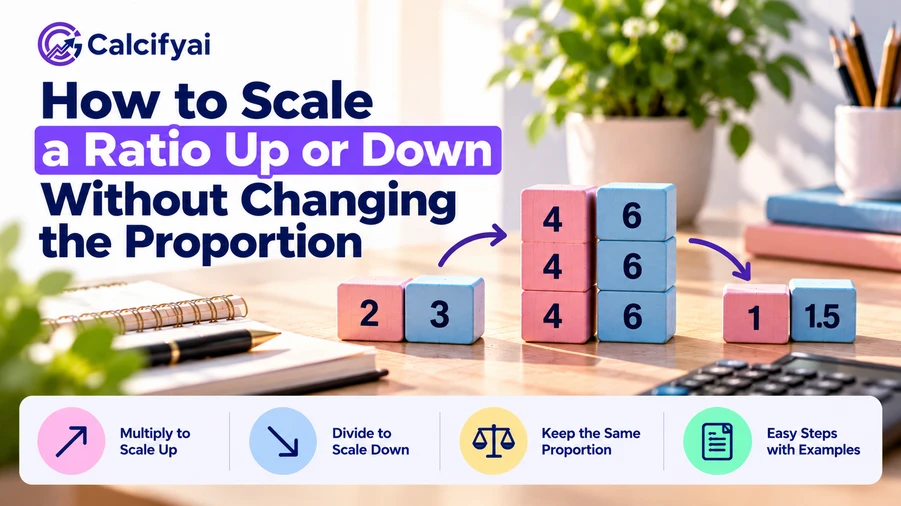
For example, the ratio 2:3 can be scaled up to 4:6 by multiplying both numbers by 2. It can also be scaled down to 1:1.5 by dividing both numbers by 2. Both ratios describe the same proportion.
This method is useful when adjusting recipes, resizing designs, comparing quantities, solving math problems, or working with measurements. Once you understand how to scale a ratio, you can change the numbers without changing what the ratio represents.
What Does It Mean to Scale a Ratio?
A ratio compares two or more quantities. Scaling changes the size of those quantities while preserving their relative values.
For example, imagine a drink recipe that uses 2 cups of juice for every 3 cups of water. Its ratio is 2:3.
If you want to make twice as much, multiply both parts by 2:
2 × 2 : 3 × 2 = 4:6
The new ratio is 4:6. It still uses the same amount of juice relative to water, so the drink's proportions remain unchanged.
If you want a smaller batch, you can divide both parts by 2:
2 ÷ 2 : 3 ÷ 2 = 1:1.5
The ratio becomes 1:1.5, which represents the same relationship in smaller quantities.
Formula for Scaling a Ratio
To scale a ratio, multiply or divide every term by the same nonzero scale factor.
For a ratio a, the formula is:
New ratio = (a × k):(b × k)
Here:
a is the first part of the original ratio.
b is the second part.
k is the scale factor.
k > 1 scales the ratio up.
0 < k < 1 scales the ratio down.
For example, scaling 3:5 by a factor of 4 gives:
(3 × 4):(5 × 4) = 12:20
Scaling it by 0.5 gives:
(3 × 0.5):(5 × 0.5) = 1.5:2.5
Both results are equivalent to 3:5.
How to Scale a Ratio Up Step by Step
Scaling up is useful when you need larger quantities but want to maintain the original proportion.
Follow these steps:
Write the original ratio.
Choose a scale factor greater than 1.
Multiply every part of the ratio by that factor.
Check that the new ratio is equivalent to the original.
Example: Scale the Ratio 3:4 Up by 5
Suppose a mixture uses 3 parts of one ingredient for every 4 parts of another. You need a larger batch that is five times the original size.
Step 1: Write the original ratio.
3:4
Step 2: Choose the scale factor.
5
Step 3: Multiply both parts by 5.
3 × 5 = 15
4 × 5 = 20
Step 4: Write the scaled ratio.
15:20
The scaled ratio is 15:20. Both quantities are five times larger, so their proportion has not changed.
How to Scale a Ratio Down Step by Step
Scaling down reduces the quantities while keeping their relationship the same. Use a scale factor between 0 and 1, or divide every part by the same number greater than 1.
Example: Scale the Ratio 12:18 Down by 3
Suppose you have a ratio of 12:18 and want to reduce both quantities to one-third of their original size.
Step 1: Write the original ratio.
12:18
Step 2: Choose the divisor.
3
Step 3: Divide both parts by 3.
12 ÷ 3 = 4
18 ÷ 3 = 6
Step 4: Write the scaled ratio.
4:6
The new ratio is 4:6. It is smaller than the original ratio but represents the same proportion.
You can simplify it further by dividing both parts by 2:
4:6 = 2:3
The ratio 2:3 is the simplest whole-number form.
Real-Life Examples of Scaling Ratios
Scaling ratios is not limited to math exercises. It is also useful in everyday situations where quantities need to change without changing their relative amounts.
Example 1: Scaling a Recipe
A pancake recipe uses flour and milk in the ratio 2:3. You want to prepare twice as much.
Original ratio: 2:3
Scale factor: 2
Multiply both parts by 2:
(2 × 2):(3 × 2) = 4:6
The new ratio is 4:6. If the original recipe uses 2 cups of flour and 3 cups of milk, the larger batch uses 4 cups of flour and 6 cups of milk.
Example 2: Resizing a Drawing
A drawing has a width-to-height ratio of 5:3. You want to make it three times larger without stretching or distorting it.
Original ratio: 5:3
Scale factor: 3
Calculate the new dimensions:
5 × 3 = 15
3 × 3 = 9
The new ratio is 15:9. The drawing becomes larger, but its width-to-height relationship remains the same.
Example 3: Reducing a Paint Mixture
A paint mixture uses blue and white paint in the ratio 8:4. You only need half the original amount.
Original ratio: 8:4
Scale factor: 0.5
Multiply both parts by 0.5:
(8 × 0.5):(4 × 0.5) = 4:2
The scaled ratio is 4:2, which simplifies to 2:1. The smaller mixture keeps the same color proportions as the original.
How to Check Whether Two Ratios Are Equivalent
After scaling a ratio, you can check whether the new ratio preserves the original proportion.
One method is to divide the corresponding terms. Another is to use cross multiplication.
For example, compare:
3:5 and 12:20
Cross-multiply:
3 × 20 = 60
5 × 12 = 60
Both products are equal, so the ratios are equivalent.
You can also divide each pair:
3 ÷ 5 = 0.6
12 ÷ 20 = 0.6
The matching results confirm that the ratios have the same value.
For a broader explanation of ratio notation, simplification, and related formulas, read our guide to the ratio formula and examples.
You can also learn more about equivalent ratios and how they represent the same relationship to understand why multiplying or dividing both parts of a ratio by the same number preserves the proportion.
Scaling Ratios With More Than Two Parts
A ratio can compare three or more quantities. The same scaling rule applies: multiply or divide every part by the same factor.
For example, a recipe uses rice, vegetables, and broth in the ratio:
2:3:5
To make a batch that is four times larger, multiply every part by 4:
2 × 4 : 3 × 4 : 5 × 4
8:12:20
The new ratio is 8:12:20. Each quantity has increased by the same factor, so the original relationship remains unchanged.
To scale it down by 2, divide every part by 2:
1:1.5:2.5
This is also equivalent to the original ratio.
Common Mistakes When Scaling a Ratio
A small mistake can change the relationship between quantities. Watch out for these common errors.
1. Changing Only One Part
Suppose the original ratio is 2:3. Multiplying only the first part by 2 gives 4:3.
This is not equivalent to 2:3 because only one quantity changed.
Correct method: Apply the same scale factor to every part.
2. Using Different Scale Factors
If you multiply 2:3 by 2 on the first part and by 3 on the second, you get 4:9.
The relationship has changed because the two parts were scaled differently.
Correct method: Use one common scale factor for the entire ratio.
3. Confusing Scaling With Simplifying
Scaling up makes the numbers larger, while simplifying reduces a ratio to smaller whole numbers when possible. Both methods preserve the proportion, but they serve different purposes.
For example:
Scaling up: 2:3 becomes 8:12.
Simplifying: 8:12 becomes 2:3.
4. Rounding Too Early
Scaling down can produce decimal values. Rounding them too soon may slightly change the proportion.
For example, scaling 2:3 by 0.5 gives 1:1.5. Rounding 1.5 to 2 changes the ratio to 1:2, which is not equivalent.
Correct method: Keep exact values during the calculation and round only when the situation requires it.
5. Ignoring Units
Before scaling quantities in a real-world problem, check that the measurements use compatible units.
For example, if one quantity is measured in meters and another in centimeters, convert them as needed before comparing or applying the ratio.
Frequently Asked Questions
How do you scale a ratio up?
Multiply every part of the ratio by the same factor greater than 1. For example, multiplying 2:5 by 3 gives 6:15. The new ratio is larger but equivalent to the original.
How do you scale a ratio down?
Multiply every part by the same factor between 0 and 1, or divide every part by the same number greater than 1. For example, dividing 12:18 by 3 gives 4:6.
Does scaling a ratio change the proportion?
No. Scaling preserves the proportion when every part is multiplied or divided by the same nonzero factor. The numbers change, but the relationship between them stays the same.
Can you scale a ratio by a decimal?
Yes. A ratio can be scaled by a decimal as long as the same factor is applied to every part. For example, scaling 4:6 by 0.5 gives 2:3.
What is the difference between scaling and simplifying a ratio?
Scaling changes the size of the numbers while preserving the relationship. Simplifying reduces a ratio to its lowest whole-number terms when possible. For example, 6:9 simplifies to 2:3, while scaling 2:3 up by 3 gives 6:9.
How can I calculate an equivalent ratio quickly?
Choose a scale factor and apply it to every part of the ratio. You can also use the Ratio Calculator to calculate equivalent ratios, simplify values, and solve proportion problems.
Conclusion
Scaling a ratio up or down is a straightforward way to adjust quantities without changing their relationship. The main rule is to multiply or divide every part by the same nonzero scale factor.
Remember these points:
Multiply by a factor greater than 1 to scale up.
Multiply by a factor between 0 and 1 to scale down.
Apply the same factor to every part.
Check the result to confirm that the proportion is unchanged.
Whether you're adjusting a recipe, resizing a drawing, or solving a math problem, this method helps you work with equivalent ratios accurately.
Disclaimer
The information provided in this article is for educational and informational purposes only. It should not be considered as professional financial, medical, or legal advice. Always consult with qualified professionals for specific guidance related to your situation.
Popular Calculators
Explore our most-used free calculators for finance, health, and everyday needs.