
How to Solve Proportions Using Cross Multiplication
Learn how to solve proportions using cross multiplication with simple steps, formulas, examples, word problems, and common mistakes.
Calcifyai Team
Expert calculators & financial tools
Cross multiplication is one of the easiest ways to solve a proportion when one value is unknown. It is useful in school math, recipes, measurements, maps, prices, scale drawings, and many everyday calculations.
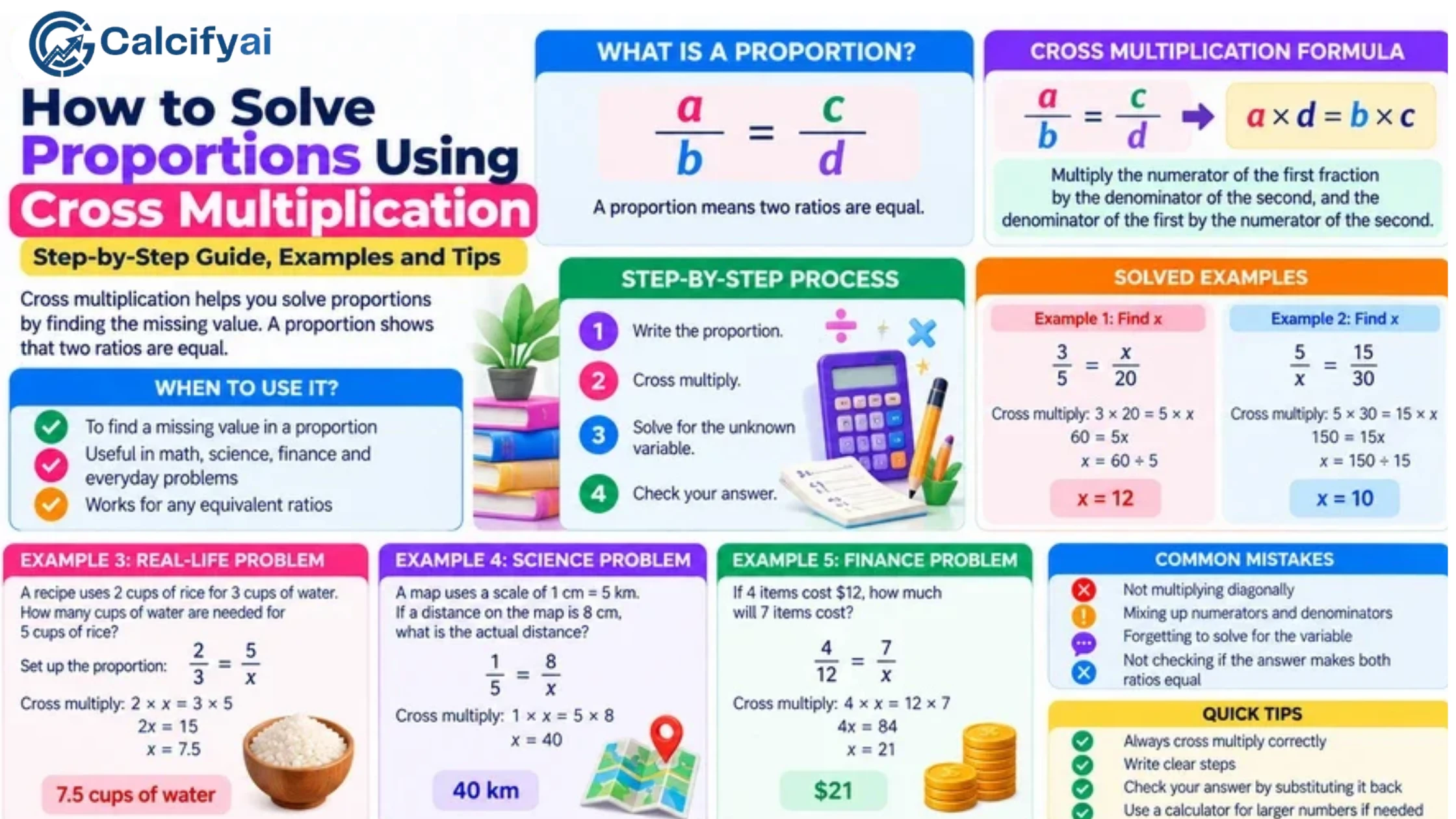
The basic idea is simple:
If two ratios are equal, their cross products are equal.
For example:
3/5 = x/20
Cross multiply:
3 × 20 = 5 × x
Then:
60 = 5x
So:
x = 12
This guide explains cross multiplication proportions step by step, including fractions, decimals, word problems, common mistakes, and ways to check your answer.
What Is a Proportion?
A proportion is an equation that states that two ratios are equal.
For example:
2:3 = 8:12
or:
2/3 = 8/12
Both ratios represent the same relationship.
A proportion normally contains four values, although one of them may be an unknown.
For example:
4/7 = x/21
Here, x is the value we need to find.
OpenStax explains that two ratios are proportional when they are equal and that, for a proportion such as a/b = c/d, the cross products satisfy a × d = b × c.
What Is Cross Multiplication?
Cross multiplication means multiplying the numbers diagonally across a proportion.
For:
a/b = c/d
multiply:
a × d
and:
b × c
Then set them equal:
a × d = b × c
This creates an equation that can usually be solved for the unknown.
Example
Suppose:
5/8 = x/24
Cross multiply:
5 × 24 = 8 × x
Calculate:
120 = 8x
Divide by 8:
x = 15
So:
5/8 = 15/24
How to Solve a Proportion Using Cross Multiplication
Use these five steps.
Step 1: Set Up the Proportion
Make sure the two ratios are written in the same order.
For example:
3/4 = x/20
Step 2: Cross Multiply
Multiply diagonally:
3 × 20 = 4 × x
Step 3: Simplify
Calculate the known multiplication:
60 = 4x
Step 4: Isolate the Unknown
Divide both sides by 4:
x = 15
Step 5: Check the Answer
Put 15 back into the original proportion:
3/4 = 15/20
Both sides are equal, so the answer is correct.
Example 1: Basic Cross Multiplication
Solve:
2/5 = x/15
Step 1: Cross multiply
2 × 15 = 5 × x
Step 2: Calculate
30 = 5x
Step 3: Divide
30 ÷ 5 = x
x = 6
Answer
x = 6
Check
2/5 = 6/15
Both simplify to the same ratio.
Example 2: Unknown in the Denominator
Not every problem has the unknown on top.
Solve:
6/10 = 15/x
Step 1: Cross multiply
6 × x = 10 × 15
Step 2: Calculate
6x = 150
Step 3: Divide
x = 150 ÷ 6
x = 25
Answer
x = 25
Check:
6/10 = 15/25
Both ratios equal 3/5.
Example 3: Unknown on the Left
Consider:
x/8 = 12/16
Step 1: Cross multiply
x × 16 = 8 × 12
Step 2: Calculate
16x = 96
Step 3: Divide
x = 6
Answer
x = 6
Check:
6/8 = 12/16
Both simplify to:
3/4
Example 4: Proportions With Decimals
Cross multiplication also works with decimals.
Solve:
2.5/5 = x/20
Step 1: Cross multiply
2.5 × 20 = 5 × x
Step 2: Calculate
50 = 5x
Step 3: Solve
x = 10
Answer
x = 10
You can also notice that 5 becomes 20 by multiplying by 4, so 2.5 must also be multiplied by 4:
2.5 × 4 = 10
Both methods give the same result.
Example 5: Proportions With Fractions
Suppose:
1/3 = x/12
Cross multiply:
1 × 12 = 3 × x
So:
12 = 3x
Divide by 3:
x = 4
Therefore:
1/3 = 4/12
This shows that cross multiplication can work directly with fractions.
How to Solve Word Problems Using Cross Multiplication
Many proportion problems are written as real-world situations instead of equations.
The most important step is to identify the quantities that correspond to each other.
The cross-multiplication method follows the rule that if two ratios form a proportion, their cross products are equal. For additional examples of solving proportions, see OpenStax's guide to solving proportions.
Example: Recipe
A recipe uses 3 cups of flour for 5 batches. How many cups of flour are needed for 20 batches?
Step 1: Identify the relationship
Flour to batches:
3 cups : 5 batches
Step 2: Set up the proportion
Let x be the flour needed:
3/5 = x/20
Step 3: Cross multiply
3 × 20 = 5 × x
60 = 5x
Step 4: Solve
x = 12
Answer
You need 12 cups of flour for 20 batches.
Example: Shopping Price
Four notebooks cost $12. How much would 10 notebooks cost at the same price?
Set up the proportion:
4/12 = 10/x
Cross multiply:
4x = 12 × 10
4x = 120
Divide:
x = 30
Answer
10 notebooks would cost $30, assuming the same price per notebook.
Example: Map Scale
A map uses a scale of 1 inch = 25 miles. Two cities are 6 inches apart on the map. What is the actual distance?
Set up:
1/25 = 6/x
Cross multiply:
1 × x = 25 × 6
x = 150
Answer
The actual distance is 150 miles.
Proportions are commonly used for scaling problems such as maps and models.
Example: Distance and Time
A car travels 180 miles in 3 hours at a constant speed. How far can it travel in 5 hours?
Set up:
180/3 = x/5
Cross multiply:
180 × 5 = 3x
900 = 3x
Divide by 3:
x = 300
Answer
The car can travel 300 miles in 5 hours at the same rate.
How to Set Up a Proportion Correctly
Setting up the proportion is often harder than the cross multiplication itself.
The corresponding quantities need to stay in the same position.
For example:
Miles / Hours = Miles / Hours
If:
180 miles / 3 hours
is compared with an unknown distance over 5 hours, write:
180/3 = x/5
Do not write:
180/3 = 5/x
because the corresponding quantities are no longer in the same order.
A useful rule
Same type of quantity should stay in the same position.
For example:
Dollars / Items = Dollars / Items
Miles / Hours = Miles / Hours
Cups / Servings = Cups / Servings
Inches / Miles = Inches / Miles
Cross Multiplication Formula
For a proportion:
a/b = c/d
cross multiplication gives:
a × d = b × c
If the unknown is x in:
a/b = x/d
then:
x = (a × d) ÷ b
If the unknown is in:
a/b = c/x
then:
x = (b × c) ÷ a
These are simply shortcuts created by applying cross multiplication and then dividing to isolate the unknown.
When Should You Use Cross Multiplication?
Cross multiplication is useful when:
You have two equal ratios.
One value is unknown.
The ratios represent the same relationship.
You need to solve a proportion.
You are working with fractions or ratios.
For example:
4/7 = x/21
is a proportion, so cross multiplication works.
However, you should not automatically cross multiply every time you see fractions. The expression needs to be structured as a proportion with two ratios. OpenStax specifically notes that cross multiplication is used when the two ratios are set up as a proportion.
When Should You Not Use Cross Multiplication?
Consider:
2/5 = x/8 + 3x
This is not simply two ratios set equal to each other.
The right side contains:
x/8 + 3x
So you should not immediately cross multiply the expression as though it were:
a/b = c/d
Instead, use normal algebraic steps to simplify and solve the equation.
This distinction is important because cross multiplication is a method for proportions, not a universal rule for equations containing fractions.
Cross Multiplication vs Equivalent Ratios
Cross multiplication is not the only way to solve proportions.
Sometimes equivalent ratios are faster.
Suppose:
2/5 = x/20
Ask:
What happened to 5?
5 was multiplied by 4:
5 × 4 = 20
So multiply 2 by 4:
2 × 4 = 8
Therefore:
x = 8
Cross multiplication gives the same answer:
2 × 20 = 5x
40 = 5x
x = 8
Use whichever method is easier for the numbers.
How to Check a Proportion
After solving, always check your answer.
Suppose:
4/7 = x/21
You calculated:
x = 12
Substitute 12:
4/7 = 12/21
Simplify 12/21:
12/21 = 4/7
The two ratios match.
You can also check the cross products:
4 × 21 = 84
7 × 12 = 84
Because both products equal 84, the proportion is correct.
Using a Ratio Calculator
If you want to check your work quickly, the Ratio Calculator can help solve proportions, simplify ratios, and calculate equivalent ratios.
It uses the same basic relationship:
a:b = c:d
which means:
a × d = b × c
A calculator can be useful for checking arithmetic, but understanding how to set up the proportion is the most important skill.
Common Cross Multiplication Mistakes
1. Multiplying the Wrong Numbers
For:
3/5 = x/20
the correct products are:
3 × 20
and:
5 × x
Do not multiply the numbers next to each other.
2. Reversing the Ratio
Suppose a recipe uses:
2 cups flour for 3 cups milk
The relationship is:
2/3
If you write:
3/2
you have reversed the quantities.
Keep the order consistent.
3. Mixing Different Units
Suppose a problem compares:
2 meters and 50 centimeters
Convert the units before setting up the ratio.
2 meters = 200 centimeters
So the comparison becomes:
200/50
not:
2/50
4. Cross Multiplying Without a Proportion
Not every equation containing fractions can be solved by immediately cross multiplying.
First ask:
Do I have two ratios that are equal?
If yes, cross multiplication may be appropriate.
5. Forgetting to Divide
After cross multiplication, you usually still have an equation to solve.
For example:
5x = 80
You must divide both sides by 5:
x = 16
Cross multiplication is only one step in the solution.
6. Skipping the Check
A quick substitution can catch errors in arithmetic or in the original setup.
Always check the result when possible.
A Quick Method to Remember
When solving a proportion, remember:
Set Up → Cross Multiply → Simplify → Divide → Check
For example:
3/4 = x/20
Set up
3/4 = x/20
Cross multiply
3 × 20 = 4x
Simplify
60 = 4x
Divide
x = 15
Check
3/4 = 15/20
Correct.
Frequently Asked Questions
What is cross multiplication in proportions?
Cross multiplication is a method for solving a proportion by multiplying the numerator of one ratio by the denominator of the other ratio.
For:
a/b = c/d
cross multiplication gives:
a × d = b × c
How do you solve a proportion step by step?
First set up the two ratios correctly. Then cross multiply, simplify the resulting equation, divide to isolate the unknown, and check the answer.
What is the cross multiplication rule?
If:
a/b = c/d
then:
a × d = b × c
The cross products must be equal.
Can you cross multiply decimals?
Yes. For example:
2.5/5 = x/20
can be solved by:
2.5 × 20 = 5x
Can you cross multiply fractions?
Yes. Cross multiplication works with fractions when they form a proportion.
For example:
1/3 = x/12
gives:
1 × 12 = 3x
so:
x = 4
Can you use cross multiplication for word problems?
Yes. Cross multiplication is commonly used for word problems involving prices, recipes, maps, scale, speed, distance, measurements, and other proportional relationships.
What is the difference between a ratio and a proportion?
A ratio compares quantities, such as:
3:5
A proportion states that two ratios are equal, such as:
3:5 = 6:10
How do I know if a proportion is correct?
Cross multiply both sides. If the cross products are equal, the two ratios are proportional.
For example:
2/3 = 8/12
Check:
2 × 12 = 24
3 × 8 = 24
The proportion is correct.
Final Takeaway
Cross multiplication proportions are easier to solve when you follow a consistent process.
Remember:
Write the two ratios in the correct order.
Make sure they represent the same relationship.
Cross multiply diagonally.
Simplify the equation.
Divide to find the unknown.
Check the answer.
The main rule is:
a/b = c/d
therefore:
a × d = b × c
Once you understand this relationship, you can solve many proportion problems involving recipes, prices, maps, measurements, distance, time, and scale.
Disclaimer
The information provided in this article is for educational and informational purposes only. It should not be considered as professional financial, medical, or legal advice. Always consult with qualified professionals for specific guidance related to your situation.
Popular Calculators
Explore our most-used free calculators for finance, health, and everyday needs.