
What Is Integer Overflow and Why Does It Happen?
Learn what integer overflow is, why it happens, how signed and unsigned integers behave, and how developers can prevent overflow errors.
Calcifyai Team
Expert calculators & financial tools
Computers use numbers constantly. Programs count items, store prices, calculate scores, track time, process data, and perform mathematical operations.
But computer numbers are not always unlimited.
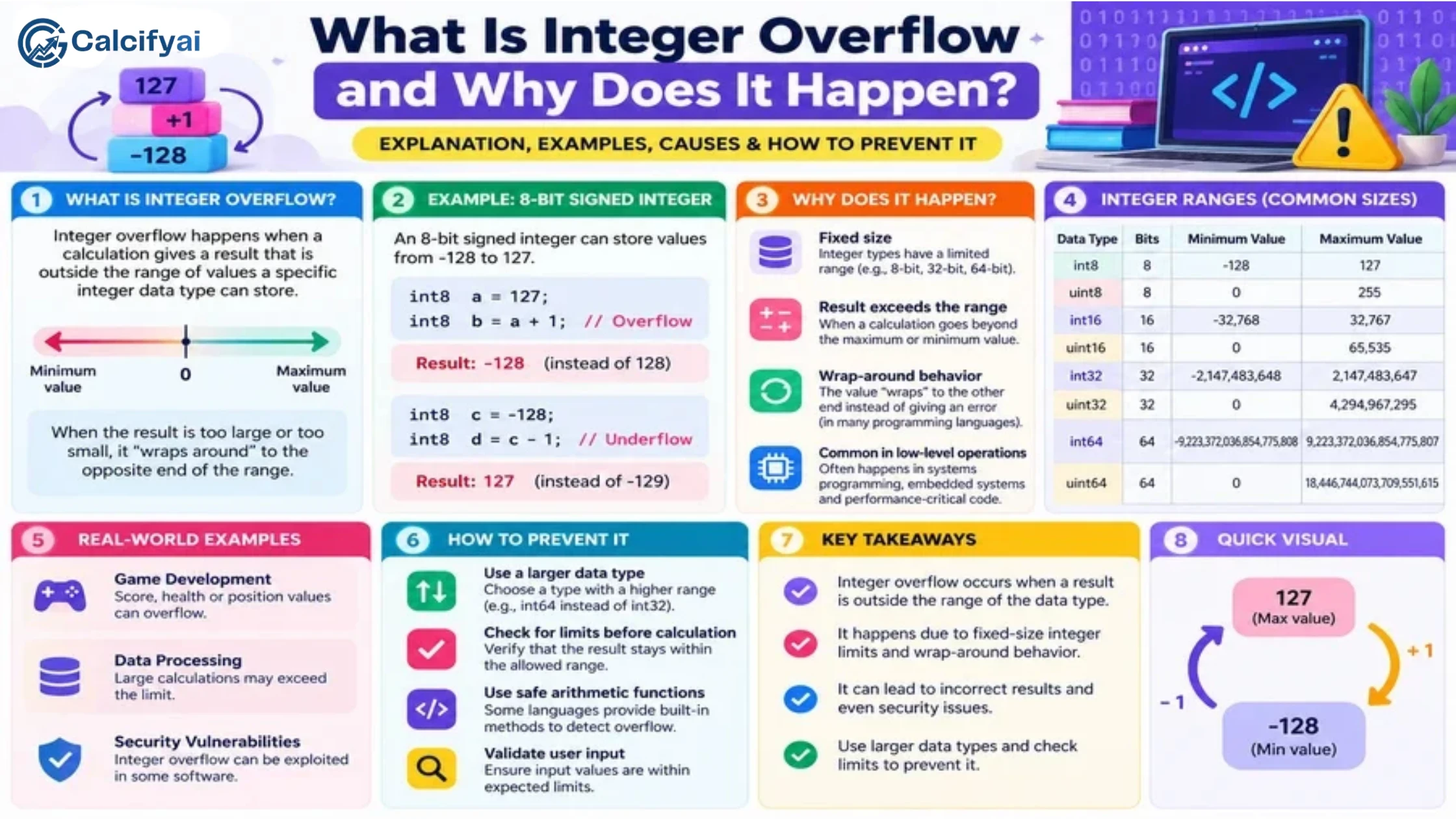
A programming language may store an integer using a fixed number of bits. If a calculation produces a value outside the range that type can represent, integer overflow can occur.
In simple terms, integer overflow happens when an integer calculation produces a value that is too large for the available integer data type to represent.
For example, an unsigned 8-bit integer can represent values from 0 to 255. If a program tries to store 256 in that type, the result depends on the language and implementation. In systems with wrapping behavior, it can wrap around to 0.
Integer overflow can cause incorrect calculations, unexpected program behavior, and, in some situations, security vulnerabilities.
What Is an Integer?
An integer is a whole number with no fractional part.
Examples include:
0
1
25
500
-10
-1,000
Programming languages commonly provide different integer types with different sizes and ranges.
For example, a system might provide:
8-bit integers
16-bit integers
32-bit integers
64-bit integers
The number of bits affects how many different values the type can represent.
What Is Integer Overflow?
Integer overflow occurs when a calculation produces an integer value outside the maximum or minimum range supported by the integer type.
For example, suppose an unsigned 8-bit integer can store values from:
0 to 255
Now consider:
255 + 1 = 256
Mathematically, the answer is 256.
But an unsigned 8-bit integer cannot represent 256.
That is an integer overflow situation.
What happens next depends on the programming language, data type, and operation. Some systems wrap the result around, while others may raise an error or use different behavior.
Why Does Integer Overflow Happen?
The main reason is simple:
Computer integer types have finite storage capacity.
A fixed-size integer has a limited number of bits.
Each bit can represent either 0 or 1. With more bits, the system can represent more possible values.
For an unsigned integer with n bits, the number of possible values is:
2ⁿ
The range is:
0 to 2ⁿ − 1
For example, an 8-bit unsigned integer has:
2⁸ = 256
possible values.
Those values range from:
0 to 255
If a calculation produces 256 or higher, the value is outside that range.
What Is Integer Overflow in Simple Terms?
Think of an integer data type as a container with a maximum capacity.
Imagine a box that can hold only 255 objects.
If the box already contains 255 objects and you try to add another one, the box cannot hold all 256 objects.
A computer integer type works in a similar way.
The difference is that computer systems have specific rules for what happens when a value goes beyond the available range.
Signed vs. Unsigned Integer Overflow
Integer overflow can behave differently depending on whether an integer is signed or unsigned.
Unsigned Integers
Unsigned integers represent zero and positive numbers.
For an unsigned integer with n bits, the range is:
0 to 2ⁿ − 1
For example, an 8-bit unsigned integer has a range of:
0 to 255
There are no negative values.
Signed Integers
Signed integers can represent both negative and positive values.
A common representation is two's complement.
For a typical n-bit signed integer using two's complement, the range is:
−2ⁿ⁻¹ to 2ⁿ⁻¹ − 1
For an 8-bit signed integer, the range is:
−128 to 127
So:
127 + 1 = 128
But 128 cannot be represented by an 8-bit signed integer in that representation.
That creates an overflow situation.
Integer Overflow Example
Consider an unsigned 8-bit integer.
Its maximum value is:
255
Now perform:
255 + 1
The mathematical result is:
256
But the data type cannot store 256.
In a wrapping system, the value may return to:
0
This is because the representation cycles through its available values.
For an unsigned 8-bit value, the next value after 255 under modular arithmetic is 0.
This behavior can be described using:
256 mod 256 = 0
The important point is that the mathematical result and the stored computer result can be different.
Integer Underflow
Integer overflow is not limited to values becoming too large.
A related problem is integer underflow, which occurs when a calculation produces a value below the minimum representable value.
For example, suppose an unsigned 8-bit integer contains:
0
Now subtract 1:
0 − 1 = −1
An unsigned 8-bit integer cannot represent −1.
In a wrapping system, the result can wrap around to:
255
So:
Overflow → value goes above the maximum
Underflow → value goes below the minimum
Both problems occur because the result falls outside the data type's representable range.
Integer Overflow vs. Floating-Point Overflow
Integer overflow and floating-point overflow are related concepts, but they are not the same thing.
Integer Overflow
Integer overflow occurs when an integer result exceeds the available integer range.
Example:
255 + 1
for an 8-bit unsigned integer.
Floating-Point Overflow
Floating-point numbers use a different representation and have their own limits.
A calculation involving extremely large floating-point values may produce a special value such as infinity, depending on the language and floating-point standard.
Therefore, you should not assume that integer and floating-point arithmetic behave the same way when values become too large.
How Many Values Can an Integer Store?
The number of possible values depends on the number of bits.
For an unsigned integer:
Number of possible values = 2ⁿ
where n is the number of bits.
8-Bit Integer
2⁸ = 256 possible values
Range:
0 to 255
16-Bit Integer
2¹⁶ = 65,536 possible values
Range:
0 to 65,535
32-Bit Integer
2³² = 4,294,967,296 possible values
Range:
0 to 4,294,967,295
64-Bit Integer
2⁶⁴ = 18,446,744,073,709,551,616 possible values
Range:
0 to 18,446,744,073,709,551,615
Larger integer types can represent much larger values, but they still have finite limits when their size is fixed.
How Integer Overflow Can Affect Calculations
Overflow can produce results that look valid even though they are incorrect.
For example, imagine a program calculates:
250 + 10
The mathematical result is:
260
If the program stores the result in an unsigned 8-bit integer, 260 is outside the range of 0 to 255.
In a wrapping system:
260 mod 256 = 4
The program could therefore end up with:
4
instead of:
260
This is particularly dangerous because the program may continue running while using the wrong value.
Integer Overflow in Multiplication
Overflow is not limited to addition.
Multiplication can also produce values that are too large.
Suppose an integer type can store values only up to 1,000.
Consider:
500 × 3 = 1,500
The mathematical result is 1,500, but the data type cannot represent it.
The operation therefore needs special handling.
Multiplication deserves particular attention because values can become large very quickly.
For example:
1,000 × 1,000 = 1,000,000
A calculation that starts with relatively small values can quickly exceed a fixed integer range.
Integer Overflow in Programming
Integer overflow is especially relevant in software development because programmers often choose data types based on expected value ranges.
Consider a program that stores the number of items sold in a 32-bit integer.
If the program assumes the count will always remain small, it may work correctly for years.
But if the value eventually exceeds the type's maximum range, the calculation or storage operation may behave unexpectedly.
Potential problems include:
Incorrect totals
Negative results where positive values are expected
Incorrect array sizes
Invalid memory calculations
Incorrect time calculations
Broken comparisons
Unexpected program logic
Security vulnerabilities
NIST's research on data-type bugs specifically includes integer overflow as a class of software-related data-type problem. (NIST)
Integer Overflow and Security
Integer overflow is not just a mathematical problem.
In some software systems, an overflow can affect memory allocation, array indexing, buffer calculations, file sizes, or other security-sensitive operations.
For example, imagine a program calculates how much memory it needs using an integer.
If the calculation overflows and produces a much smaller value than expected, the program might allocate insufficient memory.
If later operations assume the larger size, this mismatch can create serious software problems.
The exact security impact depends on the programming language, code, data types, and how the resulting value is used.
How to Prevent Integer Overflow
Developers can use several strategies to reduce the risk of integer overflow.
1. Choose an Appropriate Data Type
Use a data type that can safely represent the expected range of values.
For example, if a 16-bit integer is too small for the application's expected values, a larger type may be appropriate.
2. Check Values Before Performing Operations
Before adding or multiplying integers, check whether the result will exceed the supported range.
For example, before:
a + b
a program can determine whether the maximum representable value would be exceeded.
3. Validate User Input
User input should not automatically be trusted.
If a program expects a positive quantity, it should validate:
Whether the value is numeric
Whether it is within an acceptable range
Whether it can safely be stored
Whether later calculations could overflow
4. Use Safe Arithmetic Functions
Some programming languages and libraries provide checked arithmetic or overflow-detection functions.
These can detect problems rather than silently allowing an invalid result.
5. Use Larger or Arbitrary-Precision Integers When Appropriate
Some applications genuinely need to work with numbers much larger than standard fixed-width integers can handle.
In those situations, arbitrary-precision or big-integer arithmetic can be useful.
CalcifyAI's Big Number Calculator is designed to handle extremely large integers and decimals with full precision, which can be useful when exploring calculations that exceed ordinary calculator ranges.
6. Test Boundary Values
Testing only normal values is not enough.
Developers should test values near the minimum and maximum limits.
For an unsigned 8-bit integer, useful boundary tests include:
0
1
254
255
and values just outside the supported range.
Boundary testing can reveal overflow problems before software is released.
Common Mistakes When Handling Integer Overflow
Mistake 1: Assuming Integers Are Unlimited
A programming language may allow you to write very large numbers, but that does not mean every integer type can store them.
Always check the data type's range.
Mistake 2: Ignoring Intermediate Results
Even when the final answer would fit into a larger data type, an intermediate operation may overflow first.
For example, multiplication can overflow before a later division reduces the result.
Mistake 3: Checking Only the Final Value
The calculation itself can overflow before the program checks the result.
Overflow prevention may require checking the operation before it happens.
Mistake 4: Confusing Overflow With Rounding
Integer overflow is not the same as rounding.
Rounding changes a value to a nearby representation.
Overflow occurs when the result falls outside the supported range.
Mistake 5: Assuming All Languages Handle Overflow the Same Way
Different programming languages and integer types have different rules.
Some may wrap around, some may detect overflow, and some may behave differently depending on the operation.
Always check the documentation for the language and data type you are using.
Integer Overflow vs. Integer Underflow
The difference is easy to remember.
Problem | What Happens |
|---|---|
Integer overflow | Result is greater than the maximum supported value |
Integer underflow | Result is smaller than the minimum supported value |
For example, with an unsigned 8-bit integer:
255 + 1 → overflow
0 − 1 → underflow
Both occur because the result is outside the valid range.
Integer Overflow vs. Big Integers
A fixed-size integer has a defined maximum and minimum.
A big-integer system can represent much larger values by using additional storage as the number grows.
For example, a standard fixed-width integer might have a 32-bit or 64-bit limit.
A big-integer library can store numbers with many more digits, limited primarily by implementation and available resources.
This is one reason big integers are useful in areas such as:
Cryptography
Number theory
Large financial calculations
Scientific computing
Combinatorics
Programming
A Simple Way to Detect Possible Overflow
Before performing an integer operation, ask:
Can the result fit inside the data type's range?
For addition:
Does a + b exceed the maximum?
For subtraction:
Does a − b fall below the minimum?
For multiplication:
Could a × b exceed the maximum or fall below the minimum?
If the answer is yes, the operation needs to be handled carefully.
Frequently Asked Questions
What is integer overflow?
Integer overflow happens when an integer calculation produces a value greater than the maximum or less than the minimum value that the data type can represent.
Why does integer overflow happen?
It happens because fixed-size integer types have a limited number of bits and therefore a limited range of possible values.
What is an example of integer overflow?
For an unsigned 8-bit integer, the maximum value is 255. Calculating 255 + 1 produces 256, which cannot be represented by that type.
What happens when an integer overflows?
The result depends on the programming language, data type, and operation. It may wrap around, raise an error, or have another defined or language-specific behavior.
What is the difference between integer overflow and underflow?
Overflow occurs when a value exceeds the maximum supported range. Underflow occurs when a value falls below the minimum supported range.
Can integer overflow cause security problems?
Yes. In some software, overflow can lead to incorrect memory calculations, invalid indexing, or other conditions that may contribute to security vulnerabilities.
How can integer overflow be prevented?
Common approaches include choosing suitable data types, validating inputs, checking arithmetic operations, using safe arithmetic functions, using larger or arbitrary-precision types when appropriate, and testing boundary values.
Is integer overflow the same as rounding?
No. Rounding changes a value to a nearby representation, while integer overflow occurs when a result falls outside the range that the integer type can represent.
Can 64-bit integers overflow?
Yes. A 64-bit integer can represent much larger values than a 32-bit integer, but it still has a finite range.
Are big integers affected by overflow?
Big-integer systems can represent much larger values than fixed-size integers, but they are still limited by software design, available memory, and implementation constraints.
Final Takeaway
Integer overflow happens when a calculation produces a value outside the range that an integer data type can represent.
The problem occurs because fixed-size integers have a limited number of bits.
For example, an unsigned 8-bit integer can represent values from 0 to 255. Trying to represent 256 creates an overflow condition.
Integer overflow can affect addition, subtraction, multiplication, and other operations. It can cause incorrect results and, in some software systems, create security risks.
The safest approach is to understand the range of your integer types, validate inputs, check calculations near boundaries, and use larger or arbitrary-precision types when the application requires them.
Disclaimer
The information provided in this article is for educational and informational purposes only. It should not be considered as professional financial, medical, or legal advice. Always consult with qualified professionals for specific guidance related to your situation.
Popular Calculators
Explore our most-used free calculators for finance, health, and everyday needs.