
Arithmetic Mean Formula: Definition, Calculation, Examples & Everyday Uses
Learn the arithmetic mean formula with easy steps, solved examples, practical uses, and common mistakes. Calculate averages quickly and accurately.
Calcifyai Team
Expert calculators & financial tools
What Is the Arithmetic Mean Formula?
When working with numbers, it's often helpful to represent an entire dataset with a single value. That's exactly what the arithmetic mean does. Also known as the average, the arithmetic mean provides a simple way to summarize data and identify overall trends.
From calculating exam scores and monthly expenses to analyzing business performance and sports statistics, the arithmetic mean is one of the most widely used mathematical concepts. If you want to calculate averages or analyze datasets more efficiently, our Statistics Calculator helps you find the mean along with other important statistical values in just a few clicks.
What Is Arithmetic Mean?
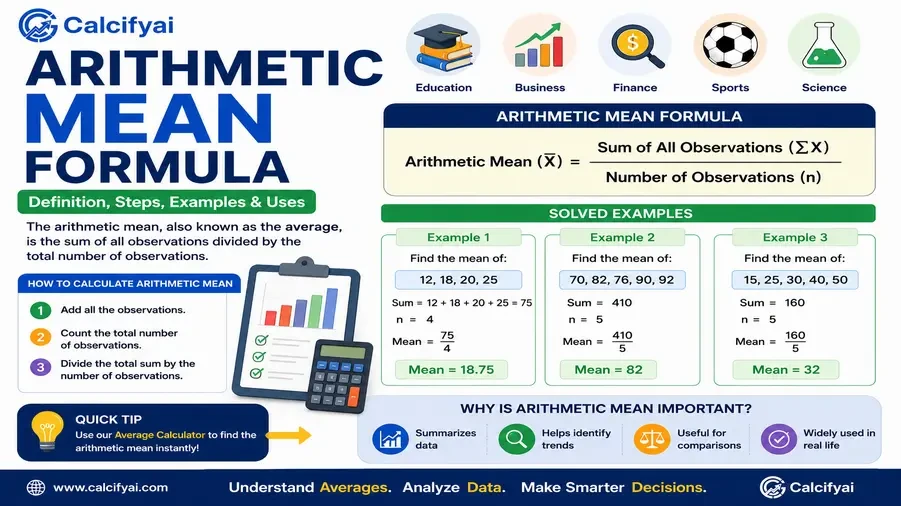
The arithmetic mean is calculated by adding all the values in a dataset and dividing the total by the number of observations.
It is one of the three primary measures of central tendency, along with the median and mode.
Example
Suppose you have the following numbers:
8, 12, 15, 10, 5
Step 1:
Add all the numbers.
8 + 12 + 15 + 10 + 5 = 50
Step 2:
Count the total numbers.
There are 5 observations.
Step 3:
Divide the sum by the total observations.
50 ÷ 5 = 10
Therefore, the arithmetic mean is 10.
Arithmetic Mean Formula
The formula for arithmetic mean is:
Arithmetic Mean = Sum of All Observations ÷ Number of Observations
How to Calculate Arithmetic Mean
Finding the arithmetic mean requires only three simple steps.
Step 1
Add together every value in the dataset.
Step 2
Count the total number of observations.
Step 3
Divide the total sum by the number of observations.
The result is the arithmetic mean.
Solved Examples
Example 1
Find the arithmetic mean of:
15, 18, 22, 25
Solution:
Total = 15 + 18 + 22 + 25 = 80
Observations = 4
Mean = 80 ÷ 4
Arithmetic Mean = 20
Example 2
Calculate the average marks of five students.
Marks:
72, 80, 78, 90, 85
Solution:
Total marks = 405
Students = 5
Mean = 405 ÷ 5
Arithmetic Mean = 81
Example 3
Find the arithmetic mean of:
30, 25, 18, 35, 42
Solution:
Total = 150
Observations = 5
Mean = 150 ÷ 5
Arithmetic Mean = 30
Why Is the Arithmetic Mean Important?
The arithmetic mean makes large sets of numbers easier to understand by representing them with a single value.
It is commonly used to:
Compare datasets.
Measure overall performance.
Identify trends.
Analyze statistical data.
Support better decision-making.
Real-Life Applications of Arithmetic Mean
Education
Teachers use the arithmetic mean to calculate students average marks and evaluate class performance.
Business
Businesses calculate average sales, revenue, customer spending, and production costs to monitor growth.
Finance
Investors analyze average returns and compare investment performance over time.
Sports
Average runs, points, goals, and batting statistics are all based on arithmetic mean calculations.
Science and Research
Researchers summarize experimental data using the arithmetic mean before performing deeper statistical analysis. Using our Statistics Calculator, you can quickly calculate averages alongside other statistical values for more accurate data interpretation.
Advantages of Arithmetic Mean
The arithmetic mean offers several benefits.
Easy to calculate.
Simple to understand.
Includes every observation in the dataset.
Useful for comparing different groups.
Widely accepted in mathematics and statistics.
Limitations of Arithmetic Mean
Despite its usefulness, the arithmetic mean has a few limitations.
Outliers can significantly affect the result.
It may not represent highly skewed datasets accurately.
It cannot be used for categorical data.
In these situations, the median or mode may provide a better representation.
Arithmetic Mean vs Median vs Mode
Arithmetic Mean | Median | Mode |
Average of all observations | Middle observation | Most frequently occurring value |
Uses every value | Depends on position | Depends on frequency |
Sensitive to outliers | Less affected by outliers | Not affected by extreme values |
Best for balanced datasets | Better for skewed data | Useful for categorical data |
Common Mistakes
Avoid these mistakes when calculating the arithmetic mean.
Forgetting one or more observations.
Adding the numbers incorrectly.
Dividing by the wrong number of observations.
Confusing the mean with the median or mode.
Ignoring decimal values when necessary.
Quick Tips
Arithmetic mean is another name for the average.
Every value contributes to the final result.
Always divide by the total number of observations.
The arithmetic mean can be a whole number or a decimal.
Practice Questions
1. Find the arithmetic mean of:
10, 15, 20, 25
Answer: 17.5
2. Find the average of:
24, 18, 30, 28
Answer: 25
3. Calculate the arithmetic mean of:
9, 12, 15, 18, 21
Answer: 15
4. A class scored a total of 540 marks across 6 students. Find the arithmetic mean.
Answer: 90
Conclusion
The arithmetic mean formula is one of the most important tools in mathematics and statistics. It helps simplify data, compare results, and identify trends across various fields, including education, finance, business, and scientific research.
For instant calculations, use our Average Calculator to find the mean of any dataset. If you need a complete statistical analysis, our Statistics Calculator can calculate the arithmetic mean along with the median, mode, variance, standard deviation, and many other statistical measures. To better understand when each measure is most useful, read our guide on Mean vs Median vs Mode.
Frequently Asked Questions
What is the arithmetic mean?
The arithmetic mean is the sum of all observations divided by the total number of observations.
Is arithmetic mean the same as average?
Yes. In most situations, the arithmetic mean and average refer to the same calculation.
Why is the arithmetic mean important?
It summarizes a dataset into a single representative value, making comparisons and analysis easier.
Can the arithmetic mean include decimal values?
Yes. If the total sum is not evenly divisible by the number of observations, the result will be a decimal.
How can I calculate the arithmetic mean quickly?
You can calculate it manually or use our Average Calculator or Statistics Calculator for fast and accurate results.
Disclaimer
The information provided in this article is for educational and informational purposes only. It should not be considered as professional financial, medical, or legal advice. Always consult with qualified professionals for specific guidance related to your situation.
Popular Calculators
Explore our most-used free calculators for finance, health, and everyday needs.